
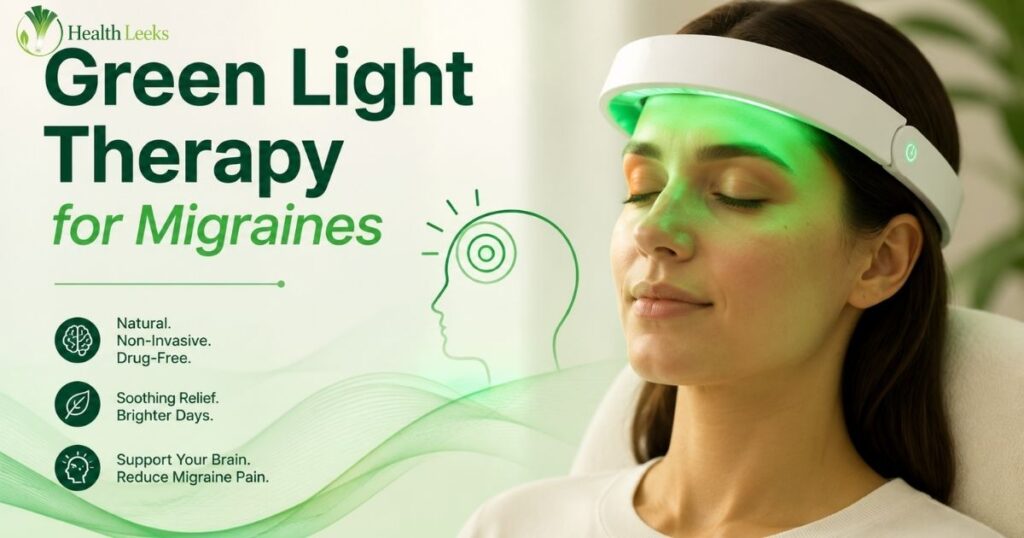
If you have ever pulled the curtains shut during a migraine attack, the idea of using light as a treatment probably sounds backwards. Light is usually the enemy, not the cure. Yet research from Harvard Medical School and the University of Arizona points to one specific wavelength, green light, as a possible exception to that rule.
Early clinical trials report that daily exposure to narrowband green light reduced headache days by as much as 50 to 60 percent in people with chronic and episodic migraine, a result comparable to some preventive medications. This has turned a once-niche idea into one of the most talked-about nonpharmacological options in migraine care today.
This article breaks down what green light therapy is, how it compares to red light therapy, what the science says so far, and how to use it safely.
Migraine and Light – An Uncomfortable Relationship
Before exploring how light can help, it helps to understand why light hurts in the first place.
Understanding Migraine as a Neurological Disorder
Migraine is not simply a severe headache. It is a neurological disorder rooted in abnormal activity along the trigeminal nerve pathways, the brainstem, and the cortex, producing the throbbing, often one-sided pain that defines an attack. It typically unfolds in stages, including a warning phase, sometimes an aura, the headache itself, and a recovery period, each with its own set of symptoms.
A Full-Body Experience
Migraine rarely stays contained to the head. Attacks frequently bring nausea, vomiting, dizziness, sensitivity to sound and smell, and even tingling in the face or limbs. According to the Migraine Research Foundation, more than 90 percent of people with migraine are unable to function normally during an attack, which is why so many describe it as a condition that takes over the entire day.
The Photophobia Puzzle
Roughly 80 percent of people with migraine report photophobia, meaning light sensitivity, during an attack. Researchers have found that different wavelengths affect this sensitivity in very different ways. White, blue, amber, and red light have all been shown to intensify headache pain in people with migraine.
This creates an obvious puzzle. If light tends to make migraine worse, how could any form of light therapy possibly help? The answer lies in the fact that not all colors of light behave the same way once they reach the eye and brain.
Light Therapy Basics: Green vs Red
To understand where green light fits into pain management, it helps to compare it with its better-known cousin, red light therapy.
The Green Light Approach: Calming Pain Pathways
Green light sits at a wavelength of roughly 520 to 560 nanometers. Research from Harvard Medical School found that narrowband green light generates much smaller electrical signals in the retina and the visual cortex compared with blue, red, or amber light. Smaller signals appear to translate into less pain amplification, and in some cases, even mild pain relief.
Because this effect works primarily through the eyes and nervous system rather than the skin, it is considered a calming, surface-level approach rather than a tissue-repair therapy.
The Red Light Approach: Repairing at the Cellular Level
Red and near-infrared light, generally in the 630 to 850 nanometer range, work very differently. These wavelengths penetrate deeper into skin and muscle tissue, where they are absorbed by mitochondria. This process, known as photobiomodulation, can boost cellular energy production and reduce localized inflammation.
Red light therapy is widely used for sore muscles, joint stiffness, and wound healing, areas where deeper tissue repair is the main goal rather than calming nerve signals in the brain.
Why the Comparison Matters
The core difference comes down to depth and mechanism. Red light works from the inside out, encouraging tissue repair. Green light works through the visual pathway, calming how the nervous system interprets pain. Knowing this distinction matters because it helps explain why green light, not red, has become the wavelength of choice for migraine specifically.
Green Light Therapy for Migraines: Calming the Storm
With the basics covered, here is a closer look at what makes green light therapy unique for migraine sufferers.
Breakthrough Studies That Changed the Conversation
Several studies have shaped how researchers and patients view this treatment.
- Harvard Medical School (Brain, 2016). Neuroscientist Rami Burstein and colleagues exposed migraine patients to blue, red, amber, and green light during attacks. Nearly 80 percent reported worse pain with every color except green, and some participants felt their pain ease under green light.
- University of Arizona (Cephalalgia). Pain researcher Mohab Ibrahim led a trial in which 29 people with episodic or chronic migraine used a narrowband green LED light for one to two hours daily over 10 weeks. Headache days dropped by roughly 60 percent, alongside better sleep and quality of life.
- Green light combined with tDCS. A preliminary randomized trial found both green light therapy and transcranial direct current stimulation reduced migraine frequency and severity, with green light showing a slightly stronger benefit for quality of life.
How Does Green Light Therapy for Migraines Work?
The leading theory centers on cone cells in the retina. When these cones are exposed to a narrow band of green wavelengths, they send comparatively weak signals through the optic pathway to the thalamus and cortex, the same brain regions involved in processing migraine pain.
Some researchers also believe green light may influence serotonin levels and the body’s natural opioid system, both of which play a role in pain regulation. Others point to its effect on melatonin and circadian rhythm, which could explain why so many users report better sleep alongside reduced pain.
How to use green light for migraines
Getting the most out of this therapy depends on consistency and the right setup. A simple routine looks like this:
- Dim or turn off all other light sources, including phone and TV screens.
- Use a device that emits narrowband green light specifically, not a generic green bulb or filter.
- Position the light within your field of vision without staring directly at it.
- Start with sessions of around 30 minutes and build up to one or two hours daily.
- Stick with it for several weeks, since benefits tend to build gradually rather than appear instantly.
- Keep using any prescribed migraine treatment alongside it unless your doctor advises otherwise.
Best Green Light for Migraines: Devices That Actually Help
Not every green light is created equal. Devices designed for migraine relief use a narrow band centered around 520 to 525 nanometers, filtering out the blue and red wavelengths found in ordinary colored bulbs. Popular options include:
- Allay Lamp. Developed with input from Harvard researchers, this portable, rechargeable lamp includes a shroud so users never look directly into the light.
- Hooga Migraine Relief Light. A budget-friendly bulb with a similar peak wavelength, often used as an entry point into green light therapy.
- Norb Relief Bulb. A standard A19 bulb that fits most household fixtures, making it an easy add-on for bedrooms or living spaces.
- Gamma Soothe Lamp. Uses precise 520 nanometer LEDs, marketed specifically for headache and anxiety relief.
When shopping, look for the words “narrowband” or a specific nanometer rating, and avoid relying on phone or computer screen filters, since these still emit a wider mix of wavelengths.
Strengths and Limitations
Like any emerging therapy, green light comes with both upsides and caveats.
Strengths
- Drug-free with no significant reported side effects
- Easy to use at home alongside existing treatment
- May improve sleep and quality of life, not just pain
- Cost-effective over time compared with ongoing medication
Limitations
- Trials so far have used small sample sizes
- Devices are generally not FDA-cleared as medical equipment
- Results vary from person to person
- Requires daily consistency to see benefits
Key Differences in Action
- Green light acts through the eyes and nervous system; red light acts through skin and tissue.
- Green light calms overactive pain signaling; red light supports cellular repair and reduced inflammation.
- Green sessions typically run one to two hours of visual exposure; red sessions are shorter, direct skin applications.
- Green light has migraine-specific clinical data; red light has broader evidence for musculoskeletal pain.
Comparison Table: Green vs Red Light Therapy
| Feature | Green Light Therapy | Red Light Therapy |
| Wavelength range | 520 to 560 nm | 630 to 850 nm |
| Primary mechanism | Calms nervous system pain signaling | Boosts cellular energy and tissue repair |
| Exposure method | Visual (eyes, ambient room light) | Direct skin exposure |
| Typical session length | 1 to 2 hours daily | 10 to 20 minutes per session |
| Best suited for | Migraine, photophobia, fibromyalgia | Muscle soreness, joint pain, wound healing |
| Migraine-specific evidence | Multiple clinical trials | Limited, and may worsen photophobia |
Complementary Potential
Some researchers are exploring whether combining green light’s calming effect on the nervous system with red light’s tissue-repair properties could help people with overlapping pain conditions, such as fibromyalgia paired with joint pain. For migraine specifically, current evidence still centers on green light alone, but this combined approach is an interesting direction for future research.
Is Light Therapy the Future of Migraine Care?
Green light therapy is part of a larger shift in how migraine is treated.
Why Patients Are Paying Attention
Many people with migraine have tried multiple medications, sometimes with limited success or unwanted side effects. A noninvasive option that can be used at home, without a prescription, appeals to patients looking for added relief rather than a complete replacement for medical care.
The Challenges Ahead
Despite encouraging results, real obstacles remain. Most studies involve small groups, and larger, long-term trials are still needed to confirm consistency. Devices also remain mostly unregulated by the FDA, and cost can be a barrier since insurance coverage is inconsistent.
The Promise of a Paradigm Shift
Green light therapy fits into a broader movement toward multimodal migraine management, blending medication with lifestyle adjustments, neuromodulation devices, and now light-based therapies. As more data accumulates, narrowband green light could become a standard complementary tool rather than a stand-alone fix.
A Bright Future Ahead
Green light therapy will not replace proven migraine medications, and it is not a guaranteed cure. What it offers is a low-risk, drug-free option that has already shown measurable benefits in early research, particularly for people who have struggled to find relief through standard treatments. As research expands, light-based therapy may move from a niche home remedy to a recognized part of mainstream migraine care.
Final Thoughts
The relationship between migraine and light has always been complicated, but science is starting to untangle it. Narrowband green light stands out as a rare example of light that calms rather than aggravates the nervous system. Pairing it with guidance from a healthcare provider, rather than using it as a sole treatment, remains the safest approach.