
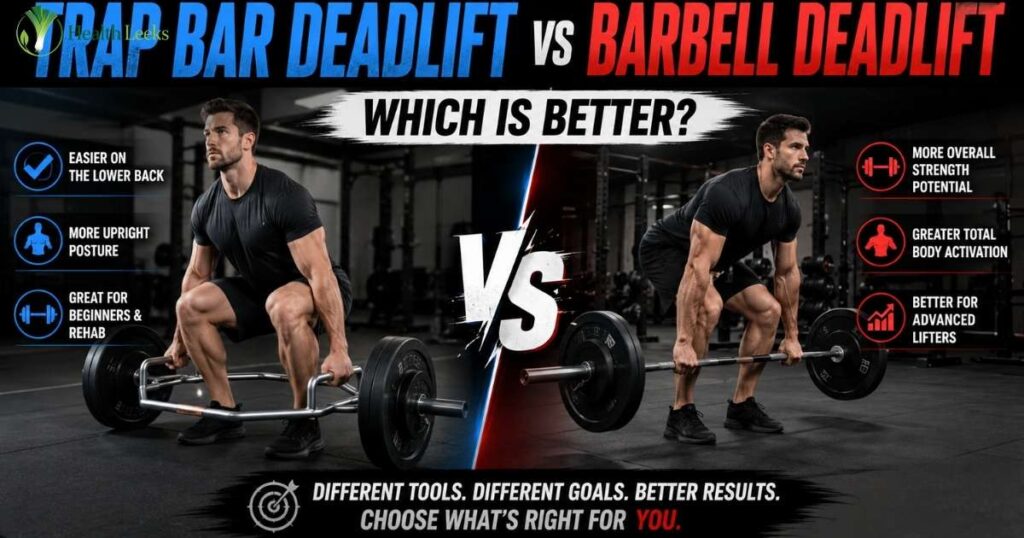
If you have spent any time around a weight room, you have heard people argue passionately about deadlift variations. The trap bar (also called the hex bar) sits in one corner while the loaded barbell commands the center platform. Both look like serious work. Both are. But they are not interchangeable, and picking the wrong one for your goals can mean slower progress or unnecessary wear on your joints.
This guide cuts through the noise. You will learn how each lift works, what the research actually says, and how to make the smartest choice for your body and your training goals.
Quick Answer
For most recreational lifters, the trap bar deadlift is more beginner-friendly, easier on the lower back, and allows higher power output. The conventional barbell deadlift delivers superior posterior chain development and is essential for powerlifters and anyone wanting maximum hamstring and glute strength. The best approach for intermediate and advanced lifters is to use both.
What Most Guides Get Wrong (Fresh Insights First)
Most comparison articles frame this as a simple either/or question. It is not. Here is what gets overlooked:
- The trap bar is not a beginner shortcut. It is a legitimate strength tool used by elite athletes and sports performance coaches. It just happens to be easier to learn.
- Pulling more weight on a trap bar does not mean you are stronger. Biomechanical advantages of the hex bar design allow higher loads, but that does not translate directly to a bigger conventional deadlift.
- “Back safety” is nuanced. The trap bar reduces lumbar moment (the rotational stress on your spine), but a well-coached barbell deadlift is also safe for most healthy individuals.
- Handle height changes everything. High handles on a trap bar reduce range of motion significantly. Low handles make the movement much more comparable to a standard pull.
Understanding these details separates average programming decisions from great ones.
What Is a Barbell (Conventional) Deadlift?
The conventional barbell deadlift is performed with a straight 20 kg Olympic bar loaded with plates. You stand with your feet hip-width apart, hinge at the hips, grip the bar just outside your legs, and drive through the floor to stand upright.
Because the bar sits in front of your body, your torso must lean forward to maintain balance. This forward lean places significant demand on the erector spinae, glutes, and hamstrings throughout the lift. The bar path travels close to the shins on the way up, which is intentional and optimal for leverage.
The conventional deadlift is the version used in powerlifting competition and is considered by many coaches to be the gold standard for posterior chain development.
What Is a Trap Bar (Hex Bar) Deadlift?
The trap bar, or hex bar, is a hexagonal frame you stand inside. Handles on the sides allow you to grip at hip level without reaching forward. The center of gravity is aligned with your feet rather than positioned in front of them.
This design allows a more upright torso angle, similar to the starting position of a squat. You load the bar the same way, set your hips, brace your core, and drive upward. Most trap bars also feature raised handles (typically 3 to 4 inches higher than standard) and a low-handle option at the same height as a barbell.
The trap bar deadlift has become a staple in athletic performance programs, physical therapy settings, and general strength training.
Trap Bar vs Barbell Deadlift: Key Differences at a Glance
| Factor | Barbell Deadlift | Trap Bar Deadlift |
| Torso angle | More horizontal | More upright |
| Primary muscles | Hamstrings, glutes, spinal erectors | Quads, glutes, upper back |
| Lower back stress | Higher lumbar moment | 10 to 15% lower |
| Range of motion | Full (standard) | Slightly shorter (high handles) |
| Learning curve | Steeper | More intuitive |
| Power output | Moderate | Higher peak velocity |
| Competition use | Powerlifting | Athletic performance |
| Load potential | Slightly less | Slightly more |
Muscles Worked: Where the Load Actually Goes
Barbell Deadlift Muscles
The conventional deadlift is a posterior chain exercise above all else. Primary movers include:
- Hamstrings (biceps femoris, semitendinosus, semimembranosus): These stretch under load at the bottom and drive hip extension at the top.
- Glutes (gluteus maximus): Responsible for locking out the hips at the top of the lift.
- Erector spinae: Work isometrically to maintain spinal position and extend the torso.
- Lats and upper back: Brace the shoulder girdle and keep the bar close to the body.
- Traps and rhomboids: Stabilize the shoulder blades throughout the pull.
Secondary muscles include the forearm flexors (grip), core, and calves.
Trap Bar Deadlift Muscles
The trap bar deadlift activates many of the same muscles but in different proportions:
- Quadriceps (vastus lateralis, rectus femoris): Significantly more active due to the greater knee bend at the start.
- Glutes: Strong activation, comparable to the barbell version.
- Upper traps: More engaged due to the neutral grip and shoulder position.
- Erector spinae: Still active but under less rotational stress.
- Hamstrings: Present but noticeably less dominant compared to the barbell deadlift.
EMG Comparison (What Muscle-Activity Studies Show)
A widely cited study published in the Journal of Strength and Conditioning Research (Swinton et al., 2011) compared both variations using force plates and electromyography on experienced lifters.
Key findings:
- Quadriceps activation was significantly higher with the hex bar, especially the vastus lateralis, during both the concentric and eccentric phases.
- Biceps femoris (hamstring) activation was about 28% greater during the barbell deadlift compared to the hex bar pull.
- Glute and erector spinae activation was broadly similar between both variations.
- Peak power, velocity, and force output were all higher with the trap bar at the same relative intensity.
A 2018 EMG study in the same journal confirmed that the barbell deadlift produces significantly greater biceps femoris activation than the hex bar deadlift, while the hex bar increases quadriceps involvement.
The takeaway is clear: if hamstring dominance is your goal, the barbell wins. If balanced leg development and power output matter more, the trap bar earns its place.
Biomechanics: Why the Two Feel So Different
The core biomechanical difference comes down to bar position relative to your center of mass.
With a barbell, the load sits in front of your body. To keep the weight balanced, you must lean your torso forward and create a hip-hinge dominant movement pattern. This increases the moment arm at the lower back, meaning your spinal erectors must work harder to resist forward lean.
With a trap bar, you stand inside the load. The center of gravity aligns with your midfoot, which allows a more vertical shin angle and a more upright torso. This shifts stress away from the lumbar spine and distributes it more evenly across the hips and knees.
Peak spine and hip moments are consistently larger in the barbell deadlift. Peak knee moment is larger in the trap bar deadlift. This is why the trap bar feels more like a squat and why it demands greater quad contribution from the start.
Is the Trap Bar Really Easier on Your Back?
Yes, with context.
Research consistently shows approximately 10 to 15% lower lumbar compressive and shear forces during the trap bar deadlift compared to the conventional version. The more upright torso reduces the moment arm at the lower back, which translates to less demand on the spinal erectors and intervertebral discs.
For people managing lower back pain or recovering from a lumbar injury, the trap bar version is often recommended as a safer alternative to continue hip hinge training.
However, this does not mean barbell deadlifts are dangerous for healthy lifters. A properly coached conventional deadlift with good technique is a safe, effective, and irreplaceable exercise. The risk emerges when form breaks down, especially when rounding occurs under heavy load.
Strength and Power: Who Wins the Numbers Game?
When it comes to raw numbers, the trap bar wins the load game. Most lifters pull 5 to 10% more weight with a trap bar than with a barbell. This is a function of the more favorable mechanics, not greater strength.
For peak power development, the trap bar also comes out ahead. The Swinton study found that peak power was significantly higher during the hex bar deadlift, making it a preferred tool in athletic performance contexts like sprinting, jumping, and sport-specific strength training.
For absolute posterior chain strength, particularly hamstring and glute force production, the barbell deadlift produces greater demands and is the superior builder over time.
Carryover: Does One Build the Other?
Somewhat, but not directly.
Both lifts train the hip hinge pattern, so there is shared neurological and muscular carryover. Getting stronger on the trap bar will improve your overall pulling capacity, and vice versa. However, they diverge enough in mechanics that each variation requires specific practice to maximize performance.
Powerlifters who switch to trap bar training for a block will likely come back to the barbell feeling stronger, but may need to regroove their conventional technique. Athletes who use only barbells may not see maximum quad development without adding trap bar work.
Programming both is the most efficient strategy for well-rounded lifters.
Pros and Cons
Barbell Deadlift
Pros:
- Superior hamstring and posterior chain development
- Required for powerlifting competition
- Greater lat and hip extensor activation
- Builds the skill of managing an asymmetric load
- Available in virtually every gym
Cons:
- Steeper technique learning curve
- Higher lower back stress, particularly with poor form
- Requires greater hip mobility
- Shin scraping and positional challenges for taller lifters
Trap Bar Deadlift
Pros:
- Easier to learn and safer for beginners
- Reduced spinal loading and lower injury risk
- Higher peak power and velocity output
- Better quad development
- More comfortable for people with limited hip mobility or back sensitivity
Cons:
- Less posterior chain emphasis
- Does not carry over directly to barbell deadlift competition
- Requires a trap bar, which not all gyms have
- High-handle version reduces range of motion
Which Deadlift Is Right for You?
Use the barbell deadlift as your primary lift if:
- You compete in powerlifting or plan to
- Maximizing hamstring and glute strength is your main goal
- You want to develop the skill of managing a front-loaded pull
- You have no significant lower back issues
Use the trap bar deadlift as your primary lift if:
- You are a beginner learning the hip hinge for the first time
- You are an athlete training for speed, power, or sport performance
- You have a history of lower back sensitivity
- You want greater quad involvement without front squatting
Use both if:
- You are an intermediate or advanced lifter looking for complete development
- You want to build strength from multiple angles
- You are a coach programming for a diverse group of athletes
Trap Bar: High Handles vs Low Handles
Most modern trap bars offer two grip heights. High handles reduce range of motion by 3 to 4 inches, making the lift more accessible and further reducing lower back demand. They are ideal for beginners, lifters returning from injury, or athletes focused on power output.
Low handles match the range of motion of a standard barbell pull. They increase hip and hamstring demand, making the movement much more comparable to a conventional deadlift. Advanced lifters who want trap bar benefits without sacrificing training depth should use low handles.
How to Program Both (You Don’t Have to Choose)
A practical approach for most lifters:
- Beginners (0 to 6 months): Start with the trap bar deadlift to build movement patterns, then introduce barbell technique after a solid foundation is established.
- Intermediate lifters: Use barbell deadlifts as the primary compound lift (2 to 3 sets, 3 to 5 reps) and trap bar deadlifts as a power or hypertrophy accessory (3 to 4 sets, 4 to 8 reps).
- Advanced lifters: Periodize both. Run a trap bar block for 4 to 6 weeks to drive power and quad volume, then return to barbell-focused blocks for posterior chain strength and competition prep.
- Athletes: Prioritize the trap bar for in-season training due to lower injury risk and higher power expression. Use barbells in off-season strength phases.
Common Mistakes to Avoid
- Jerking the bar off the floor: Create tension before pulling. The bar should not snap up. Take the slack out slowly, then drive.
- Rounding the lower back at setup: This is the most dangerous error in both variations. Brace your core, find your neutral spine, and never start a rep in flexion.
- Using high handles to avoid improving mobility: High handles are a tool, not a permanent solution. Work on hip and hamstring mobility so you can eventually use low handles.
- Ignoring the eccentric: Controlling the descent builds as much muscle as the lift itself. Do not drop the weight.
- Gripping too wide on the barbell: Keep the bar close to your shins. A wider grip increases the moment arm and makes the pull harder unnecessarily.
What Real Lifters and Coaches Say
Greg Nuckols of Stronger by Science, one of the most evidence-based voices in strength training, has written that the trap bar deadlift is a superior choice for most people in most contexts, citing higher safety, greater flexibility in execution, and comparable muscle activation.
Sports performance coaches across NFL, NBA, and collegiate programs have adopted the trap bar deadlift as a primary strength and power tool for athletes due to its force-velocity profile and reduced injury risk.
Powerlifting coaches still emphasize the conventional barbell pull as irreplaceable for competition-specific development, particularly for maximizing hip extension strength and posterior chain size.
The consensus from both camps is the same: both tools are excellent, and the best choice depends on the lifter, not ideology.
FAQ’s
Is the trap bar deadlift easier than the barbell deadlift?
Yes, the trap bar is generally easier to learn and places less stress on the lower back, making it more accessible for most lifters.
Can I replace barbell deadlifts with trap bar deadlifts?
Yes for most non-competitive lifters. No if you compete in powerlifting, where the barbell pull is the required movement.
Which deadlift builds more muscle?
Both build significant muscle. The barbell version builds more hamstring and glute mass, while the trap bar adds more quad development to the equation.
Do trap bar deadlifts count as a deadlift?
Yes. The trap bar deadlift is a legitimate deadlift variation that trains the same fundamental hip hinge pattern with comparable loading.
Which is safer for lower back pain?
The trap bar deadlift, due to roughly 10 to 15% lower lumbar loading. Always consult a physiotherapist before loading any variation with an existing injury.
How much more can you lift on a trap bar?
Most lifters pull 5 to 10% more on a trap bar due to the more favorable center of gravity and reduced moment arm at the hips.
Should beginners start with the trap bar or barbell?
The trap bar is generally recommended for beginners. It is easier to learn proper hinge mechanics without the technical demands of the conventional pull.
Conclusion
The trap bar deadlift and barbell deadlift are both exceptional exercises. They are not competitors, they are complements. The barbell version is the king of posterior chain training and an essential tool for powerlifters and anyone prioritizing hamstring and glute development. The trap bar delivers superior power output, is safer for people with back sensitivity, and offers a more beginner-friendly path into heavy pulling.
Choose the barbell if you need posterior chain strength and compete in powerlifting. Choose the trap bar if you are newer to lifting, recovering from an injury, or training for athletic performance. Use both if you want complete lower body development.
The only wrong answer is not pulling at all.