
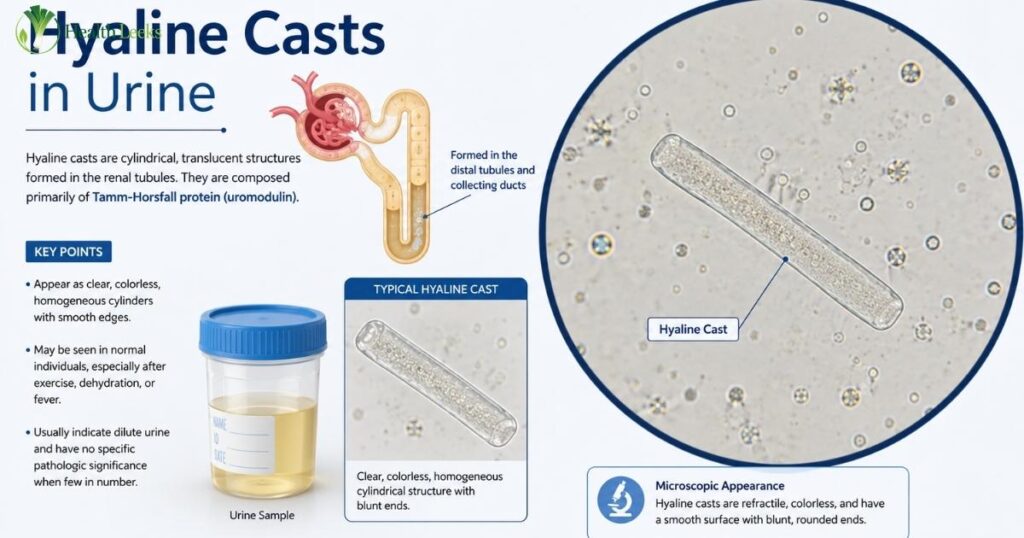
Seeing “hyaline casts” on a urine lab report can stop you in your tracks. The word “cast” sounds serious, and most people have no idea what it means. The good news? In many cases, hyaline casts in urine are a completely harmless finding. In some cases, though, they deserve a closer look.
At Glow Primary Care, we review urinalysis results like this every day. Our job is to translate confusing lab language into clear, actionable next steps. Whether your result showed up after a hard run, a bout of dehydration, or during a routine pregnancy check, this guide explains what hyaline casts are, what causes them, and exactly what we do to help.
Are Hyaline Casts Normal?
Yes, a small number of hyaline casts can be completely normal. Here is why.
Hyaline casts are microscopic, cylindrical structures made almost entirely of a protein called Tamm-Horsfall protein (also known as uromodulin). Your kidneys naturally produce this protein. When urine slows down or becomes concentrated, the protein gels inside the kidney tubules and takes on the tube-like shape of the tubule itself, forming a “cast.”
Because this can happen in any healthy person under the right conditions, finding a few hyaline casts in your urine is not automatically a red flag. They are, in fact, the most common type of urinary cast and the only type that can appear in a normal, healthy individual.
Normal Range (How Labs Report It)
Most clinical laboratories report hyaline casts using one of two methods:
- Quantitative count: Expressed as casts per low-power field (LPF) under a microscope.
- Qualitative description: Labeled as “absent,” “trace,” “occasional,” “few,” or “many.”
The widely accepted normal range is 0 to 2 hyaline casts per low-power field (LPF). A result described as “trace” or “occasional” typically falls within this range and is not considered medically significant on its own.
It is important to note that reference ranges vary slightly between laboratories. Your result should always be interpreted in the context of your symptoms, hydration status, medications, and the rest of your urinalysis panel, not the number alone.
When Isn’t It Normal?
A hyaline cast result moves from “expected” to “worth investigating” when:
- The count is persistently elevated on repeat testing, even after correcting for dehydration or exercise.
- Other urinalysis findings are abnormal alongside the casts, such as protein (proteinuria), blood (hematuria), or a very high urine specific gravity.
- You have underlying risk factors such as diabetes, high blood pressure, heart failure, or a history of kidney disease.
- You are experiencing symptoms like swelling in your legs, foamy urine, reduced urine output, flank pain, or uncontrolled blood pressure.
A single elevated result without any of the above is rarely cause for alarm. Context is everything.
What Causes Hyaline Casts in Urine?
The formation of hyaline casts is closely tied to how concentrated your urine is and how quickly it moves through the kidney tubules. When flow slows down or urine becomes thick, Tamm-Horsfall protein precipitates more easily. Several common everyday triggers can set this process in motion.
Concentrated or Slow-Moving Urine
The most straightforward cause is simply not drinking enough water. When you are dehydrated, your kidneys conserve fluid by producing more concentrated urine. This concentrated environment makes it easier for Tamm-Horsfall protein to gel and form casts. The same effect occurs with:
- Fever and sweating, which increase fluid loss
- Vomiting or diarrhea, which deplete body fluids rapidly
- First-morning urine samples, which are naturally more concentrated after hours without fluid intake
In these situations, cast counts typically return to normal once hydration is restored. Drinking adequate water throughout the day is the simplest preventive step.
Exercise and Heat
Strenuous physical activity is one of the most commonly cited causes of temporary hyaline cast elevation in otherwise healthy people. Heavy workouts, long-distance running, or training in hot and humid conditions can:
- Concentrate urine by diverting blood flow away from the kidneys and toward working muscles
- Temporarily increase protein excretion through the kidneys
- Increase the precipitation of Tamm-Horsfall protein in the tubules
This is a well-recognized physiological response, not a sign of kidney damage. Cast counts almost always normalize within 24 to 48 hours of rest and proper rehydration. If your sample was collected right after a hard workout, that alone may explain your result.
Medications and Fluid Shifts
Certain medications alter kidney blood flow or urine concentration in ways that promote cast formation:
- Diuretics (water pills): These increase urine output, which can paradoxically slow flow in certain parts of the nephron and encourage cast formation. Furosemide, hydrochlorothiazide, and similar medications are common culprits.
- NSAIDs (like ibuprofen or naproxen): These reduce blood flow to the kidneys when used frequently or in high doses.
- ACE inhibitors and ARBs: In some patients, these blood pressure medications alter kidney hemodynamics in ways that affect urinary sediment.
At Glow, we always review your current medication list when evaluating a urinalysis result. Many elevated cast findings have a straightforward pharmacological explanation that resolves when the medication is adjusted or discontinued under medical supervision.
Pregnancy-Related Changes
Pregnancy brings significant changes to kidney function. Blood volume increases by nearly 50 percent, and the kidneys work harder to filter a higher fluid load. The growing uterus can also affect urine flow, contributing to urinary stasis.
As a result, pregnant individuals may be more prone to hyaline cast formation, even without an underlying problem. However, certain pregnancy-related conditions make prompt evaluation essential:
- Preeclampsia, which involves new-onset high blood pressure and proteinuria
- Gestational hypertension
- Urinary tract infections, which are more common in pregnancy
If you are pregnant and your urinalysis shows hyaline casts alongside elevated protein, swelling, or high blood pressure, contact your care team the same day. At Glow, we take a conservative approach to any urinary findings during pregnancy.
Chronic Health Conditions
When hyaline casts are persistent and not explained by transient factors, they may reflect an underlying condition that reduces renal blood flow or impairs kidney tubule function:
- Diabetes: Diabetic nephropathy causes progressive kidney damage and is one of the leading causes of chronic kidney disease worldwide.
- Hypertension: Chronically elevated blood pressure damages the delicate blood vessels within the kidney’s filtering units (glomeruli).
- Heart failure (congestive): Reduced cardiac output lowers kidney perfusion, contributing to urinary changes including cast formation.
- Lupus nephritis: An autoimmune attack on the kidneys that can cause urinary abnormalities including various types of casts.
- Acute kidney injury (AKI): In early or mild AKI, hyaline casts may appear alongside other markers of kidney stress.
It is worth emphasizing that finding hyaline casts alone is not diagnostic of any of these conditions. They are a nonspecific finding. What matters is the full clinical picture.
What Should You Do Next?
Your next step depends on the context of your result. Here is a simple framework:
If your result showed “trace” or “occasional” casts and you:
- Were dehydrated, had a fever, or exercised hard before the test
- Have no other abnormal findings on your urinalysis
- Have no symptoms of kidney disease
Then: Rehydrate, rest from intense exercise for 24 to 48 hours, and repeat the urinalysis. Many results normalize completely.
If your result showed higher counts or accompanied by other abnormal findings:
- Schedule a primary care review promptly
- Bring your full lab report and a list of current medications
- Your clinician may order additional labs such as an albumin-to-creatinine ratio (ACR), serum creatinine, eGFR, or a basic metabolic panel (BMP) to assess kidney function
Seek same-day care if you have:
- Swelling in your face, legs, or ankles
- Foamy or visibly bloody urine
- Significant flank or back pain
- Fever alongside urinary changes
- Uncontrolled blood pressure
- If pregnant: any new swelling or blood pressure elevation
What We Do at Glow When Your Report Shows Hyaline Casts
At Glow Primary Care, a urinalysis result is never just a number. It is a conversation starter. Here is our step-by-step approach when your report shows hyaline casts:
- Triage and context review: We assess your recent activity, hydration habits, illness history, and medication list before drawing any conclusions.
- Full urinalysis interpretation: We look at the complete picture, including urine specific gravity, protein levels, blood markers, and the presence of other cast types.
- Risk stratification: We evaluate whether you have known risk factors for kidney disease, such as diabetes, hypertension, or a family history of renal conditions.
- Additional testing when appropriate: Depending on the findings, we may order an ACR, eGFR, serum creatinine, or kidney ultrasound to get a clearer picture.
- Repeat urinalysis: For borderline or unexplained results, we schedule a follow-up urinalysis after correcting potential contributing factors.
- Specialist referral when needed: If findings suggest progressive kidney disease, we coordinate a timely referral to a nephrologist (kidney specialist).
Our goal is to give you clarity without unnecessary anxiety. Most people who come to us with hyaline casts leave with a clear plan, whether that is simply drinking more water or beginning a structured kidney monitoring protocol.
Final Thoughts
Hyaline casts in urine are common, often harmless, and almost always explainable. A few casts in a concentrated urine sample, especially after exercise or with mild dehydration, are part of normal kidney physiology. They are the only urinary cast type that healthy individuals can have without any underlying disease.
That said, persistent elevation, accompanying abnormalities, or relevant risk factors make professional evaluation the right move. Your kidneys are doing important work every day, and a urinalysis is one of the simplest ways to check in on them.
At Glow Primary Care, we believe lab results should empower you, not confuse you. If you have received a urinalysis showing hyaline casts and are unsure what it means for your health, we are here to walk you through it step by step.