
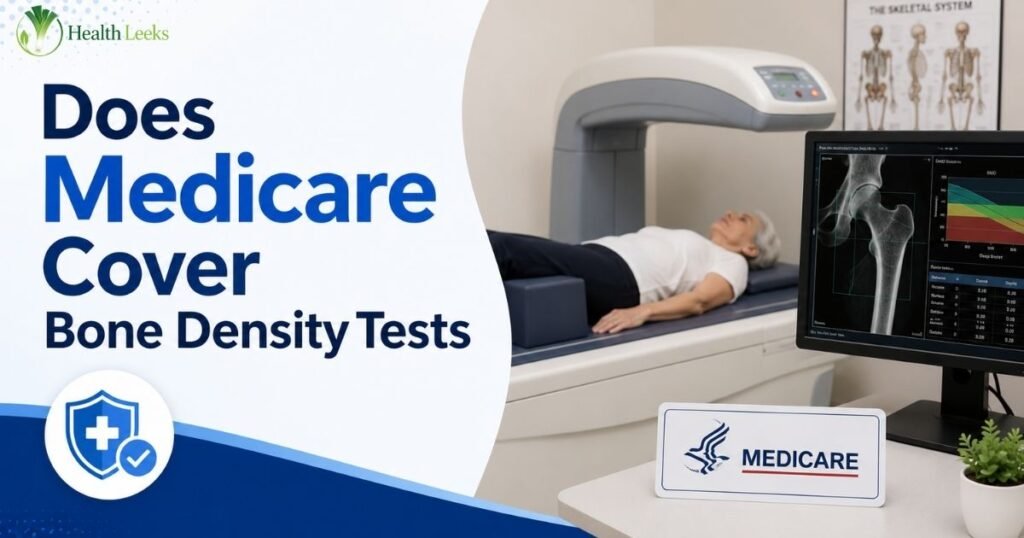
Worried about your bone health as you age? You are not alone. Millions of Americans over 65 face a higher risk of osteoporosis and bone fractures every year. The good news is that Medicare does cover bone density tests, but only under specific conditions. Knowing those conditions, and how to meet them, could mean the difference between a $0 test and a $700 out-of-pocket bill.
This guide breaks down everything you need to know: what a bone density test is, exactly who qualifies, how much Medicare pays, and the simple steps to make sure your scan is fully covered.
What Is a Bone Density Test (DEXA Scan)?
A bone density test is a medical screening tool that measures how strong and dense your bones are. It is one of the most important preventive tests available to older adults, helping doctors catch bone loss early, before a fracture happens.
What Does a Bone Density Test Actually Measure?
A bone density test measures your bone mineral density (BMD), essentially how much calcium and other minerals are packed into a specific area of bone. Higher mineral content means stronger bones with a lower risk of breaking. The test can detect conditions like osteopenia (low bone mass) and osteoporosis (severe bone loss) at a stage when treatment is still highly effective.
Is a Bone Density Test the Same as a DEXA Scan?
Yes, in most cases. DEXA stands for Dual-Energy X-ray Absorptiometry (also written as DXA). It is the gold standard for measuring bone mineral density and the test Medicare covers. DEXA scans are typically performed on the hip, lumbar spine, or forearm. Some peripheral devices test the wrist, heel, or finger, but these are less accurate and used mainly for initial screening, not diagnosis.
Why Does Your Primary Care Doctor Order This Test?
Your doctor may recommend a bone density test if you have risk factors for osteoporosis, a history of fractures, or are taking medications known to weaken bones. It is also ordered to monitor how well osteoporosis treatment is working. For postmenopausal women and older men, routine screening is one of the most effective ways to prevent life-altering fractures of the hip and spine.
What Is a Bone Density Procedure Like?
The procedure is quick, painless, and non-invasive. You lie fully clothed on a padded table while a low-dose X-ray scanner passes over your body. The entire test usually takes 10 to 30 minutes. Radiation exposure is very minimal, significantly less than a standard chest X-ray. No injections, no contrast dye, no preparation required.
Does Medicare Cover Bone Density Tests?
Yes, Medicare does cover bone density tests, but coverage depends on which part of Medicare you have, whether your doctor has documented medical necessity, and whether the testing facility accepts Medicare assignment.
Does Medicare Part B Cover Bone Density Tests?
Medicare Part B is the primary coverage for bone density testing. When you meet Medicare’s eligibility criteria and your test is performed at a Medicare-approved facility by an enrolled provider, Part B covers 100% of the Medicare-approved cost, meaning you pay nothing out of pocket. To qualify for this full coverage, at least 23 months must have passed since your last covered bone density test.
If your provider does not accept Medicare assignment, you could be charged for all or part of the cost. Always confirm this before your appointment.
Does Medicare Part A Cover Bone Density Tests?
Medicare Part A covers bone density testing only in specific situations, when you are admitted to a hospital or receiving care in a skilled nursing facility (SNF) and a bone density test is medically necessary during that stay. In those cases, the test is covered under your inpatient benefits. After meeting your Part A deductible ($1,676 in 2024), the test is covered for the first 60 days of hospitalization with no additional cost.
Does Medicare Advantage (Part C) Cover Bone Density Tests?
Medicare Advantage plans are required by law to cover everything Original Medicare covers, including bone density tests under the same eligibility criteria. However, individual plans may have their own rules about which facilities you can use, whether referrals are required, and what your cost-sharing looks like. Some Advantage plans may also offer enhanced bone health benefits. Always check with your specific plan before scheduling your scan.
Who Qualifies for a Medicare-Covered Bone Density Test?
Not everyone with Medicare automatically qualifies for a covered bone density scan. Medicare has established five specific medical conditions that make a beneficiary eligible.
The 5 Official Medicare Eligibility Conditions
To receive a Medicare-covered bone density test, you must meet at least one of the following five criteria. Your doctor must document the qualifying condition in your medical record and order the test accordingly.
1: Estrogen Deficiency (Women)
Women who are estrogen-deficient and at clinical risk for osteoporosis qualify for coverage. This typically applies to postmenopausal women, including those who have gone through early menopause or have had their ovaries surgically removed. Your physician will assess your personal and family medical history to confirm the clinical risk.
2: X-Rays Showing Bone Loss
If a standard X-ray or imaging study reveals signs of vertebral abnormalities, possible osteopenia, or existing osteoporosis, you qualify for a follow-up bone density test. This is because standard X-rays can only detect bone loss once it has progressed significantly, and a DEXA scan allows for more precise measurement and monitoring.
3: Steroid or Prednisone Use
Long-term use of corticosteroids, including prednisone, prednisolone, or similar medications, is a well-established cause of bone loss. If you have been taking steroid-type drugs, you qualify for Medicare-covered bone density testing. This is especially important for people managing conditions like rheumatoid arthritis, lupus, asthma, or COPD who rely on these medications.
4: Primary Hyperparathyroidism
Primary hyperparathyroidism is a condition in which overactive parathyroid glands cause elevated calcium levels, which in turn weakens bones over time. A confirmed diagnosis of this condition qualifies you for Medicare-covered bone density testing to monitor and manage bone health.
5: Monitoring Osteoporosis Treatment
If you have already been diagnosed with osteoporosis and are currently receiving FDA-approved drug therapy, Medicare covers bone density testing to monitor how well your treatment is working. This allows your doctor to adjust your medication plan based on measurable results.
Does Medicare Cover Bone Density Tests for Men?
This is one of the most common questions, and the answer is: it depends. Medicare’s estrogen-deficiency criterion applies only to women. However, men can still qualify under the other four conditions. Doctors generally recommend that men aged 70 and older be screened for osteoporosis, and men with hyperparathyroidism, vertebral abnormalities, or long-term steroid use can receive covered testing. If you are a male Medicare beneficiary, speak with your physician to determine which eligibility category applies to you.
What If You Have Multiple Conditions?
Having more than one qualifying condition does not change how often Medicare will pay for testing, the standard frequency rule still applies. However, multiple conditions may strengthen your doctor’s case for more frequent testing if your clinical situation requires closer monitoring.
ELIGIBILITY QUICK REFERENCE:
| Qualifying Condition | Who It Applies To |
| Estrogen deficiency + osteoporosis risk | Postmenopausal women |
| Vertebral abnormalities on X-ray | Men and women |
| Long-term corticosteroid (steroid) use | Men and women |
| Primary hyperparathyroidism | Men and women |
| Monitoring confirmed osteoporosis treatment | Men and women |
How Much Does Medicare Pay for a Bone Density Test?
When you meet the eligibility requirements and your provider accepts Medicare assignment, Medicare Part B pays 100% of the Medicare-approved amount for your bone density test. There is no copay, no coinsurance, and no deductible for this preventive benefit. This is one of the few Medicare services where out-of-pocket costs can be completely eliminated.
How Much Does a Bone Density Test Cost Without Insurance?
Without insurance, the out-of-pocket cost for a DEXA scan averages around $719, though prices vary significantly based on geographic location, facility type, and whether the scan includes a radiologist’s interpretation. In urban areas, costs tend to run higher than in rural or suburban settings.
With private insurance, most people pay between $160 and $175 after their plan’s cost-sharing rules apply, assuming the scan is deemed medically necessary.
What About Medicare Advantage?
Under a Medicare Advantage plan, you receive the same core coverage as Original Medicare. However, your cost-sharing (copays, deductibles, coinsurance) may differ depending on your specific plan. Some Advantage plans cover the scan at $0, while others may charge a copay. Always verify costs with your plan before scheduling.
COST SUMMARY TABLE:
| Scenario | Estimated Cost |
| Medicare Part B (eligible, assignment accepted) | $0 |
| Medicare Part B (provider doesn’t accept assignment) | Varies, potentially full cost |
| Without any insurance | ~$700 average |
| With private insurance | ~$160–$175 |
| Medicare Advantage | Varies by plan |
Pro Tip
Before your appointment, call your provider’s billing office and ask two questions: “Do you accept Medicare assignment?” and “Is my bone density test billed as a preventive service?” Getting clear answers to both questions protects you from unexpected charges.
How Often Does Medicare Cover a Bone Density Test?
Medicare covers a bone density test once every 24 months (every two years) for eligible beneficiaries. Practically speaking, this means at least 23 months must have passed since your last Medicare-covered scan before the next one is approved.
Can You Get Tested More Frequently?
Yes, in certain clinical situations. If your physician determines that more frequent testing is medically necessary, they can submit documentation to support additional coverage. Situations that may qualify include:
- Being newly diagnosed with osteoporosis and starting medication
- Showing an unexpectedly rapid rate of bone loss
- Undergoing treatment changes that require closer monitoring
- Having a documented condition that significantly accelerates bone loss
Your doctor must provide proof of medical necessity for Medicare to approve coverage outside the standard two-year window.
How Often Should You Have a Bone Density Test After 70?
Most clinical guidelines, including those from the U.S. Preventive Services Task Force and the Bone Health and Osteoporosis Foundation, recommend screening every one to two years for women over 65 and men over 70. For those in this age group who are already managing osteoporosis or osteopenia, annual testing may be appropriate under physician guidance. Medicare’s two-year rule sets the coverage baseline, but your doctor’s recommendation should always drive the clinical decision.
Understanding Your Bone Density Test Results
Once your DEXA scan is complete, a radiologist interprets the results and generates a report. The most important number on that report is your T-score.
What Is a T-Score?
A T-score compares your bone mineral density to the average peak bone density of a healthy 30-year-old of the same sex. The result is expressed as a positive or negative number. Here is how to interpret it:
- T-score of -1.0 or above: Normal bone density
- T-score between -1.0 and -2.5: Low bone mass (osteopenia), a warning sign
- T-score of -2.5 or below: Osteoporosis, significantly increased fracture risk
Think of osteopenia as a yellow light and osteoporosis as a red light. Neither means a fracture is inevitable, but both call for action.
You may also see a Z-score on your report. Unlike the T-score, the Z-score compares your bone density to people of your same age and sex. A Z-score below -2.0 suggests your bone loss is greater than expected for your age and warrants further investigation for secondary causes such as vitamin D deficiency, hyperparathyroidism, or medication-related bone loss.
Bone Density Chart by Age
| Age Group | Typical T-Score Range |
| Young adults (20s–30s) | 0 or slightly above (peak bone mass) |
| Perimenopausal women (45–55) | -0.5 to -1.0 |
| Postmenopausal women (55–70) | -1.5 to -2.5 |
| Elderly (70+) | -1.5 or lower; higher fracture risk |
Note: These are general reference ranges. Individual results vary significantly based on body size, ethnicity, lifestyle, and medical history.
What Happens After Your Results?
Your physician will review your T-score in combination with your full medical history, age, risk factors, and FRAX score (a fracture risk assessment tool) before making any treatment recommendations. Depending on your results, next steps may include:
- No immediate action if bone density is normal
- Lifestyle changes (calcium-rich diet, vitamin D, weight-bearing exercise) for osteopenia
- Prescription medications such as bisphosphonates for osteoporosis
- A follow-up scan in 12 to 24 months to track progress
How to Get a Bone Density Test Covered by Medicare
Getting your bone density test covered is a straightforward process, as long as you follow the right steps.
Step-by-Step Guide:
- Schedule a visit with your primary care physician. Discuss your risk factors, medical history, and any symptoms that may point toward bone loss.
- Ask your doctor to document your qualifying condition. Whether it is postmenopausal status, steroid use, or another criterion, proper documentation in your chart is essential for Medicare to approve coverage.
- Get a written referral or order. Your Medicare-enrolled physician must formally order the test. Medicare will not cover a self-referred scan.
- Choose a Medicare-approved facility. Call ahead and confirm that the imaging center accepts Medicare assignment. This is the single most important step to ensuring a $0 bill.
- Confirm at least 23 months have passed since your last covered bone density test (if applicable).
- Attend your appointment and follow up. After the scan, schedule a follow-up with your doctor to review results and discuss next steps.
Can You Check Bone Density at Home?
No reliable at-home bone density test currently exists. While some consumer devices and wearables claim to provide bone health insights, none of them are accurate enough to diagnose osteopenia or osteoporosis or replace a clinical DEXA scan. If you are concerned about your bone health, the only medically validated path is a DEXA scan ordered by your physician and performed at a licensed imaging center.
Some wellness companies offer body composition DEXA scans that include bone density data, but these are typically not covered by Medicare because they are considered elective fitness services rather than diagnostic medical tests.
Final Thoughts
If you are a Medicare beneficiary with risk factors for osteoporosis, or if you are a postmenopausal woman, a long-term steroid user, or someone over 70, a covered bone density test may be available to you at zero cost. The key is working with your doctor to document your qualifying condition, getting a formal referral, and choosing a provider that accepts Medicare assignment.
Do not wait for a fracture to find out your bones need attention. Talk to your doctor today, confirm your eligibility, and take this simple, painless step toward protecting your bone health for years to come.