
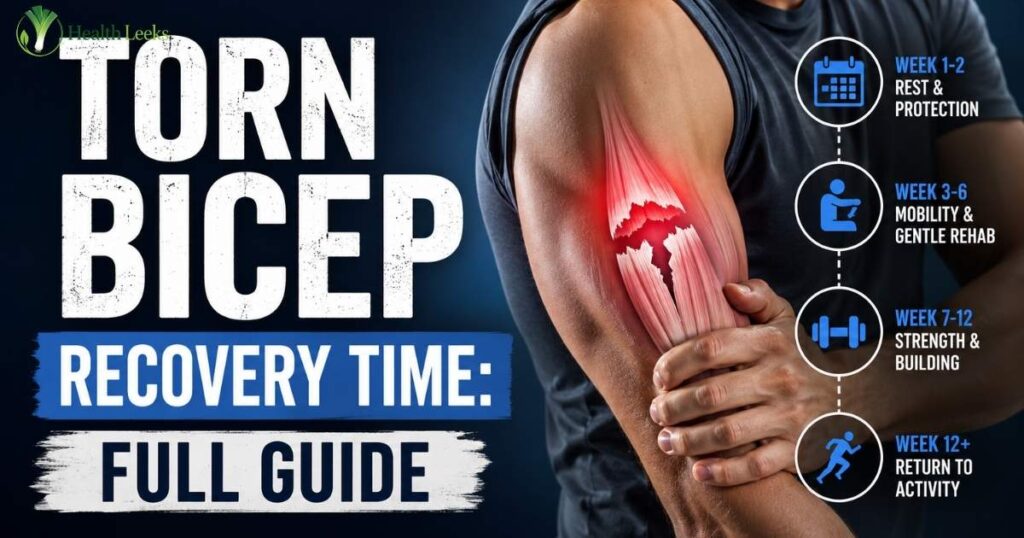
A torn bicep can knock you off your feet fast. One moment you are lifting, reaching, or catching something heavy, and the next you feel a sharp pop followed by immediate pain and weakness in your arm. Whether you are an athlete, a manual worker, or someone who simply pushed too hard at the gym, knowing what to expect from torn bicep recovery time can make a massive difference in how well and how fast you heal.
This guide walks you through everything: what a torn bicep actually is, how long recovery takes with and without surgery, the rehabilitation phases you will go through, and the factors that shape your healing journey.
What Is a Torn Bicep?
The bicep muscle connects your shoulder to your forearm through two tendons at the top and one at the bottom. When one of those tendons stretches beyond its limit, it can partially or fully tear away from the bone.
The distal bicep tendon, which attaches near the elbow, bears the greatest mechanical load during lifting and rotation. This makes it particularly prone to rupture. When a complete tear occurs, the muscle retracts upward, often creating the well-known “Popeye deformity” in the upper arm.
Torn bicep injuries affect roughly 3 to 5 people per 100,000 annually at the elbow level alone, and they are far more common in men over 30 who are involved in heavy lifting or overhead sports.
Types of Torn Bicep Injuries
Understanding the type of tear you have determines your treatment path and recovery timeline:
- Proximal bicep tendon tear: Occurs near the shoulder, usually affecting the long head of the bicep. Often manageable without surgery, especially in older, less active individuals.
- Distal bicep tendon tear: Occurs near the elbow where the tendon attaches to the radius. More functionally significant. Surgery is usually recommended for active patients.
- Partial tear: Only a portion of the tendon is damaged. Many partial tears respond well to conservative treatment.
- Complete tear: The tendon is fully detached from the bone. More likely to require surgical repair, particularly at the distal end.
Symptoms of a Torn Bicep
Knowing the signs early helps you act quickly. The most common symptoms include:
- A sudden, sharp pop or snap at the time of injury
- Immediate pain in the upper arm or elbow region
- Visible bruising that travels down the arm within 24 to 48 hours
- Swelling in the upper arm or elbow
- Muscle weakness, especially when bending the elbow or rotating the forearm
- The classic “Popeye bulge,” where the muscle bunches up in the middle of the arm
- Tenderness along the front of the arm or near the elbow crease
If you notice any of these signs, especially the visible deformity or severe weakness, seek medical attention promptly. Early evaluation improves your treatment options significantly.
Torn Bicep Recovery Time: A Complete Overview
Recovery time varies widely depending on the severity of the injury and whether surgery is needed. Here is a broad summary before we break each path down:
| Injury Type | Treatment | Recovery Time |
| Mild strain | Conservative | 2 to 6 weeks |
| Partial tear | Conservative | 6 to 12 weeks |
| Complete tear (proximal) | Conservative or surgery | 3 to 6 months |
| Complete tear (distal) | Surgery | 4 to 12 months |
Non-Surgical (Conservative) Recovery Timeline
Not every torn bicep requires an operation. Partial tears, proximal tears in older or less active patients, and mild strains are frequently managed without surgery.
- Weeks 1 to 2: Rest, ice, and anti-inflammatory medications to manage pain and swelling. A sling may be used for comfort.
- Weeks 3 to 6: Gentle range-of-motion exercises begin once acute pain settles.
- Weeks 6 to 12: Light resistance exercises are introduced. Functional strength gradually returns.
- 3 to 6 months: Most patients regain satisfactory strength and function, though some permanent loss of supination strength (rotating the forearm) is common with untreated distal tears.
Patients are typically cleared for a return to pre-injury activities between 8 and 12 weeks for non-surgical cases. However, regaining complete muscle strength often extends toward the 6-month mark.
Surgical Recovery Timeline
Surgery is the standard recommendation for complete distal bicep tears and for proximal tears in patients who demand full arm function. The procedure reattaches the torn tendon to the bone using surgical anchors or screws.
Timing matters. Repairing a torn bicep tendon within the first 2 to 3 weeks after injury gives the best outcome. After that window, the tendon and muscle begin to shorten and develop scar tissue, making reattachment more complex and outcomes less predictable.
Post-surgical milestones typically look like this:
- Weeks 1 to 4: Arm immobilized in a sling or brace. Passive motion only.
- Weeks 4 to 8: Sling is removed. Passive and active range-of-motion exercises begin.
- Weeks 8 to 16: Light resistance training introduced under physical therapy supervision.
- Months 4 to 6: Return to most daily and occupational activities.
- Months 6 to 12: Return to heavy lifting, manual labor, or sport-specific activity.
Full recovery may take up to a year, though most patients regain functional range of motion and strength by 4 to 6 months after surgery.
Factors That Affect Torn Bicep Recovery Time
No two recoveries look identical. Here are the key variables that shape how long healing takes.
1. Severity of the Tear
A partial tear that involves less than 50% of tendon thickness is far more likely to heal with conservative care in 6 to 10 weeks. A complete rupture, particularly at the distal end, requires surgical repair and extends recovery to 4 months or longer.
2. Location of the Tear
Distal tears near the elbow are biomechanically critical and almost always need surgery for active individuals. Proximal tears near the shoulder are often left to heal conservatively, with less functional consequence in everyday activity.
3. Age and Overall Health
Tendons naturally lose elasticity with age. Older patients generally experience slower tissue regeneration and longer recovery windows. Underlying conditions such as diabetes, poor circulation, or a history of smoking can further impair blood flow to the injured site, slowing tendon repair.
4. Timing of Surgery
Early surgical repair, ideally within 2 to 3 weeks of injury, produces significantly better results than delayed procedures. Scar tissue formation and muscle retraction after this window make surgery technically harder and often compromise the final functional outcome.
5. Adherence to Rehabilitation
Consistent, structured physical therapy is the single most important controllable factor in recovery quality. Patients who skip sessions, overload the repair too early, or return to strenuous activity before being cleared face a markedly higher risk of re-rupture and prolonged disability.
6. Type of Surgery (Open vs. Arthroscopic)
Research shows that patients who undergo open biceps tenodesis may return to sports more quickly in some cases. However, arthroscopic surgery is associated with less post-operative pain and a shorter hospital stay. The choice depends on the individual anatomy, the surgeon’s expertise, and the nature of the tear.
Rehabilitation: The Heart of Recovery
Rehabilitation is not a step you take after healing. It is the mechanism through which healing translates into restored function. A well-structured rehab program addresses range of motion, strength, flexibility, and neuromuscular coordination.
Phase 1: Protection and Rest (Weeks 1 to 4)
The priority in this phase is protecting the surgical repair or allowing acute inflammation to settle in non-surgical cases.
- Arm held in a sling or hinged brace
- Elbow typically positioned at 90 degrees to reduce tension on the tendon
- No lifting, pulling, or active flexion
- Hand and wrist exercises may begin to maintain circulation
- Ice and elevation to control swelling
Phase 2: Restoring Range of Motion (Weeks 4 to 8)
Once the initial healing has progressed, the focus shifts to regaining movement.
- Passive range-of-motion exercises begin, guided by a physical therapist
- Pendulum exercises and gentle elbow flexion and extension
- Forearm supination and pronation drills introduced gradually
- Grip strengthening with soft squeeze tools
- Avoid any movement that causes sharp pain at the repair site
Phase 3: Strengthening (Weeks 8 to 16)
With motion restored, rebuilding strength becomes the main goal.
- Isometric exercises transition to isotonic resistance training
- Resistance bands, light dumbbells, and cable machines used progressively
- Eccentric loading exercises to build tendon resilience
- Core and shoulder stability work to support the recovering arm
- Supination strength training, particularly important for distal tears
Phase 4: Return to Activity (Months 4 to 6+)
The final rehabilitation phase prepares you for the demands of real life, work, and sport.
- Sport-specific or occupation-specific drills introduced
- Progressive loading toward pre-injury levels
- Functional movement patterns: pushing, pulling, carrying, overhead work
- Clearance from your surgeon and physical therapist is required before full return
At-Home Care Tips to Support Recovery
What you do between therapy sessions matters just as much as the sessions themselves.
- Rest and protect: Use your sling as instructed. Do not rush to discard it.
- Ice regularly: Apply ice wrapped in a cloth for 15 to 20 minutes several times a day during the first two weeks to manage swelling.
- Elevate your arm: Keeping your elbow above heart level helps reduce fluid buildup.
- Eat for healing: A diet rich in lean protein, vitamin C, zinc, and omega-3 fatty acids supports tissue repair.
- Stay hydrated: Tendons and muscles need adequate hydration to function and heal properly.
- Prioritize sleep: Aim for 7 to 9 hours of restorative sleep each night. The body does most of its repair work during deep sleep cycles.
- Avoid smoking: Smoking restricts blood flow to tendons and significantly slows healing.
- Follow your protocol: Never modify your exercise plan without consulting your surgeon or physical therapist first.
Possible Complications to Watch For
Most torn bicep recoveries progress smoothly, but complications do occur. Watch for:
- Re-rupture: Returning to heavy activity too early is the most common cause. This may require repeat surgery.
- Nerve injury: Numbness, tingling, or weakness in the forearm or hand following surgery should be reported immediately.
- Infection: Warmth, increasing redness, fever, or discharge around the surgical site need prompt medical evaluation.
- Stiffness: Limited elbow range of motion that does not improve with therapy may require additional intervention.
- Strength deficit: Some permanent reduction in supination strength is expected after non-surgical management of distal tears.
Return to Work: What the Timeline Looks Like
Your ability to return to work depends heavily on the physical demands of your job.
- Desk jobs and sedentary roles: Most people can return within 1 to 2 weeks after surgery, as long as they avoid using the injured arm.
- Light physical work: Return is typically possible around 6 to 8 weeks with medical clearance.
- Moderate physical work (regular lifting): Expect 3 to 4 months before safely resuming regular duties.
- Heavy manual labor, construction, or overhead work: A return to full duty may take 4 to 6 months or longer.
Always get formal clearance from your orthopedic surgeon before returning to any physically demanding job.
When to See a Doctor
Seek medical evaluation if you:
- Heard or felt a pop in your arm during activity
- Have significant weakness when bending your elbow or rotating your forearm
- Notice a visible bulge or deformity in the upper arm
- Experience persistent pain that does not improve after a few days of rest and ice
- Have swelling, bruising, or tenderness that is worsening rather than improving
- Underwent conservative treatment and are not seeing improvement after 4 to 6 weeks
Early diagnosis opens more treatment options and leads to better long-term outcomes, particularly for complete tears where the 2 to 3 week surgical window is critical.
Key Takeaways
- Torn bicep recovery time ranges from 2 to 6 weeks for mild strains up to 12 months for surgically repaired complete tears.
- Partial tears treated conservatively typically heal in 6 to 12 weeks, with full strength returning around 3 to 6 months.
- Complete distal tears almost always require surgery, ideally within 2 to 3 weeks of injury.
- Recovery progresses through four rehabilitation phases: protection, range of motion, strengthening, and return to activity.
- Factors including age, injury severity, location, surgery timing, and rehab consistency all shape how long healing takes.
- Physical therapy adherence is the most reliable predictor of long-term functional outcome.
- Desk workers can often return to work within 1 to 2 weeks; heavy-duty workers may need 4 to 6 months.