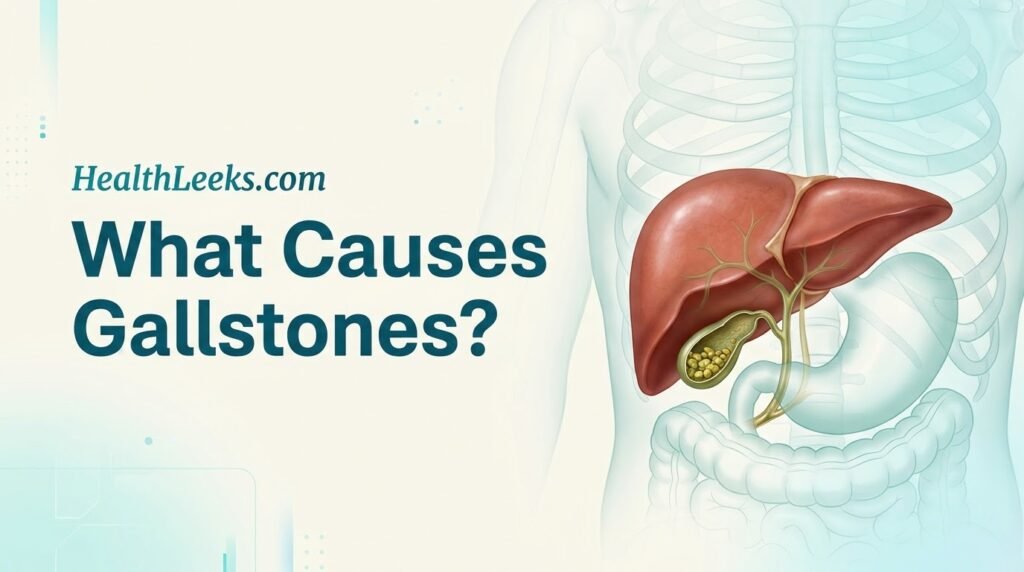
What causes gallstones is a chemistry problem, not bad luck. The fluid in your gallbladder, called bile, falls out of balance, and solid crystals slowly grow into stones.
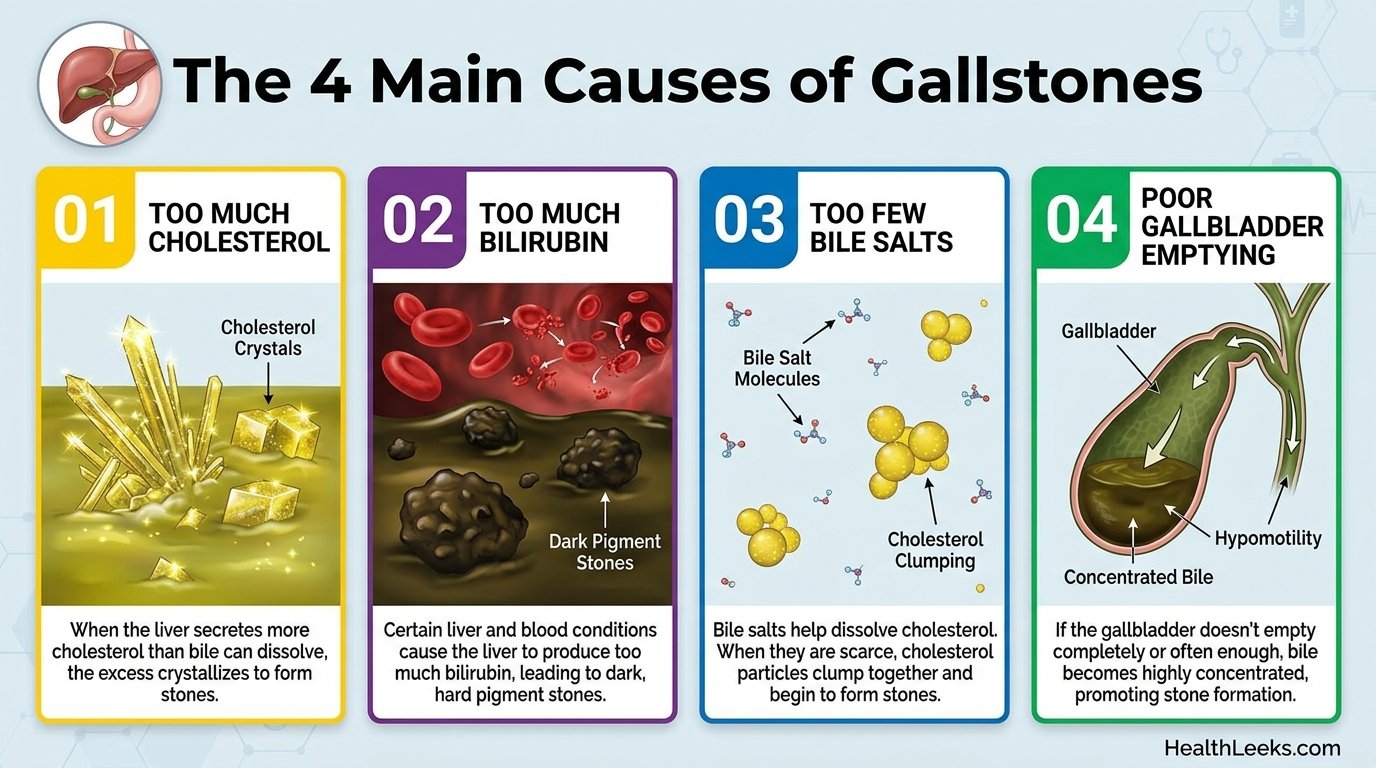
The United States’ own digestive institute names four ways this happens. Bile can hold too much cholesterol, too much bilirubin, too few bile salts, or it can sit too long in a gallbladder that empties poorly.
About 10 to 15 percent of US adults have gallstones, per the NIDDK. Most never feel them, because stones only hurt when they block the narrow ducts bile travels through.
This page explains each cause in plain language, then organises every major risk factor by the cause it feeds. You will finish able to answer the only question that matters: which of these apply to me?
Quick Answer: The Four Ways Gallstones Form
Gallstones form when bile falls out of balance. The NIDDK’s Symptoms & Causes of Gallstones guidance states the mechanism directly, and every cause below serves one of its four problems.
|
# |
The problem in bile |
What grows from it |
|---|---|---|
|
1 |
Too much cholesterol |
Cholesterol crystals, then cholesterol stones |
|
2 |
Too much bilirubin |
Dark pigment stones |
|
3 |
Not enough bile salts |
Cholesterol can no longer stay dissolved |
|
4 |
Bile sits too long |
Concentrated bile where crystals form easily |
One honest line from the same source deserves print. Researchers do not fully understand why these bile changes occur, which is why this page separates proven mechanisms from risk factors carefully.
Meet Your Gallbladder and Bile: A Two Minute Anatomy
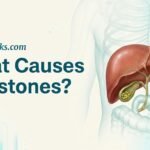
Your gallbladder is a small pear shaped pouch tucked under your liver. It stores bile between meals and squeezes it into the intestine when you eat fat.
Your liver makes the bile, roughly a litre a day in common clinical descriptions. Bile’s job is digestion: it breaks dietary fat into droplets your body can absorb.
Bile is a recipe with four key ingredients: cholesterol, bile salts, a fat called lecithin, and bilirubin, the pigment left when old red blood cells break down. Water carries them all.
The recipe works while the proportions hold. Bile salts and lecithin act like dish soap, keeping cholesterol dissolved in the fluid instead of letting it settle.
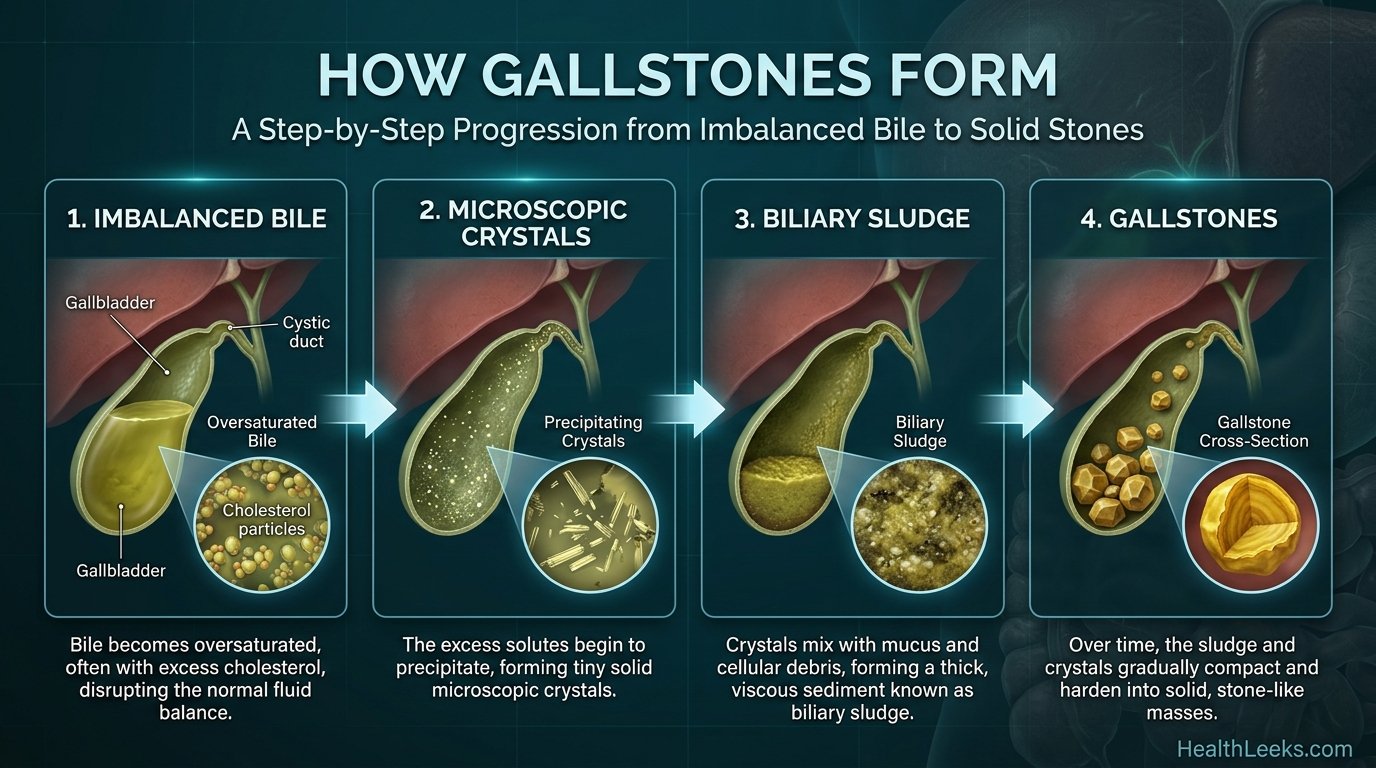
Stones begin the moment that balance tips. Crystals appear first, then clump with mucus into sludge, then harden over months and years into stones from sand grain to golf ball size.
Cause 1: Too Much Cholesterol in Bile
This is the commonest cause by far. When the liver sends more cholesterol into bile than bile salts can dissolve, the excess has nowhere to go.
Doctors call the state cholesterol supersaturation. The surplus cholesterol precipitates out as microscopic crystals, exactly as sugar crystallises from an over sweetened syrup left to cool.
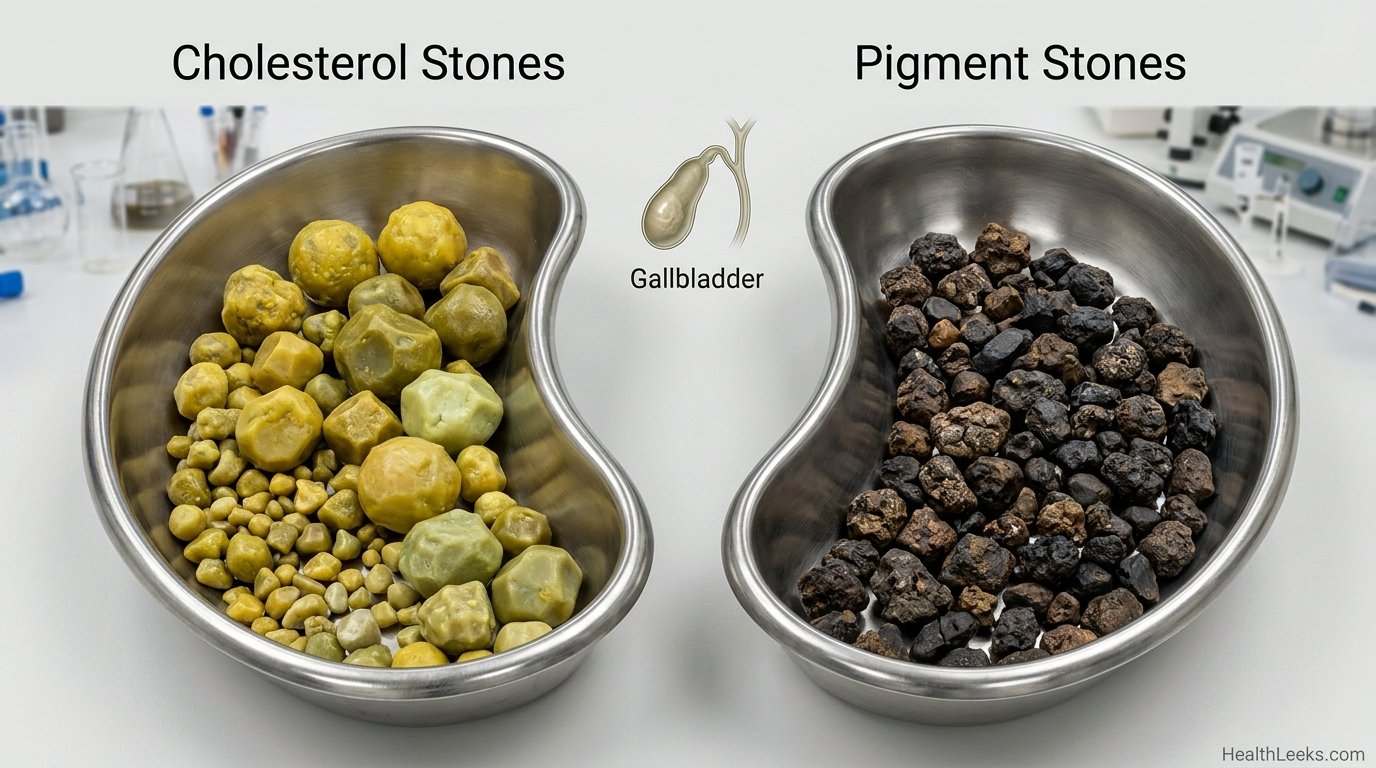
Given time and calm, stagnant bile, the crystals grow and merge. The result is a cholesterol stone: yellow green, sometimes single and large, sometimes one of several.
About 80 percent of gallstones in the United States are this cholesterol type, per figures attributed to the National Institutes of Health across clinical reviews. Western diets and body weights explain much of that share.
Cause 2: Too Much Bilirubin in Bile
Bilirubin is the dark pigment produced when your body recycles worn out red blood cells. A healthy liver processes it smoothly into bile and out of the body.
Some conditions flood the system with bilirubin. When red cells break down too fast, or the liver struggles, bile carries more pigment than it can keep in solution.
The pigment binds with calcium salts and hardens into pigment stones. These are smaller, darker, and usually more numerous than cholesterol stones.
The classic settings are blood and liver conditions: sickle cell disease and other hemolytic anemias, and liver cirrhosis. Bile duct infections drive a related brown pigment type, discussed below.
Cause 3: Not Enough Bile Salts
Bile salts are the dissolvers of the system. They are made in the liver, used in the intestine, then reabsorbed and recycled, several times a day.
Anything that breaks the recycling loop starves bile of its salts. With too few salts, even a normal amount of cholesterol can no longer stay dissolved.
The recognised loop breakers are intestinal conditions. Crohn’s disease affecting the last part of the small intestine, and surgical removal of that segment, both reduce bile salt reabsorption.
This cause hides inside the other three. It rarely appears on patient pages, yet it completes the NIDDK’s list and explains stones in people with bowel disease.
Cause 4: A Gallbladder That Empties Poorly
Bile is meant to move. Each meal triggers the gallbladder to contract and flush its contents toward the intestine, which keeps the fluid fresh.
When contractions weaken or meals are skipped for long stretches, bile sits and concentrates. Water is absorbed from the stored bile, so every solid ingredient becomes more crowded.
Crowded, stagnant bile is crystal friendly. Pregnancy, prolonged fasting, very low calorie dieting, and rapid weight loss all slow emptying, which is why they recur throughout the risk section.
Think of it as a river versus a pond. Moving bile carries crystals out; still bile lets them settle, gather, and grow.
The Two Stone Types, and Why Their Causes Differ
Knowing your stone type tells you which cause chain built it. Treatment and prevention conversations both start from this table.
|
Feature |
Cholesterol stones |
Pigment stones |
|---|---|---|
|
Share of US stones |
About 80 percent |
Most of the rest |
|
Made of |
Hardened cholesterol |
Bilirubin and calcium salts |
|
Appearance |
Yellow green |
Dark brown or black |
|
Typical size |
Can grow large |
Usually small, often many |
|
Main cause |
Cholesterol heavy, stagnant bile |
Extra bilirubin in bile |
|
Linked with |
Weight, pregnancy, estrogen, ancestry |
Blood disorders, cirrhosis, duct infection |
Cholesterol stones: the Western pattern
These dominate in developed countries and track the metabolic pattern of those populations. Higher body weight, insulin resistance, and estrogen exposure all feed the cholesterol mechanism.
Cleveland Clinic puts cholesterol stones at roughly three quarters of gallstones in Western countries. The exact share varies by study, so this page uses the commonly cited figure of about 80 percent for the US.
Pigment stones: black and brown
Black pigment stones form in the gallbladder itself, mainly where hemolysis floods bile with bilirubin. Sickle cell patients can develop them from childhood onward.
Brown pigment stones form in the bile ducts and are classically linked to bacterial infection in stagnant bile, including organisms such as E. coli. They are more common in parts of Asia than in the United States.
Mixed stones also exist in clinical classification. They carry meaningful amounts of both cholesterol and pigment, a reminder that real biology rarely respects tidy categories.
Risk Factors, Organised by the Mechanism They Drive
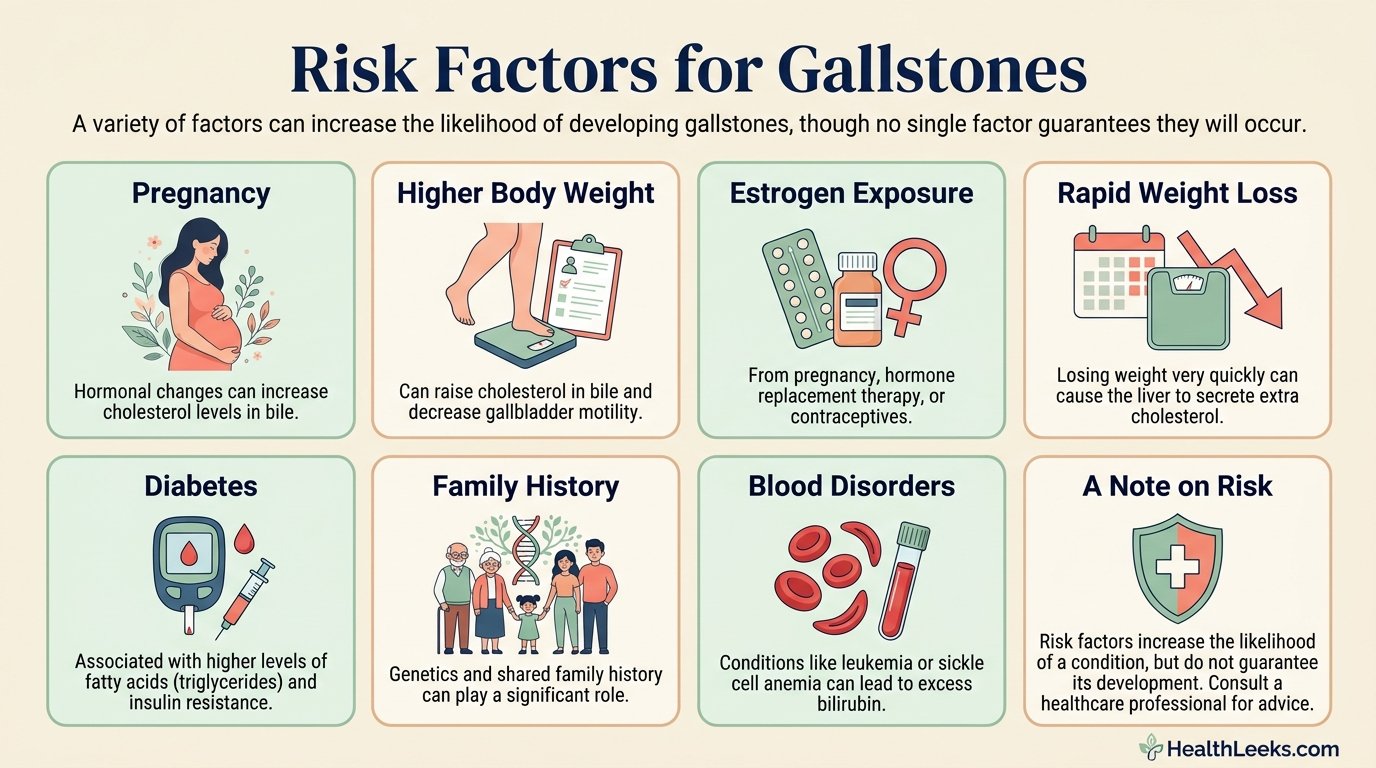
Most pages list risk factors as a flat alphabet. Grouping them by mechanism shows you which of the four causes your own life is feeding.
What raises cholesterol in bile
|
Risk factor |
How it feeds the cause |
|---|---|
|
Higher body weight and obesity |
The liver secretes more cholesterol into bile |
|
Female sex and estrogen |
Estrogen increases cholesterol in bile |
|
Pregnancy |
Hormones raise cholesterol and slow emptying together |
|
Birth control pills and hormone therapy |
Estrogen effect, as above |
|
Age over 40 |
Bile cholesterol saturation rises with age |
|
Diabetes and metabolic syndrome |
Metabolic changes raise bile cholesterol |
|
Fatty liver disease |
Travels with the same metabolic pattern |
|
Diet high in fat and low in fibre |
Long term pattern linked to cholesterol rich bile |
What raises bilirubin in bile
|
Risk factor |
How it feeds the cause |
|---|---|
|
Sickle cell disease |
Constant red cell breakdown floods bile with bilirubin |
|
Other hemolytic anemias |
Same pathway: hereditary spherocytosis and relatives |
|
Liver cirrhosis |
A struggling liver mishandles bilirubin |
|
Bile duct infection |
Bacteria alter pigment chemistry (brown stones) |
What slows gallbladder emptying
|
Risk factor |
How it feeds the cause |
|---|---|
|
Rapid weight loss |
More cholesterol released while the gallbladder rests |
|
Very low calorie diets and fasting |
Few meals means few contractions |
|
Weight loss (bariatric) surgery |
The rapid loss period after surgery is high risk |
|
Pregnancy (again) |
Progesterone relaxes gallbladder muscle |
|
Total parenteral nutrition (IV feeding) |
The gut and gallbladder are bypassed entirely |
|
Certain medicines (for example octreotide) |
Motility effects noted in clinical reviews |
|
Diabetes |
Motility changes accompany the metabolic ones |
Your personal risk audit
Read the three lists as one audit. Each factor you recognise points at a specific mechanism, and several factors often stack in the same person.
The classic teaching shorthand is the four Fs: female, forty, fertile, and fat. It is memorable and broadly accurate, and it still misses men, younger people, and every pigment stone cause.
Ancestry belongs in the audit too. Gallstones affect 60 to 70 percent of American Indian adults per a widely cited review, and Mexican American adults also carry elevated rates, while about 20 million Americans overall live with stones.
A family history works the same way. If a parent or sibling needed gallbladder surgery, mention it at your own checkups, because bile chemistry runs in families.
Using this audit with your doctor
An audit only helps if it changes a conversation. Bring yours to your next checkup in this simple form: the factors you recognised, and any symptoms you have noticed.
With no symptoms, the usual outcome is documentation and awareness. Your record gains a flag, and you gain the red flag list from the symptoms section below.
With symptoms, the same list helps your clinician judge likelihood and urgency. Mechanism patterns, like stones after childbirth or rapid loss, sharpen their thinking immediately.
Do not use the audit to diagnose yourself. Gallbladder type pain has imitators, from reflux to heart problems, and separating them is precisely the clinician’s job.
When Gallstones Run in the Family
A strong family pattern deserves its own plan, because genetic bile chemistry does not respond to willpower. Several relatives with gallbladder surgery is meaningful information.
Tell your clinician who and at what age. Early surgeries in a parent or sibling suggest stronger inherited saturation than a grandparent’s late life finding.
There is no routine screening recommendation for symptom free relatives in mainstream guidance. The plan is awareness, the modifiable habits from the prevention section, and a low threshold for reporting symptoms.
Teach the red flags across the family while you are at it. Shared knowledge turns one person’s diagnosis into everyone’s early warning system.
Causes Are Not Triggers: Why Attacks Follow Fatty Meals
Here is the distinction that clears up the most confusion in this topic. Causes build stones slowly; triggers provoke attacks from stones that already exist.
A fatty meal is a trigger, never a cause. Fat in the intestine orders the gallbladder to contract, and a strong contraction can push a stone into the cystic duct opening.
The stone that blocks you tonight has been forming for months or years. No single dinner created it, and no single dinner could have prevented it.
Attacks often arrive in the evening or night, after the day’s largest meal. Clinical writers note that the exact reason for the nocturnal pattern is not fully explained, even though the meal link is clear.
Understanding this split ends two common guilts: blaming yourself for last night’s food, and fearing that one future meal might suddenly manufacture a stone.
How a Stone Grows: From Sludge to Gravel to Stone
Stones are grown, not made, and the growth has recognisable stages. Seeing the sequence explains why causes act over years while symptoms arrive in a night.
|
Stage |
What is happening |
|---|---|
|
The recipe tips; cholesterol or bilirubin exceeds what bile can hold |
|
Microscopic solids precipitate and gather in mucus |
|
Crystals and mucus thicken into a layer that may still clear |
|
Crystals fuse and harden into gravel sized or larger stones |
|
A stone lodges in a duct, often decades after stage one |
Sludge is the reversible stage. It appears during pregnancy, fasting, and serious illness, and it can melt away when normal eating and emptying resume.
Once stones harden, the story changes. Formed stones rarely dissolve on their own, which is why prevention advice always targets the early stages.
Medicines and Medical Situations That Can Cause Stones
Beyond hormones, clinical reviews name specific medical triggers that consumer pages often skip. Each works through sludge or stasis rather than diet.
Ceftriaxone, a widely used antibiotic, can precipitate with calcium in bile and form sludge, especially in children. The sludge usually clears after the medicine stops.
Octreotide, used for certain hormone conditions, slows gallbladder emptying strongly. Long term use is a recognised stone risk in clinical literature.
Total parenteral nutrition, feeding entirely by vein, rests the gut completely. With no meals to trigger contractions, bile stagnates and sludge forms within weeks.
Major illness and long hospital fasting create the same stillness. This is why stones sometimes appear after serious surgery that had nothing to do with the gallbladder.
None of these is a reason to refuse a needed treatment. They are reasons for the treating team, and you, to know the gallbladder is under extra strain.
Gallstones Around the World: Why Geography Changes the Cause
The cause map changes by continent, and the difference teaches the mechanism better than any diagram. Where you live tilts which bile problem dominates.
In the United States and Europe, cholesterol stones rule, tracking obesity and metabolic patterns. Prevention talk there rightly centres on weight and bile cholesterol.
In parts of Asia, brown pigment stones from duct infection have historically been far commoner. The enemy there is stagnant, infected bile rather than cholesterol saturation.
Among American Indian populations, genetics pushes cholesterol saturation so high that prevalence reaches 60 to 70 percent. Chilean and some Northern European populations also show elevated rates in the literature.
The global picture proves the page’s central claim. Different roads, same destination: tip the bile, by any mechanism, and stones follow.
What Your Doctor Hears in Your Story: Cause Clues
Clinicians read a patient’s history as a cause map, and you can preview their logic. Certain story details point them toward specific mechanisms instantly.
Attacks after childbirth suggest pregnancy’s hormone double effect. Stones after major weight loss point at the rapid loss pathway, especially with a dieting or surgery timeline.
Stones in a teenager redirect attention to blood disorders. Stones with bowel disease raise the bile salt loop, and stones in a parent and sibling raise the genetic flag.
Bringing these details organised makes consultations shorter and better. Dates of weight change, pregnancies, surgeries, and family history are the facts that matter most.
A Day of Bile: How Meals Keep the System Moving
Picture one ordinary day inside the gallbladder. Overnight, the organ fills and concentrates bile while you fast in your sleep.
Breakfast fat triggers the first squeeze, flushing the night’s concentrated bile out before crystals can settle. Lunch and dinner repeat the rinse twice more.
Now delete breakfast and lunch for a diet. The bile sits twenty hours instead of eight, concentrating further with every hour, in exactly the pattern stage two of stone growth requires.
That daily rhythm is why regular meals appear in prevention guidance beside weight and fibre. The gallbladder is a pump that only runs when you eat.
The Size Paradox: Why Mid Sized Stones Cause the Trouble
Stone size decides whether a stone can hurt you, in a way that surprises most readers. The relationship runs opposite to intuition.
Very small stones and sludge often wash out of the gallbladder unnoticed. Very large stones are too big to enter the narrow cystic duct, so they tend to stay put quietly.
The troublemakers are in between: small enough to enter the duct, too large to pass through it. Those lodge, block, and produce the classic attack of biliary colic.
This is one reason scan reports alone cannot predict symptoms. A gallbladder full of gravel may behave better than one holding a single mid sized stone.
Myths About Gallstone Causes, Corrected
Myths thrive where mechanisms are poorly explained. Four deserve direct correction, each against the medical sources used throughout this page.
|
Myth |
What the evidence supports |
|---|---|
|
One greasy meal gave me gallstones |
Stones form over months to years; meals trigger attacks only |
|
A gallbladder flush can clear my stones |
No credible evidence; passed lumps are soap like formations from the oil itself |
|
Only overweight people get gallstones |
Weight is one factor among many; blood disorders, pregnancy, and ancestry cause stones at any size |
|
Normal blood cholesterol means no gallstone risk |
Bile cholesterol saturation is local chemistry, unrelated to your blood test |
The flush warning, plainly
So called gallbladder flushes mix olive oil, juices, and salts, then present the resulting soft lumps as expelled stones. Chemical analyses reported in medical literature identify such lumps as formations created by the oil mixture itself.
Worse, a flush can provoke a genuine attack by forcing strong gallbladder contractions. Anyone with real stones and real symptoms needs medical care, not a cleanse.
A similar crystal story appears in our guide to what causes gout, where uric acid crystals, not bile ones, do the damage. The lesson repeats: crystals form quietly long before they hurt.
Symptoms, Silent Stones, and Red Flags
Most gallstones are silent. About 80 percent of people who have them never develop symptoms, a figure Cleveland Clinic reports.
The American Academy of Family Physicians’ 2024 gallstone disease review echoes it, noting nearly 80 percent are found incidentally. Silent stones usually surface on scans ordered for something else entirely.
Per NIDDK aligned guidance, stones without symptoms generally need no treatment at all. Awareness of warning symptoms is the usual plan.
When symptoms do come, the classic pattern is biliary colic. It is a steady, gripping pain in the upper right abdomen or centre, often after a meal, lasting thirty minutes to several hours.
Nausea and vomiting can accompany an attack. Our guide on what to eat after throwing up covers gentle recovery eating afterwards.
Pain location confuses many readers. Our explainer on whether a UTI can cause bloating and gas shows how easily abdominal symptoms blur together, which is why persistent pain deserves a proper examination rather than self diagnosis.
When to seek urgent care
Treat the following as same day or emergency signs, because they point to complications such as gallbladder infection, duct blockage, or pancreatitis.
- Abdominal pain lasting more than a few hours or too strong to sit still through
- Fever or chills alongside abdominal pain
- Yellowing of the skin or the whites of the eyes (jaundice)
- Dark urine or pale, clay coloured stools
- Repeated vomiting with upper abdominal pain
Untreated duct blockages can be fatal, in the NIDDK’s own words. If the list above describes you, stop reading and get medical help.
What Happens If Stones Are Left Untreated
Silent stones need nothing, but symptomatic stones tend to repeat. After a first clear attack, further attacks become more likely, which is why clinicians usually raise the surgery conversation then.
The complications list is short and serious: acute cholecystitis (an inflamed, infected gallbladder), stones escaping into the bile duct, gallstone pancreatitis, and duct infection called ascending cholangitis.
Doctors diagnose stones first with an abdominal ultrasound, the standard initial test in the AAFP review. Other scans answer specific questions when ultrasound leaves doubt.
Treatment for troublesome stones is usually removal of the gallbladder (laparoscopic cholecystectomy), since the organ is useful but not essential. Dissolving medicines exist for selected cholesterol stones, but the AAFP cautions against their routine use.
None of this is a self treatment menu. It is the map of what a clinician will discuss, so you can walk into that conversation informed.
Can Gallstones Be Prevented? What Guidelines Support
You cannot rewrite ancestry, sex, or age. Prevention therefore targets the mechanisms you can influence: bile cholesterol, body weight, and gallbladder emptying.
|
Supported habit |
Mechanism it helps |
|---|---|
|
Lose weight gradually, never by crash dieting |
Avoids the rapid loss cholesterol surge |
|
Eat regular meals; do not skip breakfast routinely |
Keeps the gallbladder contracting and bile moving |
|
Build meals around fibre: vegetables, legumes, whole grains |
Linked with healthier bile chemistry |
|
Stay physically active |
Supports weight and metabolic health |
|
Choose meals lower in saturated fat overall |
Reduces the long term dietary pressure |
Our collection of healthy dinner ideas for weight loss fits the gradual, fibre forward pattern this table describes. Steady habits protect the gallbladder in a way no crash plan can.
After bariatric surgery, rapid loss is unavoidable for a time. Surgical teams sometimes prescribe ursodiol during that window to reduce stone formation, a clinician led decision worth asking about before surgery.
Honesty matters here too. These habits lower risk; none can promise you will never form a stone, especially where genetics loads the bile from birth.
Gallstones and Your Digestive System: The Wider Picture
The gallbladder sits inside a busy neighbourhood, and its symptoms overlap with neighbours constantly. That overlap is why cause pages and symptom pages belong together.
Our guide to what causes jelly like mucus in stool covers another common digestive finding readers investigate at 2 a.m. Our morning symptom explainer on why you might have diarrhea every morning does the same for bowel patterns.
The point of reading them together is pattern recognition. Gallstone pain follows meals and sits high and right; bowel symptoms follow their own logic, and a clinician sorts the overlap in minutes.
Bile Cholesterol Is Not Blood Cholesterol
One confusion deserves its own short section, because it misleads nearly every newly diagnosed reader. The cholesterol in bile and the cholesterol in your blood test are related but different stories.
Blood cholesterol reflects lipids travelling in your bloodstream, measured on a standard panel. Bile cholesterol is cholesterol your liver has secreted into bile for disposal and digestion.
The liver’s secretion rate and the bile salt supply decide saturation, not the blood number. People with excellent blood results form stones, and people with high blood cholesterol may never do so.
Statins and other heart medicines therefore sit outside this page’s advice. Never adjust a prescribed medicine for gallstone reasons without the prescriber’s own review.
Gallstones vs Kidney Stones: A Common Mix Up
Both are called stones, both crystallise from body fluids, and the similarity ends there. A short comparison prevents a very common reading error.
|
Feature |
Gallstones |
Kidney stones |
|---|---|---|
|
Form in |
The gallbladder and bile ducts |
The kidneys and urinary tract |
|
Built from |
Cholesterol or bilirubin pigment |
Calcium oxalate, uric acid, and others |
|
Fluid involved |
Bile |
Urine |
|
Classic pain |
Upper right abdomen, after meals |
Flank and back, waves toward the groin |
|
Main chemical problem |
Bile imbalance or stasis |
Urine concentration and mineral load |
The practical lesson is that prevention advice does not transfer. Hydration strategies built for kidneys do not dissolve bile problems, and gallbladder diets do nothing for urinary crystals.
Coffee, Water, and Other Folk Causes, Answered Honestly
Three everyday questions follow this topic everywhere. Each deserves the evidence graded answer rather than a slogan.
Coffee: several observational studies associate regular coffee drinking with lower gallstone risk, plausibly because caffeine stimulates gallbladder contraction. That is an association, not a prescription, and nobody should start coffee for their gallbladder.
Water: dehydration is not a listed primary cause of gallstones. Bile concentration is governed by gallbladder storage and emptying, not by how much you drank today, so hydration claims for stone prevention overreach.
Stress: stress appears in no clinical cause list. It can change eating patterns, weight, and meal timing, which matter indirectly, but stress itself does not crystallise bile.
Spicy food: chillies and spices neither create stones nor dissolve them. They can aggravate digestive discomfort that readers then blame on the gallbladder, which is a symptom confusion, not a cause.
Mistakes People Make After a Gallstone Finding
A scan report can frighten people into errors that calm information prevents. Five mistakes appear again and again in clinic conversations.
- Demanding surgery for silent stones that guidelines say to leave alone.
- Trying a flush or cleanse instead of a medical review, and triggering the attack they feared.
- Crash dieting to fix it, which is itself a proven way to grow new stones.
- Ignoring red flag symptoms because a website called their stones probably harmless.
- Blaming one meal or one food, then eating fearfully while the real risk factors go unaddressed.
The corrective habit is simple. Match your response to your symptoms: none means monitor, attacks mean a clinician conversation, red flags mean urgent care.
Key Takeaways
- Gallstones form when bile falls out of balance: too much cholesterol, too much bilirubin, too few bile salts, or bile that sits too long.
- About 80 percent of US stones are cholesterol stones; pigment stones track blood disorders, cirrhosis, and duct infection.
- Risk factors work through mechanisms: estrogen and weight raise bile cholesterol, hemolysis raises bilirubin, fasting and rapid loss stall emptying.
- A fatty meal can trigger an attack but can never create a stone, which forms over months to years.
- About 80 percent of stones stay silent and generally need no treatment when found by accident.
- Prevention is gradual: steady weight loss, regular meals, fibre, and activity, with no flushes and no crash diets.
Frequently Asked Questions
What is the main cause of gallstones?
An imbalance in bile, most often too much cholesterol for the bile salts to keep dissolved. The NIDDK names that mechanism first, ahead of excess bilirubin, bile salt shortage, and poor gallbladder emptying.
What are gallstones made of?
About 80 percent in the United States are hardened cholesterol. Most of the rest are pigment stones built from bilirubin and calcium salts.
How do gallstones form?
Crystals form in imbalanced or stagnant bile, gather into sludge, and harden into stones. The process usually takes months to years, not days.
Why do women get more gallstones than men?
Estrogen raises cholesterol in bile, and progesterone slows gallbladder emptying. Pregnancy combines both effects, which is why risk climbs for women of childbearing age.
What is the classic four Fs risk profile?
Female, forty, fertile, and fat: a teaching shorthand for the commonest cholesterol stone pattern. It is a memory aid only, and pigment stone causes sit entirely outside it.
Can rapid weight loss cause gallstones?
Yes. Fast weight loss is a recognised cause pathway: the liver releases extra cholesterol into bile while the resting gallbladder empties less often. Very low calorie diets and the months after bariatric surgery are classic settings.
Can fasting or skipping meals cause gallstones?
Prolonged fasting lets bile sit and concentrate in the gallbladder, encouraging sludge and crystals. Regular meals keep the gallbladder contracting, which is why routine breakfast skipping appears in risk discussions.
Does a fatty diet cause gallstones?
Long term patterns high in fat and low in fibre raise risk, mainly through body weight and bile chemistry. No single fatty meal creates a stone.
Can one fatty meal cause a gallstone attack?
It can trigger one, by ordering the gallbladder to contract around an existing stone. Causing the attack and causing the stone are different events, often years apart.
Does alcohol cause gallstones?
Alcohol is not a recognised direct cause. Heavy drinking can end in cirrhosis, which is linked to pigment stones, and that indirect pathway is the accurate version of the claim.
Are gallstones hereditary?
Family history raises risk, and ancestry matters greatly. Rates reach 60 to 70 percent among American Indian adults in a widely cited review, with Mexican American adults also at higher risk.
Can diabetes cause gallstones?
Diabetes is a recognised risk factor in the AAFP’s clinical review. Metabolic changes raise bile cholesterol, and motility changes slow the gallbladder, so two mechanisms are involved.
Can birth control pills cause gallstones?
Estrogen containing contraceptives are a recognised risk factor for cholesterol stones. Anyone weighing that risk should discuss their full picture with their own clinician.
Why do gallstones happen in pregnancy?
Pregnancy hormones raise bile cholesterol and relax gallbladder muscle at the same time. Sludge and stones are common scan findings in pregnancy for exactly that reason.
What causes pigment gallstones?
Extra bilirubin, from red blood cells breaking down too fast or from liver disease. Sickle cell disease is the textbook example, with cirrhosis and bile duct infection also on the list.
Why do sickle cell patients get gallstones?
Their red cells break down constantly, flooding bile with bilirubin from childhood. Black pigment stones are the predictable result, and many patients form them young.
What is gallbladder sludge?
A thick mixture of cholesterol crystals, pigment, and mucus that has not yet hardened into stones. Sludge can clear on its own, sit quietly, or progress to stones.
Can gallstones form after gallbladder removal?
Stones can occasionally form in or remain within the bile ducts after surgery. Persistent or returning pain after removal always deserves medical review.
Can children get gallstones?
Yes, though it is uncommon. In children the cause is usually a blood disorder such as a hemolytic anemia rather than the adult metabolic pattern.
Can you have gallstones with normal blood cholesterol?
Yes. Gallstone risk turns on cholesterol saturation inside bile, a local chemistry measured nowhere on a standard blood panel. A normal cholesterol result does not clear the gallbladder.
Do all gallstones cause pain?
No. About 80 percent never cause symptoms at all. They are typically discovered incidentally on scans performed for unrelated reasons.
Do silent gallstones need treatment?
Generally no, per NIDDK aligned guidance, when they cause no symptoms. The usual plan is awareness of warning symptoms rather than surgery.
What makes a silent stone become painful?
It moves into the cystic duct opening: small enough to enter, too large to pass. That lodging produces biliary colic, the classic gallstone attack.
Why do gallstone attacks often happen at night?
Attacks commonly follow the day’s largest, fattiest meal, and evening meals plus lying down set the scene. Clinical writers note the exact timing is not fully explained.
What are the danger signs of gallstones?
Pain lasting hours, fever, jaundice, dark urine, pale stools, or repeated vomiting. These suggest complications such as cholecystitis, duct blockage, or pancreatitis and need urgent care.
Can gallstones cause pancreatitis?
Yes. A stone blocking the shared duct opening can inflame the pancreas, producing gallstone pancreatitis, one of the most serious complications in the AAFP review.
Do gallbladder flushes remove gallstones?
No credible evidence supports them. The lumps passed are typically soap like formations from the oil mixture, and flushes can provoke real attacks or delay needed care.
Can supplements dissolve gallstones?
No supplement is proven to dissolve gallstones. A prescription option, ursodiol, suits selected cholesterol stones under medical supervision and works slowly over months.
How are gallstones diagnosed?
An abdominal ultrasound is the standard first test, per the AAFP review. Further scans such as MRCP or HIDA answer specific questions when ultrasound is not conclusive.
When should I see a doctor about gallstones?
Promptly for any severe, lasting, or repeated upper abdominal pain, and urgently if fever or jaundice joins it. Known silent stones with new symptoms deserve a same day call.
Conclusion
What causes gallstones is, in the end, a recipe falling out of balance. Too much cholesterol or bilirubin, too few bile salts, or bile left sitting too long will each grow stones given time.
Your own risk becomes clear when you map your life onto those four causes: hormones and weight on one side, blood and bowel conditions on another, dieting speed underneath them all.
Protect the balance you can control with gradual weight change, regular meals, and fibre, skip the flushes, and treat red flag symptoms with the urgency they deserve. For more plain language health explainers, browse the HealthLeeks homepage.