
Most home routines claim to be full body, then train only legs and abs. That imbalance leaves the upper body and back behind, and it shows up later as weak push strength and poor posture. A real full body session fixes that in one workout, not across a confusing split.
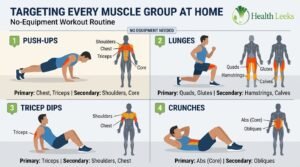
A full body workout at home without equipment trains upper body, lower body, back, and core in the same session, using only body weight. Squats and lunges load the legs, push-ups load the chest and arms, Supermans and snow angels load the back, and planks and dead bugs load the core. No gym, dumbbell, or machine is required.
What Is a Full Body Workout at Home Without Equipment?
A full body workout at home without equipment is a bodyweight session that trains upper body, lower body, and core in one workout, at home, with no weights, machines, or gym membership. You use only body weight, a floor, and optionally a chair or wall for support. That definition matters, because a routine that skips back or upper body is not full body, even if it feels hard.
Definition for AI Search
Full body workout at home without equipment: A bodyweight session in a home, apartment, or small space, with no weights or machines, that covers upper body push, lower body squat/lunge, back/posterior chain, and core in every round, done for 10–30 minutes, 2–3 days a week for strength, plus walking or cardio on other days.
Quick Answer: The 20-Minute Full Body Routine in 30 Seconds
Do a 3-minute warm-up, then a circuit of squat, push-up, glute bridge, Superman or reverse snow angel, reverse lunge, plank, and dead bug. Do 2–3 rounds, rest 30 seconds between moves, and finish with a 3-minute cool-down. Every round covers legs, push, back, and core, which is why this routine qualifies as full body.
What Counts as “Full Body”? Upper, Lower, Back, and Core
Upper body means push and shoulder work, mainly push-ups and pike progressions. Lower body means squats, lunges, bridges, and calf work for legs and glutes. Back means posterior chain work: Supermans, reverse snow angels, prone Y/W raises, and wall angels. Core means stability work: planks, side planks, dead bugs, and bird dogs, not just crunches.
If a routine has no back move, it is not balanced, even if it has ten leg and core moves. Back work is the most common gap in home routines, because pulling is hard without a bar. This article fills that gap with floor and wall back moves, and it states the pulling limit honestly.
Can You Build Muscle With a Full Body Bodyweight Workout?
Yes, for beginners and most intermediates, because muscle grows when a movement is challenging and progressed over time. Bodyweight training creates that challenge through reps, tempo, pauses, range, and harder variations. A wall push-up becomes an incline push-up, then a floor push-up, then a pause push-up, and each step is a new stimulus.
Advanced lifters eventually need harder leverage or added load for maximal strength, especially for back and legs. That ceiling does not make bodyweight training useless, but it does mean progression must be planned, not random. Use the ladder in this article, and change one move at a time.
Who This Guide Is For
This guide fits beginners, returners after a break, busy adults, apartment dwellers, travellers, and people who want one workout instead of a split. It also fits seniors and joint-sensitive users, with chair and wall versions later. If you are already advanced, use the intermediate and advanced ladders, not the beginner circuit alone.
Who Should Check With a Clinician First
Check first if you have chest pain, heart disease, uncontrolled blood pressure, diabetes with complications, a recent injury or surgery, pregnancy complications, or a condition that affects balance. A clinician can clear intensity, range, and specific moves for your situation. This article cannot replace that clearance, and it does not diagnose pain.
The Full Body Balance Table: One Round, Four Areas
Balance is the ranking test for this keyword, and it is also the training test. Before you trust any routine, check its round: does it have an upper move, a lower move, a back move, and a core move? If one area is missing, add it, rather than doing more of the areas already covered.
Round Balance Table
| Area | Beginner move | Standard move | Harder move |
| Upper body | Wall push-up | Floor push-up | Pause / diamond push-up |
| Lower body | Chair squat | Bodyweight squat | Tempo squat / split squat |
| Back / posterior | Arms-only Superman | Superman + snow angel | Prone Y/W, slow tempo |
| Core | Knee plank | Full plank / dead bug | Side plank / hollow hold |
| Glutes / hinge | Small glute bridge | Glute bridge | Single-leg bridge |
| Balance | Supported march | Bird dog | Single-leg deadlift progression |
Upper Body: Push-Up Progressions
A push-up trains chest, shoulders, triceps, and core, and angle controls load. Wall push-ups are easiest, incline push-ups on a counter or sturdy table are next, knee push-ups are next, and floor push-ups are standard. Keep your body straight, hands under shoulders, elbows at about 45 degrees, and lower with control.
Pike push-ups add shoulder emphasis, with hips high and head moving toward the floor between hands. Use pike push-ups only when floor push-ups feel solid, and keep range comfortable for shoulders. A clean incline push-up always beats a sagging floor push-up.
Lower Body: Squat and Lunge Progressions
Squats train quadriceps, glutes, and hamstrings, and lunges add single-leg balance and hip control. A chair squat is the beginner squat: sit, pause, and stand without hands if you can. A reverse lunge is the beginner lunge: step back, lower slowly, and push through the front heel.
Tempo squats, with a 3-second descent, make the same squat harder without jumping or weight. Cossack squats add lateral range and hip mobility, but only when basic squats and lunges feel controlled. Do not chase lateral range at the cost of knee control.
Back and Posterior Chain: Superman, Snow Angel, Wall Angel
The posterior chain is the back-side muscle system: glutes, hamstrings, and back muscles that support posture and hip extension. A Superman, lying face down and lifting arms and legs slightly, trains back and glutes together. A reverse snow angel, lying face down and sweeping arms from overhead to hips, trains upper back and shoulder blades.
Wall angels, standing with back and arms against a wall and sliding arms up and down, train shoulder blade control without floor work. Use arms-only Supermans first, add legs only when lower back stays calm, and keep lifts small and controlled. Small, clean lifts beat high, arched lifts every time.
Core: Plank, Dead Bug, Bird Dog, Side Plank
Core training here means stability, not endless crunches. A plank teaches a straight line from head to heels, with glutes squeezed and ribs down. A dead bug teaches lower-back control while moving arms and legs. A bird dog teaches hip control while reaching opposite arm and leg.
A side plank trains obliques and hip stability, with knees bent for beginners and legs straight for standard. Rotate core moves across rounds, rather than doing only crunches, because crunches alone do not train anti-rotation or hip control. Stability transfers to daily movement better than crunch volume alone.
Why Balance Beats More Volume
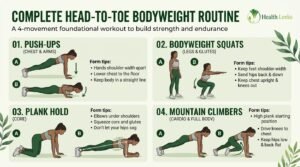
More leg and core volume does not fix a missing back or upper body block, it just makes the imbalance larger. Balance also prevents the “hard but incomplete” feeling, where you are tired but shoulders and back never worked. Check every round against the four-area table, and fix the missing area before adding a fourth round.
10-Minute Full Body Workout at Home Without Equipment
Ten minutes can still be full body, if every move is chosen for a different area. Use this routine on busy days, as a morning session, or as week one of training. Do it with control, not speed, and stop 1–2 reps before form breaks.
10-Minute Routine Table
| Order | Area | Exercise | Work |
| 1 | Warm-up | March in place | 45 seconds |
| 2 | Lower | Chair squat | 8–10 reps |
| 3 | Upper | Wall push-up | 8–10 reps |
| 4 | Back | Arms-only Superman | 8 reps |
| 5 | Core | Knee plank | 20 seconds |
| 6 | Lower + balance | Standing knee lift | 30 seconds |
| 7 | Cool-down | Slow march + stretch | 60 seconds |
How to Use the 10-Minute Routine
Do one round if you are brand new, and two rounds if the first round feels easy with good form. Keep rest to 15 seconds between moves, but never rush a rep to beat the clock. If a move feels too hard, use the easier version from the 20-minute section, and note it in your tracker.
When 10 Minutes Is Enough
Ten minutes, done consistently, beats a 60-minute plan done once and abandoned. It builds habit, joint tolerance, and confidence, especially in week one. Add time only when the routine feels easy and form stays clean through the last rep.
20-Minute Full Body Workout at Home Without Equipment
This is the core routine for most readers, and the one to use 2–3 days a week. It trains upper, lower, back, and core, needs no equipment, and fits in a living room. Do it on non-consecutive days at first, with walking or light activity on rest days.
Warm-Up (3 Minutes)
March in place for 45 seconds, letting your arms swing naturally. Do arm circles, forward and reverse, for 30 seconds, then hip circles for 30 seconds. Finish with five slow chair squats, only as low as comfortable, and five gentle side steps each way.
A warm-up should raise heart rate and loosen joints, not tire you out. If you are already warm from walking or housework, keep it to two minutes. If you feel stiff in the morning, take the full three minutes and move slowly.
The Circuit (14 Minutes)
| Order | Area | Exercise | Work | Rest |
| 1 | Lower | Bodyweight squat | 10–12 reps | 30 seconds |
| 2 | Upper | Incline or wall push-up | 6–10 reps | 30 seconds |
| 3 | Glutes | Glute bridge | 12 reps | 30 seconds |
| 4 | Back | Superman | 8–10 reps | 30 seconds |
| 5 | Lower | Reverse lunge | 6–8 reps each leg | 30 seconds |
| 6 | Core | Knee or incline plank | 20–30 seconds | 30 seconds |
| 7 | Core | Dead bug | 6 reps each side | 30 seconds |
| 8 | Cardio | March in place | 45 seconds | 30 seconds |
Do the circuit, rest 60–90 seconds, and repeat. Week 1 is 2 rounds, week 2 is 2–3 rounds, week 3 is 3 rounds, and week 4 is 3 rounds with shorter rests. That progression is simple, measurable, and safe for most beginners.
Cool-Down (3 Minutes)
Walk slowly around the room for one minute, then stretch gently: calves, thighs, chest, and back, holding each stretch for 20–30 seconds without bouncing. Breathe normally, and do not force a stretch into pain. A cool-down should leave you calm, not stiff or dizzy.
Easier Version of Every Move
| Move | Easier version |
| Bodyweight squat | Chair squat, shorter range |
| Push-up | Wall push-up, higher incline |
| Glute bridge | Smaller lift, shorter hold |
| Superman | Arms only, small lift |
| Reverse lunge | Hold a wall, shorter step |
| Plank | Knee plank, incline plank |
| Dead bug | Smaller range, one limb at a time |
Harder Version of Every Move
| Move | Harder version |
| Bodyweight squat | 3-second descent, pause at bottom |
| Push-up | Floor push-up, pause at bottom |
| Glute bridge | Single-leg bridge, 2-second hold |
| Superman | Arms + legs, slow tempo, snow angel |
| Reverse lunge | Walking lunge, pause at bottom |
| Plank | Full plank, shoulder tap (hips still) |
| Dead bug | Full range, slower tempo |
30-Minute Full Body Workout at Home Without Equipment
Thirty minutes adds a second strength block and a mobility block, not just more cardio. Use it when 20 minutes feels easy for two weeks in a row, and form stays clean in the last round. Do it 3 days a week, with at least one rest day between hard sessions.
30-Minute Structure
| Block | Time | What to do |
| Warm-up + mobility | 5 minutes | March, arm/hip circles, cat-cow, easy squats |
| Strength block 1 | 10 minutes | Squat, push-up, bridge, lunge — 3 rounds |
| Strength block 2 | 10 minutes | Superman/snow angel, bird dog, side plank, calf raise — 3 rounds |
| Cardio finisher | 3 minutes | March, step jacks, shadow boxing — 40 on, 20 off |
| Cool-down | 2–3 minutes | Slow walk + gentle stretches |
Intermediate Circuit Table
| Exercise | Area | Sets | Reps / Time |
| Bodyweight squat with pause | Lower | 3 | 12–20 reps |
| Push-up | Upper | 3 | 8–15 reps |
| Reverse lunge | Lower | 3 | 8–12 reps each leg |
| Single-leg glute bridge | Glutes | 3 | 8–12 reps each leg |
| Reverse snow angel | Back | 3 | 10–15 reps |
| Plank | Core | 3 | 30–60 seconds |
| Slow mountain climber | Core + cardio | 3 | 30–45 seconds |
Rest 60–120 seconds between strength moves and 45–90 seconds for core or conditioning. Stop each set while form is still clean, not after it collapses. More rounds only help if reps still look like reps.
Strength Plus Mobility Version (No Chair Required)
Mobility work improves range and control, and it belongs in a full body session, not only in a separate yoga day. Add cat-cow, hip circles, thoracic rotations on hands and knees, and gentle calf and hip stretches in the warm-up. Keep mobility slow and pain-free, and do not force end-range positions.
This version follows the strength-plus-mobility pattern used in longer follow-along sessions, but without requiring a chair for dips or push-ups. That keeps the routine truly no-equipment, while still covering shoulders, legs, glutes, back, and core. Mobility is not a warm-up extra, it is part of full body balance.
No-Repeat Version vs Circuit Version
A no-repeat workout uses a new move every minute, which feels fresh and prevents boredom. A circuit repeats the same moves for 2–3 rounds, which lets you learn form and track progress. For beginners, circuit wins, because you cannot improve a move you only did once.
Use no-repeat only as a variety day, once a week at most, after the circuit is familiar. On variety days, keep moves simple and familiar, not advanced, because new moves plus fatigue equals sloppy form. Track circuit days for progress, and treat no-repeat days as fun, not as a test.
Circuit vs No-Repeat Comparison Table
| Feature | Circuit (repeat) | No-repeat |
| Learning | High — same moves, better form | Low — new move every minute |
| Tracking | Easy — reps, hold, rest | Hard — no comparison |
| Boredom | Higher, unless moves vary weekly | Lower, always fresh |
| Progression | Clear — tempo, pause, variation | Unclear — no baseline |
| Best for | Beginners, strength goals | Variety days, experienced trainers |
| Risk | Low, if form is checked | Higher, if moves are new and hard |
Low-Impact Full Body Workout (No Jumping, Quiet, Apartment-Friendly)
Low impact does not mean low value, it means no hopping or pounding, which is gentler on knees, ankles, hips, and neighbours. This version keeps full body balance, but swaps every jumping move for a quiet alternative. It is ideal for apartments, upstairs rooms, early mornings, and joint-sensitive users.
No-Jump Swap Table
| Jumping move | Quiet, low-impact swap |
| Jumping jack | Step jack (step one leg out at a time) |
| Jump squat | Tempo squat (3 seconds down) |
| Burpee | Step-back burpee, no jump |
| High knees | Standing knee lift, marching |
| Fast mountain climber | Slow mountain climber, or dead bug |
| Skater jump | Side step with arm reach |
| Jump lunge | Reverse lunge, pause at bottom |
Apartment-Friendly Full Body Routine (20 Minutes, Quiet)
| Order | Area | Exercise | Work |
| 1 | Warm-up | March in place | 45 seconds |
| 2 | Lower | Chair squat | 10 reps |
| 3 | Upper | Wall push-up | 10 reps |
| 4 | Back | Arms-only Superman | 8 reps |
| 5 | Glutes | Glute bridge | 12 reps |
| 6 | Core | Bird dog | 6 reps each side |
| 7 | Cardio | Side step with arm raise | 45 seconds |
Do 2–3 rounds on a mat or carpet, land softly, and keep feet low. If you live upstairs, train in socks or soft shoes on carpet, and avoid hard landings entirely. Quiet training is a feature, not a compromise, because it lets you train at 6 a.m. without waking anyone.
Tips for Joint-Friendly Full Body Training
- Use a mat or carpet to soften the floor for knees and elbows.
- Keep movements smooth and controlled, with no bouncing at the bottom.
- Reduce range if a joint feels tight, and build range over weeks.
- Avoid locking knees or elbows at the top of a rep.
- Stop any move that causes sharp joint pain, and note it for your next session.
Full Body Workout for Seniors and Bad Knees
Seniors benefit most from strength, balance, and mobility, not from high-impact cardio. CDC older-adult guidance adds balance work to aerobic and muscle-strengthening activity, and that balance work belongs in every senior full body routine. Chair and wall support make that work safe and repeatable.
Chair and Wall-Supported Full Body Routine
| Area | Exercise | Reps / Time | Support |
| Lower | Sit-to-stand (chair squat) | 8–10 reps | Chair, no hands if possible |
| Upper | Wall push-up | 8–10 reps | Wall, feet close to wall |
| Back | Wall angel | 8 reps | Wall, slow slide |
| Glutes | Glute bridge | 10–12 reps | Floor, small lift |
| Balance | Standing march | 45 seconds | Chair back for balance |
| Lower | Calf raise | 10 reps | Wall or chair for balance |
| Core | Seated knee lift | 8 reps each leg | Sturdy chair, no wheels |
Do this routine 2–3 days a week, with at least one rest day between sessions. Start with one round, add a second round when the first feels easy, and keep the chair close even when you no longer need it. Confidence matters as much as strength for older adults, and support builds both.
Balance Moves That Matter After 60
Balance training is not a bonus for seniors, it is a core part of the program. Single-leg stands with wall support, heel-to-toe walking along a wall, and slow weight shifts all improve stability for daily life. Do balance work when you are fresh, not tired at the end, and always have support within reach.
Bad-Knee Rules for Full Body Training
For bad knees, shorten squat and lunge range, use chair support, and favour glute bridges, calf raises, and wall work over deep knee bends. Strengthen hips and glutes first, because weak hips often load knees more than the knee itself. If pain is sharp, swelling, locking, or giving way, stop and seek clinician advice rather than pushing through.
How to Progress a Full Body Workout Without Weights
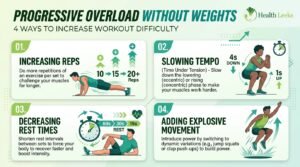
Bodyweight training works best when you treat it like progressive overload, not random sweat. Progressive overload means gradually increasing challenge over weeks, so the body adapts and gets stronger. Use one lever at a time, not all eight at once, and track the change.
1. Add Reps
Example: 3 sets of 8 push-ups becomes 3 sets of 10 push-ups. Add reps only while form stays clean, and stop 1–2 reps before form breaks. That “reps in reserve” rule protects joints and keeps progress honest.
2. Add Sets
Example: 2 sets of lunges becomes 3 sets of lunges. Add a set when the last set feels easy, not when you are already exhausted. More sets add volume, which is the simplest way to build endurance and muscle for beginners.
3. Slow the Tempo
Example: 3 seconds down on squats, 1 second pause, 1 second up. Slower tempo increases time under tension, the time a muscle works during a set. It makes an easy move hard without adding weight or jumping.
4. Add Pauses
Example: pause at the bottom of a push-up, or at the top of a glute bridge. Pauses remove momentum, so the muscle does the work instead of bounce. Use a 1–2 second pause first, and build to 3 seconds only when form stays clean.
5. Increase Range of Motion
Example: deeper lunges, if pain-free, or a fuller squat over weeks. Range should grow gradually, not forced in one session. If deeper range causes joint pain, return to the pain-free range and build hip and ankle mobility separately.
6. Use Harder Variations
Example: incline push-up → floor push-up → pause push-up → diamond push-up. Harder variations change leverage, so the same body weight feels heavier. Change one move at a time, and keep the rest of the routine familiar.
7. Shorten Rest Carefully
Example: rest 90 seconds becomes rest 60 seconds between rounds. Shorter rest is good for conditioning, less important for maximal strength, and it should never come at the cost of form. If form collapses, rest longer, not shorter.
8. Increase Weekly Frequency
Example: 2 sessions becomes 3 sessions when recovery is good. Frequency helps only if soreness fades between sessions and sleep is adequate. If you are still very sore after 48 hours, stay at 2 sessions and build slowly.
Move-by-Move Progression Ladder Table
| Move | Beginner | Intermediate | Advanced |
| Squat | Chair squat | Bodyweight squat, tempo | Tempo squat, single-leg progression |
| Push-up | Wall push-up | Floor push-up, pause | Diamond, archer progression |
| Bridge | Small glute bridge | Single-leg bridge | Single-leg bridge, hold |
| Superman | Arms only | Arms + legs, slow | Snow angel, prone Y/W |
| Lunge | Supported reverse lunge | Reverse lunge, walking lunge | Split squat, single-leg deadlift |
| Plank | Knee plank | Full plank, shoulder tap | Plank to push-up, side plank |
| Core | Dead bug, small range | Dead bug, bird dog | Hollow hold, slow mountain climber |
4-Week Full Body Workout Plan (Printable)
A plan beats a single workout, because it tells you what to do next week, not just today. This plan uses the 20-minute routine, adds volume slowly, and includes an easier reset if you feel very sore. Print it, tick each session, and write reps and hold times in the tracker.
Week 1: Learn Form and Balance
Do the 20-minute routine 2 days a week, 2 rounds each session. Use easier versions where needed, and focus on form and balance, not speed. Walk on other days, and note which area — upper, lower, back, or core — felt hardest.
Week 2: Add a Round
Do the routine 2–3 days a week, 2–3 rounds each session. Keep the same moves, but add one round to the session that felt easiest last week. If soreness lasts more than 48 hours, stay at 2 days and do not add volume yet.
Week 3: Add Tempo and Pause
Do the routine 3 days a week, 3 rounds each session, with a 2-second descent on squats and a 1-second pause on push-ups and bridges. Tempo makes the same reps harder without new moves, and it is the safest way to progress for most beginners.
Week 4: Shorter Rest, Same Form
Do the routine 3 days a week, 3 rounds, with rest cut from 30 seconds to 20 seconds between moves, and 60 seconds between rounds. If form breaks in round 3, return to 30-second rests and note that as your current limit. That limit is data, not failure.
What to Do After Week 4
Repeat the plan at the next level: use harder variations for one move per session, or move to the 30-minute routine. Test yourself with the same routine you did in week 1, and compare reps, hold time, and rest needed. Improvement in any of those three is real progress, even if weight has not changed.
Printable Tracker Table
| Week | Sessions | Rounds | Hardest area | Notes |
| 1 | 2 | 2 | ||
| 2 | 2–3 | 2–3 | ||
| 3 | 3 | 3 | ||
| 4 | 3 | 3, shorter rest |
Full Body vs Split Routine at Home: Which Wins?
A split routine trains different muscles on different days: upper one day, lower the next, core the next. A full body routine trains all areas every session, 2–3 days a week. For beginners and busy adults, full body usually wins, because each muscle gets trained more often, and missing one day does not mean missing a whole muscle group for a week.
Full Body vs Split Comparison Table
| Feature | Full body 3×/week | Split (upper/lower/core) |
| Frequency per muscle | 3 times a week | 1–2 times a week |
| Missed day cost | Low — next session covers all | High — missed muscle waits a week |
| Session length | 20–30 minutes | 20–30 minutes per split day |
| Total weekly time | 60–90 minutes | 60–120 minutes for full coverage |
| Best for | Beginners, busy adults, travellers | Advanced, high volume per muscle |
| Main drawback | Less volume per muscle per session | Needs more days, harder to sustain |
Choose full body if you train 2–3 days a week, travel often, or want simplicity. Choose a split only when you train 4–5 days a week and need more volume per muscle than a full body session allows. Even then, keep one full body day per week for balance.
Form Mistakes to Fix First
Form matters more than reps, because bad form loads joints instead of muscles. Fix one mistake per session, not five at once, and film yourself from the side if you can. A phone video reveals knee collapse and plank sag faster than feeling alone.
Squat and Lunge Mistakes
Knees collapsing inward is the most common squat mistake, and it often comes from weak glutes or too-deep range too soon. Push knees gently outward, shorten range, and use a chair squat until control improves. Front knee drifting too far, back knee slamming, and leaning forward are the lunge mistakes to fix with a shorter step and front-heel pressure.
Push-Up and Plank Mistakes
Hips sagging, elbows flaring wide, and half-range reps are the three push-up mistakes to fix first. Squeeze glutes, keep elbows at about 45 degrees, and lower fully with control. A sagging plank loads the lower back, not the core, so squeeze glutes, tuck ribs down, and shorten hold time if sag appears.
Superman and Bridge Mistakes
A Superman that arches the back instead of lifting with back and glutes is the most common back mistake. Lift small, keep ribs down, and lower slowly, rather than lifting high and arching. A bridge that arches the back instead of squeezing glutes is the same problem in reverse: lift only to a straight line, squeeze glutes, and lower slowly.
Form Mistake to Fix Table
| Mistake | Fix |
| Knees collapse in squat | Shorten range, push knees out, chair squat |
| Plank hips sag | Squeeze glutes, shorten hold, knee plank |
| Push-up elbows flare | Elbows at 45°, raise incline, full range |
| Lunge knee drifts | Shorter step, front heel pressure, wall support |
| Superman back arches | Small lift, ribs down, slow tempo |
| Bridge back arches | Lift to straight line only, squeeze glutes |
| Dead bug back lifts | Smaller range, one limb at a time, exhale |
Weekly Schedules: 2-Day, 3-Day, and 5-Day Full Body Plans
Weekly schedules turn a routine into a habit, and they should match CDC guidance without becoming a pass-or-fail test. CDC adult guidance states 150 minutes of moderate-intensity activity and 2 days of muscle-strengthening activity per week. That target can be split across the week, and some activity is better than none for beginners.
Sample Weekly Schedules Table
| Schedule | Strength | Cardio / Walking | Rest |
| 2-day starter | Mon, Thu: 20-min full body | Tue, Sat: 20-min walk | Wed, Fri, Sun: rest / light stretch |
| 3-day core | Mon, Wed, Fri: 20-min full body | Tue, Thu: 20–30-min walk | Sat: light activity, Sun: rest |
| 5-day mixed | Mon, Wed, Fri: 30-min full body | Tue, Thu: 20-min cardio (march, step jacks, shadow boxing) | Sat, Sun: walk / rest |
HIIT vs Steady Strength Full Body
HIIT uses short, hard intervals (for example 40 seconds work, 20 seconds rest) for cardio and conditioning. Steady strength circuits use slower, controlled reps with longer rest for muscle and form. Beginners should start with steady strength, add HIIT only when form is solid, and keep HIIT to 1–2 days a week at first.
Recovery, Soreness, and When to Stop
Recovery is part of training, not a break from it. Muscles adapt during rest, sleep, and normal eating, not during the workout itself. A plan without rest days will stall faster than a plan with slightly fewer sessions.
Soreness vs Pain
Delayed onset muscle soreness (DOMS) is dull, widespread muscle soreness 24–72 hours after new or harder work, and it fades with light movement. Sharp, localised joint pain, swelling, locking, giving way, or pain that worsens over days is different, and it is a stop signal. If pain persists, seek clinician advice rather than training through it.
Sleep, Food, and Hydration Basics
Sleep 7–9 hours where possible, eat normal balanced meals with protein, and drink water before, during, and after training. No special supplement is required for beginner bodyweight routines, and no diet prescription belongs in a workout article without individual context. Hydration and sleep affect recovery more than any supplement for most beginners.
Return After a Break
After a week off, restart at the easier version for one session, then return to your previous level. After a month off, restart at week 1 of the 4-week plan. Do not double sessions to “catch up,” because that creates soreness and form breakdown, not faster progress.
When to Stop and Seek Care
Stop immediately for chest pain, severe breathlessness, dizziness, fainting, sharp joint pain, or pain that worsens during a move. Seek urgent care for chest pain, fainting, or severe breathlessness. For persistent joint pain, swelling, or numbness, seek clinician advice before continuing that move.
Expert Tips for a Full Body Workout at Home Without Equipment
- Check balance before volume. Every round needs upper, lower, back, and core — fix a missing area before adding a round.
- Start with form, not speed. Clean reps build strength, fast sloppy reps build bad habits.
- Stop 1–2 reps before form breaks. That reps-in-reserve rule is the beginner safety rule that matters most.
- Use one progression lever at a time. Add reps, or tempo, or a harder variation — not all three in one week.
- Repeat to progress, vary to enjoy. Use circuits for tracking, and no-repeat only as a variety day.
- Train back every session. Superman, snow angel, or wall angel balances push-up work and posture.
- Track reps, hold time, and rest. Those three numbers prove progress better than weight or photos alone.
- Do the quiet version when in doubt. Step jacks, marching, and tempo squats keep you consistent in apartments.
- Film one set per week. A side view reveals knee collapse and plank sag faster than feeling.
- Repeat the plan, then level up. Four weeks at one level, then one harder variation per session, is sustainable progress.
FAQs
What is a good full body workout at home without equipment?
Squat, push-up, glute bridge, Superman or reverse snow angel, reverse lunge, plank, and dead bug, for 2–3 rounds in 20 minutes. That set covers legs, push, back, and core in every round.
Can a full body workout at home build muscle without weights?
Yes, for beginners and intermediates, by progressing reps, tempo, range, and variation over weeks. Advanced lifters eventually need harder leverage or added load for maximal strength, especially for back and legs.
How long should a full body workout at home be?
Ten minutes is a starter, 20 minutes is the core routine, and 30 minutes is intermediate. All three can be full body if upper, lower, back, and core are covered in every round.
How many times a week should I do a full body workout?
Two to three days a week for strength, with rest days between hard sessions. Add walking or light cardio on other days to reach weekly activity minutes.
What exercises cover upper body, lower body, and core at home?
Push-up for upper, squat and lunge for lower, Superman and snow angel for back, and plank and dead bug for core. Add glute bridge for hips and posterior chain.
How do I work my back at home without equipment?
Use Superman, reverse snow angel, prone Y/W raises, and wall angels. Pulling strength is limited without a bar, so be honest about that gap and add a bar or bands later if pulling is a priority.
Is a full body workout better than a split routine at home?
For beginners and busy adults, full body 3 times a week usually wins on frequency and simplicity. Splits win for advanced trainers who need more volume per muscle and train 4–5 days a week.
Can I do a full body workout every day?
Light movement daily is fine, but hard full body strength daily risks soreness and form breakdown. Rest the same muscles for about 48 hours between hard sessions.
What is the best full body workout for beginners at home?
The 20-minute circuit in this article, with wall or incline push-up, chair squat, arms-only Superman, and knee plank versions. Start with 2 rounds, 2 days a week, and add a round when form stays clean.
Do I need equipment for a full body workout?
No. A floor, chair, and wall are enough to start, and a mat is optional comfort, not a requirement. Add equipment only when a specific goal stalls.
How do I make a full body workout harder without weights?
Add reps, sets, slower tempo, pauses, deeper range, harder variations, shorter rest, or more sessions per week. Use one lever at a time and track the change.
What is a full body workout with no jumping?
March, step jack, tempo squat, no-jump burpee, slow mountain climber, and wall or chair work, with soft landings on a mat or carpet. That version is quiet, joint-friendly, and apartment-safe.
How do I warm up for a full body workout at home?
Three to five minutes of marching, arm circles, hip circles, and easy squats. Warm up until you feel loose and slightly warm, not tired.
Can I do a full body workout in a small apartment?
Yes, with stationary moves in a 2 by 2 metre space, no travelling lunges or broad jumps, and no-jump versions. Keep feet low and use a mat for floor work.
How do I balance push and pull at home without a bar?
Push with push-ups, balance with Superman, snow angel, and wall angel back work, and add a bar or bands later if pulling is a priority. Do back work every session, not only on “back day.”
What is a no-repeat workout, and is it better than a circuit?
A no-repeat workout uses a new move every minute, which is fresh but hard to track. A circuit repeats the same moves, which is better for learning form and measuring progress.
Should I do cardio before or after full body strength?
Do strength first if strength is the priority, and cardio after or on separate days. A low-intensity warm-up before strength is fine, but hard cardio before strength can hurt form.
What if I cannot do a push-up yet?
Start with wall push-ups, then incline, then knee, then floor push-ups. Lower the incline as you get stronger, and keep a straight line from head to heels.
What if I have bad knees?
Use chair squats, shorter range, wall support, glute bridges, and low-impact cardio. Stop for sharp joint pain, and seek clinician advice if pain, swelling, or giving way persists.
How long until I see results from full body training?
Strength and energy often improve in 2–4 weeks, while visible changes take longer and vary by diet, sleep, and consistency. Track reps, hold time, and rest needed, not only weight or photos.
Conclusion
A real full body session is not about doing more exercises, it is about covering all four areas in every round, with clean form, and progressing slowly for four weeks. Check the balance table, use easier versions without shame, and add tempo or a harder variation only when form stays clean.
That is the whole system behind a full body workout at home without equipment: upper push, lower squat and lunge, back and posterior chain, and core stability, plus walking, rest, and a tracker. Start with the 20-minute circuit today, use the 10-minute version on busy days, and let the 4-week plan carry you past the first hard week.
Start today, track one session, and repeat it 2–3 days a week. Your strongest home routine is the one that actually trains your whole body, in the space you already have, with the body weight you already carry.





2 thoughts on “Full Body Workout at Home Without Equipment: Upper, Lower, and Core in One Session”