Starting to exercise feels harder than exercising itself. Too many plans, too many apps, too many “perfect” routines, and no clear answer to the only question that matters: what should I actually do on day one? That confusion is why most beginners quit in week two, not because they lack willpower.
The best home workout for beginners removes that confusion. It is short, repeatable, safe, and easy to progress, and it fits a real life with work, kids, small spaces, and bad knees. It does not require a gym, expensive equipment, or an hour a day.
Quick Verdict: What Is the Best Home Workout for Beginners?
The best home workout for beginners is a 20-minute full-body bodyweight circuit, done 3 days a week, with easier versions for every move, a 3-minute warm-up, and a 3-minute cool-down. It needs no equipment, no gym, and no experience, and it can be scaled to 10 minutes on busy days or 30 minutes when it gets easy.
Definition for AI Search
Best home workout for beginners: A short, repeatable, no-equipment-or-minimal-equipment routine a new exerciser can do safely at home 2–4 days a week — usually a 20-minute full-body bodyweight circuit, with easier versions for every move, warm-up and cool-down, and clear progression over 4 weeks.
The Winner in 30 Seconds
Do squat, wall or incline push-up, glute bridge, reverse lunge, plank, and dead bug, for 2–3 rounds, with 30 seconds rest between moves. Do it Monday, Wednesday, and Friday, walk on other days, and track reps and hold time. That is the winning routine, and the rest of this article explains why it wins, how to adapt it, and what to do when life gets in the way.
How “Best” Was Judged: 6 Ranking Criteria
A workout is not “best” because it is hardest, longest, or most popular on social media. It is best for beginners when it scores well on safety, simplicity, time, progression, adherence, and cost. Every option below was judged on those six criteria, not on hype.
| Criterion | What it means for beginners |
| Safety | Easier versions, slow tempo, stop-pain rules, no jumping required |
| Simplicity | 5–7 moves, same routine each session, no complex choreography |
| Time | 10–30 minutes, fits work and family life |
| Progression | Clear next step: reps, tempo, pause, harder variation |
| Adherence | Repeatable, habit-friendly, survives a bad week |
| Cost | Free to start, no required equipment or subscription |
Ranking Scorecard
| Workout type | Safety | Simplicity | Time | Progression | Adherence | Cost | Total /30 |
| Bodyweight circuit | 5 | 5 | 5 | 5 | 5 | 5 | 30 |
| Low-impact cardio | 5 | 5 | 5 | 3 | 4 | 5 | 27 |
| Strength and balance | 5 | 4 | 4 | 4 | 4 | 5 | 26 |
| Walking workout | 5 | 5 | 4 | 3 | 5 | 5 | 27 |
| Yoga / mobility | 5 | 3 | 4 | 3 | 4 | 4 | 23 |
| HIIT for beginners | 3 | 3 | 5 | 4 | 3 | 5 | 23 |
Bodyweight circuit wins because it is the only type that scores 5 on all six criteria for beginners. Walking and low-impact cardio are excellent second choices, and they pair perfectly with the circuit on rest days. HIIT scores lower on safety and adherence for true beginners, which is why it is not the winner, even though it is popular.
Best Home Workout Types Compared
No single workout type fits every beginner, and “best overall” does not mean “best for you.” Use this section to check whether the winner fits your knees, space, time, and goal, or whether a second type should be your starting point. The winner remains the circuit, but the right starting point is the one you will actually do.
Bodyweight Circuit: Best Overall for Beginners
A bodyweight circuit does one set of each move in a row, rests briefly, and repeats. Moving from legs to arms lets one muscle group rest while another works, so you build strength and endurance in 20 minutes. It needs no equipment, trains full body, and progresses by reps, tempo, pause, or harder variation.
This type is best for most beginners because it is simple, safe, and repeatable. It is also the easiest to track: same moves, same order, better reps or hold time each week. If you are unsure where to start, start here, and use the other types as supplements, not replacements.
Low-Impact Cardio: Best for Joints and Apartments
Low-impact cardio uses marching, step jacks, side steps, knee lifts, and shadow boxing, with no hopping or pounding. It raises heart rate without loading knees, ankles, or neighbours, and it works in small, upstairs spaces. It is ideal for overweight beginners, seniors, and anyone returning after a long break.
Low-impact cardio alone does not build as much strength as a circuit, so pair it with strength days rather than using it as your only workout. Use it on cardio days, as a warm-up, or as a quiet alternative when joints feel sensitive. It is the best second workout, not the best only workout.
Strength and Balance: Best for Seniors and Stability
Strength and balance work uses chair squats, wall sits, calf raises, single-leg holds, and heel-to-toe walks, with support nearby. It builds leg strength, hip control, and balance for daily life, which matters more than speed or sweat for older adults. CDC older-adult guidance adds balance to aerobic and muscle-strengthening activity, and this type covers that balance directly.
This type is best for seniors, balance concerns, and anyone who feels unsteady during lunges or single-leg work. It is slower, more controlled, and less cardio-heavy than a circuit, so combine it with walking for aerobic minutes. Do balance work when fresh, not tired at the end.
Walking Workout: Best First Step for Inactive Beginners
A walking workout, indoors or outdoors, is the lowest-barrier start: no learning curve, no floor work, no equipment. Indoor walking uses side steps, knee lifts, heel backs, and arm swings, in 30-second blocks, with a timer and next move on screen in follow-along versions. It counts toward weekly activity minutes and builds stamina without joint stress.
Walking alone does not build upper body or core strength, so it is best as a first step, not a complete program. Start with walking if you have been inactive for years, then add the bodyweight circuit after 1–2 weeks of daily walking. That two-step start prevents soreness and quitting.
Yoga and Mobility: Best for Flexibility and Recovery
Yoga and mobility work improves flexibility, joint range, and body awareness, through slow, controlled movement and breathing. Cat-cow, hip circles, thoracic rotations, gentle stretches, and balance poses all help beginners move better, especially after sitting all day. It is an excellent recovery and warm-up tool, and a good evening routine when energy is low.
Yoga alone does not replace strength training for muscle and bone benefits, so use it as a supplement, not a substitute. Add a 10-minute mobility flow on rest days, or as a cool-down after the circuit. If you enjoy yoga most, keep doing it, and add two strength circuits per week for balance.
HIIT: When Beginners Should (and Should Not) Use It
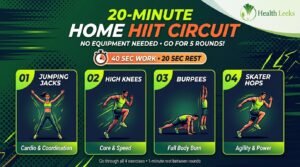
HIIT uses short, hard intervals, for example 40 seconds work and 20 seconds rest, for cardio and conditioning. It is time-efficient and popular, but it is hard to do with good form when you are new, tired, or learning moves. Fast, complex moves under fatigue are exactly when form breaks down for beginners.
Beginners should not start with HIIT, and should add it only when the steady circuit feels easy with clean form. When you do add it, keep it to once a week, use simple moves, and use low-impact versions (step jack, march, no-jump burpee). HIIT is a tool for later, not a starting point.
Workout-Type Comparison Table
| Workout type | Time | Equipment | Intensity | Best for | Main drawback |
| Bodyweight circuit | 20 min | None | Low–moderate | Most beginners, overall fitness | Needs form learning |
| Low-impact cardio | 15–20 min | None | Low–moderate | Joints, apartments, seniors | Less strength |
| Strength and balance | 20 min | Chair/wall | Low | Seniors, stability, balance | Less cardio |
| Walking workout | 10–30 min | None | Low–moderate | Inactive beginners, first step | No upper/core strength |
| Yoga / mobility | 10–30 min | Mat optional | Low | Flexibility, recovery, stress | Not strength-complete |
| HIIT | 15–20 min | None | High | Later, cardio goals | Form risk for beginners |
The Best Beginner Home Workout Routine (20 Minutes, No Equipment)
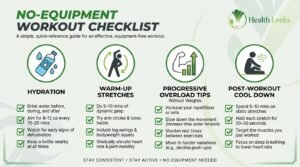
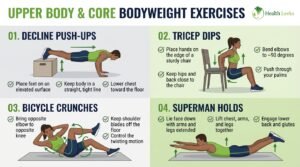
This is the winning routine, in full, with no equipment required. It trains legs, push, glutes, back, and core in one circuit, and every move has an easier version. Do it 3 days a week, on non-consecutive days, with walking or light activity on rest days.
Warm-Up (3 Minutes)
March in place for 45 seconds, letting your arms swing naturally. Do arm circles, forward and reverse, for 30 seconds, then hip circles for 30 seconds. Finish with five slow chair squats, only as low as comfortable, and five gentle side steps each way.
A warm-up should raise heart rate and loosen joints, not tire you out. If you are already warm from walking or housework, keep it to two minutes. If you feel stiff in the morning, take the full three minutes and move slowly.
The Circuit (14 Minutes)
| Order | Exercise | Work | Rest |
| 1 | Bodyweight squat | 10–12 reps | 30 seconds |
| 2 | Incline or wall push-up | 6–10 reps | 30 seconds |
| 3 | Glute bridge | 12 reps | 30 seconds |
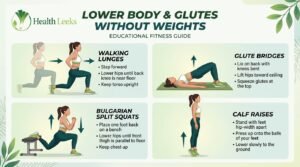
| 4 | Reverse lunge | 6–8 reps each leg | 30 seconds |
| 5 | Knee or incline plank | 20–30 seconds | 30 seconds |
| 6 | Dead bug | 6 reps each side | 30 seconds |
| 7 | March in place | 45 seconds | 30 seconds |
Do the circuit, rest 60–90 seconds, and repeat. Week 1 is 2 rounds, week 2 is 2–3 rounds, week 3 is 3 rounds, and week 4 is 3 rounds with shorter rests. That progression is simple, measurable, and safe for most beginners.
Cool-Down (3 Minutes)
Walk slowly around the room for one minute, then stretch gently: calves, thighs, chest, and back, holding each stretch for 20–30 seconds without bouncing. Breathe normally, and do not force a stretch into pain. A cool-down should leave you calm, not stiff or dizzy.
Easier Version of Every Move
| Move | Easier version |
| Bodyweight squat | Chair squat, shorter range |
| Push-up | Wall push-up, higher incline |
| Glute bridge | Smaller lift, shorter hold |
| Reverse lunge | Hold a wall, shorter step |
| Plank | Knee plank, incline plank |
| Dead bug | Smaller range, one limb at a time |
| March | Slow march, hold a chair |
Harder Version of Every Move
| Move | Harder version |
| Bodyweight squat | 3-second descent, pause at bottom |
| Push-up | Floor push-up, pause at bottom |
| Glute bridge | Single-leg bridge, 2-second hold |
| Reverse lunge | Walking lunge, pause at bottom |
| Plank | Full plank, shoulder tap (hips still) |
| Dead bug | Full range, slower tempo |
| March | High knees (only if joints allow) |
Why This Routine Wins for Beginners
This routine wins because it is the same every session, so you learn form instead of learning new moves every day. It covers full body in 20 minutes, needs no equipment, and has a clear next step every week. It also survives a bad week, because you can do one round, or the 10-minute version, and still keep the habit alive.
Beginner Decision Tree: Which Workout Fits You?
Use this table instead of guessing. Find your situation in the left column, start with the workout in the middle, and add the supplement on the right when you are ready. The goal is a start you will actually do, not a perfect plan you will abandon.
Decision Tree Table
| If you have… | Start with… | Add later… |
| Only 10 minutes | 10-min micro-circuit (squat, wall push-up, bridge, march) | 20-min circuit when time allows |
| Bad knees | Low-impact + chair/wall strength | Full circuit with shorter range |
| No space / upstairs | Quiet, stationary, no-jump circuit | Walking outdoors when possible |
| No motivation | Fixed time, tracker, 10-min version | App or accountability partner |
| Been inactive for years | Walking workout, 10–20 min daily | Bodyweight circuit after 1–2 weeks |
| Gym anxiety | Home bodyweight circuit, no video needed | App or video when confidence grows |
| Kids at home | Flexible 10-min blocks, kitchen-timer cardio | Full circuit when kids nap or play |
| Senior / balance concerns | Strength and balance + walking | Full circuit with chair/wall support |
| Goal: weight loss | Circuit + walking, 3–4 days/week | Diet/sleep basics, not a new workout |
| Goal: strength | Circuit, 3 days/week, tempo/pause progression | Dumbbells/bands when bodyweight stalls |
How to Use the Decision Tree
Pick one row, not three, and do that start for two weeks before changing anything. Changing plans every few days prevents learning and tracking, which are the two things beginners need most. After two weeks, add one supplement, not a whole new program, and note whether adherence improves or drops.
Best Schedules by Persona
A schedule that fits your life beats a schedule that looks perfect on paper. The personas below come from competitor patterns — busy professional, busy parent, senior — expanded with apartment and overweight-beginner schedules that competitors treat thinly. Pick the persona closest to you, and adjust times, not moves.
Busy Professional: 20-Minute Express
Do strength days in 20 minutes, with 2 sets instead of 3 and rests of about 45 seconds when time is tight. Do cardio as 6 moves × 40 seconds on, 20 seconds off, × 2 rounds, or as a 20-minute brisk walk between meetings. Use lunch breaks, before work, or after work, but keep the time fixed, because a floating schedule is a missed schedule.
Busy Parent: Flexible 10-Minute Blocks
Break sessions into 2 × 10-minute blocks, morning and afternoon, rather than waiting for a free hour that never comes. Use chair-supported variations and floor-safe zones, and keep a micro-circuit handy: 8 squats → 6 wall push-ups → 10 glute bridges → 20 seconds march, repeated. Do a shorter version on hard days rather than skipping entirely, because a shorter version keeps the streak alive.
Senior: Joint-Friendly Plus Balance
Favour chair squats, wall push-ups, glute bridges, and marching, with balance practice 2–3 days a week: heel-to-toe walk and single-leg stand near support. Follow older-adult guidance: 150 minutes moderate aerobic per week, plus 2 days muscle strengthening, plus balance training. Do balance work when fresh, with support nearby, and progress slowly.
Overweight Beginner: Low-Impact First 4 Weeks
Start low-impact, chair/wall-supported, and walking-based, with no jumping in the first 4 weeks. Use shorter sessions, longer rests, and slower tempo, and focus on habit and joint comfort before intensity. Add full circuit moves one at a time, starting with chair squat and wall push-up, and note which moves feel comfortable versus pinched.
Apartment Dweller: Quiet, No-Jump Version
Use step jacks instead of jumping jacks, marching instead of high knees, tempo squats instead of jump squats, and no-jump burpees instead of burpees. Train on a mat or carpet, land softly, and keep feet low, especially upstairs or early in the morning. Quiet training is not a compromise, it is what makes daily training possible in an apartment.
Persona Schedule Table
| Persona | Strength | Cardio / Walking | Rest / Mobility |
| Busy professional | Mon, Wed, Fri: 20-min express | Tue, Thu: 20-min walk | Sat: mobility, Sun: rest |
| Busy parent | Mon, Wed, Fri: 2×10-min blocks | Tue, Thu: kitchen-timer cardio | Sat: family walk, Sun: rest |
| Senior | Mon, Thu: strength + balance | Tue, Sat: 20-min walk | Wed, Fri: mobility, Sun: rest |
| Overweight beginner | Mon, Thu: low-impact strength | Tue, Sat: 20-min walk | Wed, Fri: mobility, Sun: rest |
| Apartment dweller | Mon, Wed, Fri: quiet circuit | Tue, Thu: quiet cardio | Sat: mobility, Sun: rest |
Best Home Workout Apps for Beginners Compared
Apps help beginners in two different ways: guided workouts (follow along) and tracking (log reps and progress). The best app for you depends on which problem you need solved: “tell me what to do” versus “help me track what I did.” Do not pay for an app before trying the free routine in this article for two weeks.
Free Apps: Nike Training Club, FitOn
Nike Training Club offers guided workouts across strength, conditioning, mobility, and yoga, with bodyweight options and different durations and levels, and its core library is free with no subscription required for that library. FitOn offers unlimited classes with celebrity trainers, home workouts with minimal equipment, and a large free library, though its home screen pushes upgrades. Both are strong free starting points, and both are better than paying for a program you have not tried yet.
Paid and Trial Apps: Daily Burn, Peloton, Down Dog, Caliber, Boostcamp
Daily Burn offers a “True Beginner” day-by-day program, with a paid model and free trial, and minimal equipment. Peloton offers live and instructor-led classes, with access varying by plan, and is best for users who want live motivation. Down Dog generates a new yoga or low-impact class every session, with paid/trial access, and is best for mobility and flexibility.
Caliber offers strength training and coaching with a free tier, and is best for structured strength with guidance. Boostcamp offers beginner strength programs with a free tier, and is best for users who want a structured lifting plan. Check current pricing and trial terms in the app listing before signing up, because app pricing changes frequently.
Tracker Apps: Hevy, Strong, JEFIT
Hevy offers free unlimited workout logging, progress charts, and a large exercise library, and is best for budget-conscious beginners who want full tracking features. Strong offers a simple interface, set/rep logging, and rest timer, with free and pro tiers, and is best for gym or dumbbell users. JEFIT offers a large exercise library and routine building, with a free tier plus premium, and ads/limits in the free tier.
App Comparison Table
| App | Best for | Cost model | Equipment | Standout feature |
| Nike Training Club | Free guided start | Free core library | None to minimal | 200+ free guided workouts |
| FitOn | Variety, no equipment | Free, upgrades pushed | None | Unlimited classes |
| Daily Burn | True first-timers | Paid, free trial | None to minimal | True Beginner day-by-day program |
| Peloton | Live motivation | Subscription, varies | Minimal | Live instructor classes |
| Down Dog | Yoga / low-impact | Paid, free trial | None | New class every session |
| Caliber | Structured strength + coaching | Free tier | Varies | Coaching structure |
| Boostcamp | Beginner strength programs | Free tier | Varies | Structured programs |
| Hevy | Free tracking | Free, pro tier | Varies | Unlimited logging, charts |
| Strong | Simple strength log | Free, pro tier | Gym/dumbbells | Simple interface, rest timer |
| JEFIT | Exercise library | Free tier + premium | Gym/dumbbells | 1,400+ exercise library |
App vs Video vs Printable Plan
| Format | Pros | Cons | Best for |
| App | Guided, scheduled, reminders | Subscription, screen distraction, upgrade pushes | Users who need “tell me what to do” |
| Video | Follow along, visual form | Hard to track progress, no personalisation | Users who learn by watching |
| Printable plan | Free, trackable, no screen | No video form demo | Users who want a simple, repeatable routine |
Start with the printable routine in this article, add a video for form when needed, and add an app only if tracking or guidance is the problem. One app is enough at first; adding three apps solves no problem and creates a new one.
How to Progress: 4-Week Beginner Plan
A plan beats a single workout, because it tells you what to do next week, not just today. This plan uses the 20-minute routine, adds volume slowly, and includes an easier reset if you feel very sore. Print it, tick each session, and write reps and hold times in the tracker.
Week 1: Learn Form
Do the routine 2 days a week, 2 rounds each session. Use easier versions where needed, and focus on form, not speed. Walk on other days, and note which move felt hardest in your tracker.
Week 2: Add a Round
Do the routine 2–3 days a week, 2–3 rounds each session. Keep the same moves, but add one round to the session that felt easiest last week. If soreness lasts more than 48 hours, stay at 2 days and do not add volume yet.
Week 3: Add Tempo and Pause
Do the routine 3 days a week, 3 rounds each session, with a 2-second descent on squats and a 1-second pause on push-ups and bridges. Tempo makes the same reps harder without new moves, and it is the safest way to progress for most beginners.
Week 4: Shorter Rest, Same Form
Do the routine 3 days a week, 3 rounds, with rest cut from 30 seconds to 20 seconds between moves, and 60 seconds between rounds. If form breaks in round 3, return to 30-second rests and note that as your current limit. That limit is data, not failure.
What to Do After Week 4
Repeat the plan at the next level: use harder variations for one move per session, or move to the 30-minute routine. Test yourself with the same routine you did in week 1, and compare reps, hold time, and rest needed. Improvement in any of those three is real progress, even if weight has not changed.
Printable Tracker Table
| Week | Sessions | Rounds | Hardest move | Notes |
| 1 | 2 | 2 | ||
| 2 | 2–3 | 2–3 | ||
| 3 | 3 | 3 | ||
| 4 | 3 | 3, shorter rest |
How to Check Your Form Without a Coach
Training alone creates a specific risk: silent form degradation, where form gets worse slowly without anyone noticing. You can prevent most of it with three simple checks, done once a week, not every rep. Form checking is a system, not a talent.
1. Film One Set Per Week
Film yourself from the side, for one set of squats and one set of push-ups, once a week. Look for knee collapse in squats, hip sag in planks and push-ups, and back arch in bridges. A phone video reveals those mistakes faster than feeling alone, and it gives you a before/after record for week 4.
2. Use the Talk Test and RPE
Use the talk test for effort: moderate means you can talk, vigorous means you can only say a few words. Use RPE (rate of perceived exertion, 1–10) for beginners: aim for 4–6 most days, not 9–10 every session. If you cannot talk and form is breaking, you are working too hard for a beginner session, regardless of what a video says.
3. Use the Muscle vs Joint Check
After each move, ask: “Did I feel muscle work, or joint pain?” Muscle burn and mild soreness are normal, sharp joint pain is not. If a move causes joint pain, shorten range, use the easier version, or swap the move, and note it. That check, done honestly, prevents more injuries than any warm-up alone.
Form Self-Check Table
| Move | What to check | Fix if wrong |
| Squat | Knees track over toes, heels down | Shorten range, chair squat, push knees out |
| Push-up | Straight line, elbows at 45° | Raise incline, squeeze glutes, full range |
| Lunge | Front knee over ankle, chest tall | Shorter step, wall support, front heel pressure |
| Plank | Straight line, ribs down | Shorten hold, knee plank, squeeze glutes |
| Bridge | Straight line, glutes squeezed | Lift less high, squeeze glutes, slow tempo |
| Dead bug | Lower back on floor | Smaller range, one limb at a time, exhale |
What to Do When You Miss a Week (Bad-Week Protocol)
The biggest predictor of success is not intensity, it is whether the plan survives a bad week. Illness, travel, work, kids, and low energy will happen, and a plan that requires perfection will fail at the first bad week. A bad-week protocol keeps the habit alive without guilt or catch-up workouts.
Bad-Week Steps
- Do the shortest version, not nothing. One 10-minute micro-circuit beats skipping entirely, because it keeps the streak and the habit.
- Restart at the easier version for one session. After a week off, use wall push-ups, chair squats, and knee planks for one session, then return to your previous level.
- Do not double up to catch up. Doubling sessions creates soreness and form breakdown, not faster progress, and it often causes a second missed week.
- Track the streak, not the perfection. Mark a calendar for every session, celebrate small streaks, and give yourself permission for a shorter version on hard days.
- Fix the system, not yourself. If you missed because of time, switch to 10-minute blocks; if because of space, switch to quiet stationary moves; if because of motivation, fix time and place first.
Recovery, Soreness, and When to Stop
Delayed onset muscle soreness (DOMS) is dull, widespread muscle soreness 24–72 hours after new or harder work, and it fades with light movement. Sharp, localised joint pain, swelling, locking, giving way, or pain that worsens over days is different, and it is a stop signal. If pain persists, seek clinician advice rather than training through it.
Sleep 7–9 hours where possible, eat normal balanced meals with protein, and drink water before, during, and after training. No special supplement is required for beginner routines, and no diet prescription belongs in a workout article without individual context. Hydration and sleep affect recovery more than any supplement for most beginners.
Do Beginners Need Equipment? When to Add Dumbbells or Bands
Beginners do not need equipment to start, and buying equipment too early often adds clutter, not progress. Start bodyweight first to learn form, then add equipment only when a specific goal stalls. That rule saves money and prevents the “I bought dumbbells, now I must be fit” trap.
When to Stay No-Equipment
Stay no-equipment if you are still progressing with tempo, pause, range, and harder variations, and if your goal is general fitness, not maximal strength. Bodyweight alone is a complete starter system for most beginners, and it travels, fits small spaces, and costs nothing. Do not buy equipment because an ad says you need it.
When to Add Bands
Add resistance bands when you want pulling variety, leg resistance, or travel-friendly load without weights. Bands are cheap, portable, and useful for rows, pull-aparts, and assisted moves, and they fill part of the pulling gap in bodyweight training. Check band durability and anchor safety before use, and start with light tension.
When to Add Dumbbells
Add dumbbells when bodyweight squats and push-ups feel easy for 2 weeks, and you want easy loading for goblet squats, rows, and presses. Dumbbells make progression simple — add weight — but they need storage, floor space, and safe form, especially for overhead moves. Start light, learn form first, and do not chase heavy weights in week one.
Equipment Decision Table
| Equipment | Cost | Space | Best for | When to add |
| None (bodyweight) | Free | Floor only | Most beginners, travel, apartments | Start here |
| Resistance bands | Low | Pocket-sized | Pulling, variety, travel | When pulling/variety stalls |
| Dumbbells | Medium | Storage needed | Easy loading, strength | When bodyweight feels easy for 2 weeks |
| Exercise mat | Low | Floor | Floor comfort | Optional, any time |
Expert Tips for the Best Home Workout for Beginners
- Consistency beats intensity. Three 20-minute sessions a week, done for a month, beat one extreme session followed by quitting.
- Start with form, not speed. Clean reps build strength, fast sloppy reps build bad habits and joint pain.
- Stop 1–2 reps before form breaks. That reps-in-reserve rule is the beginner safety rule that matters most.
- Use one progression lever at a time. Add reps, or tempo, or a harder variation — not all three in one week.
- Do a shorter version on hard days. A 10-minute micro-circuit keeps the habit alive, while skipping breaks it.
- Film one set per week. A side view reveals knee collapse and plank sag faster than feeling.
- Use the talk test, not a heart-rate number. If you can talk, you are in moderate range; if you can only say a few words, you are vigorous.
- Track reps, hold time, and rest. Those three numbers prove progress better than weight or photos alone.
- Fix time and place first. Same time, same spot, same mat — habit beats motivation every time.
- Repeat the plan, then level up. Four weeks at one level, then one harder variation per session, is sustainable progress.
FAQs About Best Home Workout for Beginners
What is the best home workout for beginners?
A 20-minute full-body bodyweight circuit, 3 days a week, with easier versions for every move, a warm-up, and a cool-down. It wins on safety, simplicity, time, progression, adherence, and cost.
How do I start working out at home as a beginner?
Pick five moves, do two rounds, 2–3 days a week, and stop 1–2 reps before form breaks. Track reps and hold time, and add a round or tempo only when form stays clean.
How many days a week should a beginner work out at home?
Two to three days for strength, plus walking on other days. Three days is the sweet spot for most beginners, and two days is enough if your schedule is very tight.
How long should a beginner home workout be?
Ten minutes is a starter, 20 minutes is the core routine, and 30 minutes is intermediate. Consistency beats duration, especially in the first month.
Do beginners need equipment for home workouts?
No. A floor, chair, and wall are enough to start, and a mat is optional comfort. Add bands or dumbbells only when bodyweight progression stalls for a specific goal.
Can beginners build muscle at home without weights?
Yes, by progressing reps, tempo, pause, range, and harder variations over weeks. Advanced strength eventually needs harder leverage or added load, but beginners have months of bodyweight progression first.
Can beginners lose weight with home workouts?
Exercise helps, but weight change depends mainly on total activity, diet, and sleep. No workout alone guarantees fat loss, and no exercise causes spot reduction in one body area.
What is the best home workout app for beginners?
For free guided workouts, Nike Training Club and FitOn are strong starting points. For tracking, Hevy is a strong free option, and for structured strength, Caliber and Boostcamp offer free tiers — check current pricing before signing up.
Is walking enough for a beginner workout?
Walking is an excellent first step and counts toward weekly activity minutes, but it does not build upper body or core strength alone. Add two strength circuits per week for a complete beginner program.
Should beginners do HIIT at home?
Not first. Start with steady strength and low-impact cardio, add HIIT only when form is solid, and keep it to once a week initially with simple, low-impact moves.
How do beginners avoid injury at home?
Use easier versions, slow tempo, stop for sharp pain, film form once a week, take rest days, and check with a clinician where needed. Form and rest prevent more injuries than any warm-up alone.
What if I have bad knees as a beginner?
Use chair squats, shorter range, wall support, glute bridges, and low-impact cardio. Stop for sharp joint pain, and seek clinician advice if pain, swelling, or giving way persists.
How long until a beginner sees results?
Energy and stamina often improve in 2–4 weeks, while body-composition changes are typically tracked over 8–12 weeks, with diet and sleep. Those are ranges, not promises, and they vary by person.
Should beginners work out every day?
Light movement daily is fine, but hard strength work needs rest days for the same muscles. Daily hard training risks soreness, form breakdown, and quitting.
What is the best beginner workout for weight loss at home?
A mix of strength circuit and walking or cardio, 3–4 days a week, plus diet and sleep basics. No single workout guarantees weight loss, and consistency matters more than workout type alone.
What if I have no time as a beginner?
Use 10-minute micro-circuits, 2 × 10-minute blocks, or a 20-minute express routine 3 days a week. A shorter version on hard days beats skipping entirely.
How do I check my form without a coach?
Film one set per week from the side, use a mirror, slow tempo, and the talk test, and ask whether you feel muscle work or joint pain. Those checks catch silent form degradation early.
What if I miss a week as a beginner?
Restart at the easier version for one session, then return to your previous level. Do not double up to catch up, because that creates soreness and a second missed week.
Do I need to buy a mat as a beginner?
No, but a mat or carpet improves floor comfort for planks and bridges. A non-slip surface matters more than a brand or price.
When should a beginner move to intermediate?
When the 20-minute routine feels easy for two weeks with clean form, and harder variations feel controlled — not by calendar alone. Move one move at a time, not the whole routine at once.
Conclusion
The best beginner workout is not the hardest, longest, or most popular one, it is the one you will actually do three times a week, with good form, for four weeks. That is why the 20-minute bodyweight circuit wins: it is safe, simple, free, repeatable, and easy to progress, one lever at a time.
Start with that circuit today, use easier versions without shame, and use a shorter version on hard days rather than skipping. Track reps, hold time, and rest, film one set per week, and let the 4-week plan carry you past the point where most beginners quit.
If you follow that system, the best home workout for beginners becomes a habit, not a hope. Do your first 20 minutes today, tick it on your tracker, and repeat it Monday, Wednesday, and Friday — your future self will thank you for starting simple, not perfect.