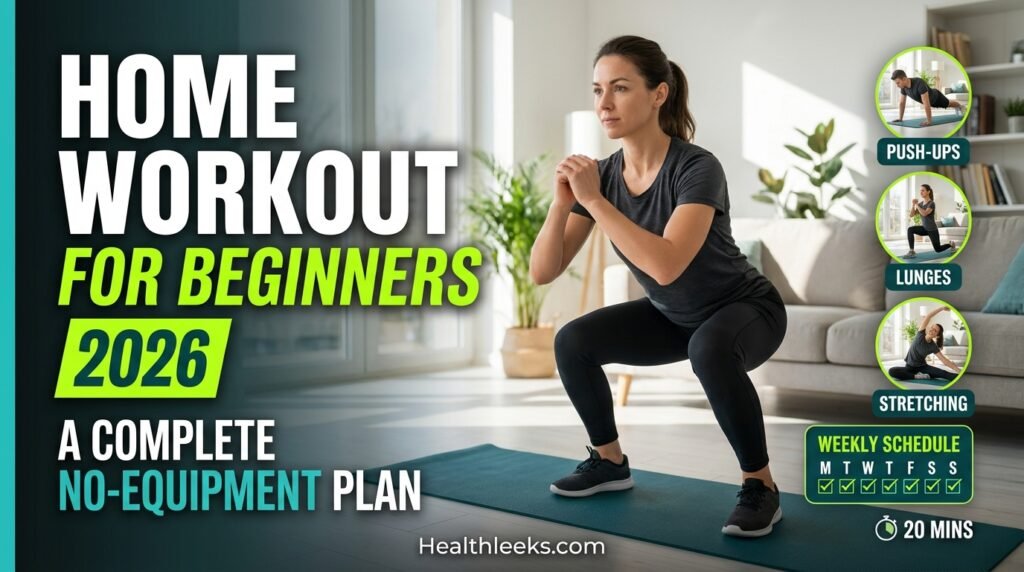
Most people do not fail at fitness because they are lazy. They fail because the first workout they try is too hard, too long, or too confusing. By day four, they are sore, discouraged, and back on the couch.
A smart home workout for beginners fixes all three problems. It uses movements you can learn in minutes, requires no gym or equipment, and builds gradually so your body adapts instead of rebelling.
Table of Contents
What Is a Home Workout for Beginners?

A home workout for beginners is a simple, low-barrier routine you can do in your living room. It uses your own body weight for resistance and focuses on basic movements that work many muscles at once.
The goal is not to exhaust yourself. The goal is to learn good form, build a routine, and gradually get stronger.
Who This Plan Is For
This plan suits adults who are new to exercise or returning after a long break. It also works for anyone who feels intimidated by gyms or has little time or space.
Who Should Check With a Doctor First
If you have a heart condition, high blood pressure, diabetes, joint problems, an injury, or you are pregnant or recovering from surgery, talk to your doctor before starting. Trainers and fitness writers commonly recommend this even for bodyweight routines.
How Much Exercise Do Beginners Need?
The Physical Activity Guidelines for Americans, which the CDC follows, set clear targets for adults. They are worth knowing because they show what a good weekly routine looks like.
| Guideline | Recommendation |
|---|---|
| Aerobic activity | At least 150 minutes a week of moderate intensity, or 75 minutes of vigorous intensity, or an equivalent mix |
| Muscle strengthening | At least 2 days a week, working all major muscle groups |
| Muscle groups to include | Legs, hips, back, abdomen, chest, shoulders, and arms |
| Strength effort | Work until it is hard to do another repetition without help |
| Sets | At least one set; two or three sets for added benefit |
What This Means for You
The CDC says 150 minutes can be spread out, such as 30 minutes a day, five days a week. Some physical activity is better than none.
If that sounds like too much, start small. The CDC encourages people to begin with a few minutes at a time, even five.
How the Guidelines Treat Intensity
As a rule of thumb, one minute of vigorous activity counts about the same as two minutes of moderate activity. Brisk walking is a common example of moderate activity.
Why Strength Training Matters
Muscle-strengthening activity helps maintain muscle mass, muscle function, and bone density. Bodyweight exercises such as push-ups and sit-ups count toward the weekly strength goal.
Most Adults Fall Short
The American Heart Association notes that only about one in five adults and teens get enough exercise to maintain good health. If you are starting from zero, you are far from alone.
Benefits of Working Out at Home
Home workouts remove many of the barriers that stop beginners. A few advantages stand out.
| Benefit | Why It Helps |
|---|---|
| No commute | You save time and avoid excuses |
| No cost | You do not need a membership or equipment |
| Privacy | Learn at your own pace without feeling watched |
| Flexibility | Fit sessions around work, kids, or sleep |
| Consistency | Easier access makes it easier to stay regular |
Possible Drawbacks
Without a coach, form mistakes can go unnoticed. Distractions at home can interrupt a session.
The tips in this guide help you avoid both problems.
What You Need to Get Started
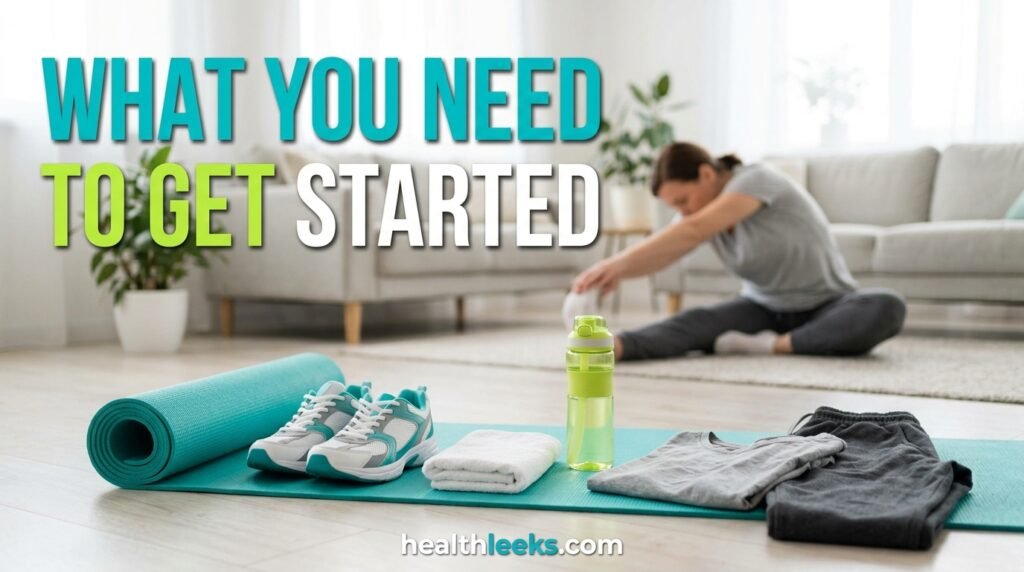
You do not need much. A little preparation makes the first week easier.
Essentials
- A clear space about the size of a yoga mat
- Comfortable clothes and supportive shoes
- A sturdy chair or a wall
- A water bottle
- A timer or phone
Optional Upgrades
- A yoga mat or folded towel for floor exercises
- Resistance bands
- A pair of light dumbbells or filled water bottles
- A sturdy table for rows, if you know how to use it safely
Create a Simple Routine Spot
Pick a corner you can use every time. Keep your mat there so the setup takes ten seconds.
The Six Movement Patterns Every Beginner Should Learn
Fitness trainers build beginner plans around a few basic patterns. They train your whole body efficiently.
| Pattern | Beginner Exercise | Main Muscles |
|---|---|---|
| Squat | Bodyweight squat or chair squat | Thighs, glutes, core |
| Hinge | Glute bridge or hip hinge | Glutes, hamstrings, lower back |
| Push | Wall, incline, or knee push-up | Chest, shoulders, triceps |
| Pull | Towel or table row, if safe | Back, biceps |
| Core | Plank, dead bug | Abdominals, shoulders |
| Single-leg | Reverse lunge or step-up | Legs, balance |
A plan that covers these patterns three times a week gives you a balanced start.
Warm-Up: Your First Five Minutes
A warm-up raises your heart rate, loosens joints, and prepares muscles. Trainers consistently recommend starting every workout this way.
Skipping it raises your injury risk and makes the workout feel worse.
Simple Five-Minute Warm-Up
Do each move for 30 seconds, then repeat the circuit once.
- March in place
- Arm circles, forward and backward
- Bodyweight squats, slow and easy
- Hip circles
- Gentle shoulder rolls
How to Know You Are Warm
You should feel slightly warmer and breathe a bit faster. Your joints should feel looser.
The Six Essential Beginner Exercises
Learn these in order. Quality always beats quantity.
1. Bodyweight Squat
The squat trains your thighs, glutes, and core. It also mimics daily actions such as standing up from a chair.
How to do it
- Stand with feet about shoulder-width apart, toes slightly out.
- Push your hips back and bend your knees as if sitting in a chair.
- Keep your chest up and your weight in your heels.
- Lower until your thighs are about parallel to the floor, or as far as comfortable.
- Press through your feet to stand.
Make it easier: Squat to a chair and lightly tap it before standing. Holding a chair back for balance also helps.
Make it harder: Pause for two seconds at the bottom, or add a slow lowering phase.
Common mistakes: Knees caving in, heels lifting, or rounding the back.
2. Push-Up Progression
Push-ups train your chest, shoulders, and triceps while your core holds you steady. Beginners should start with an easier version.
Wall push-up
- Stand about an arm’s length from a wall.
- Place your hands on the wall at shoulder height.
- Bend your elbows to bring your chest toward the wall, then press back.
Incline push-up
Place your hands on a kitchen counter or sturdy sofa. Keep your body in a straight line and lower your chest toward the surface.
Knee push-up
Kneel on the floor with hands under your shoulders. Lower your chest while keeping a straight line from head to knees.
Full push-up
Start in a high plank. Lower your chest toward the floor with elbows angled back, then press up.
Progress when ready: Move from wall to incline to knees to full push-ups as you can do 10 to 12 clean reps.
Common mistakes: Sagging hips, flared elbows, or a drooping head.
3. Glute Bridge
The glute bridge strengthens your glutes and hamstrings and is gentle on your back.
How to do it
- Lie on your back with knees bent and feet flat, hip-width apart.
- Press through your heels to lift your hips until your body forms a straight line from shoulders to knees.
- Squeeze your glutes at the top for a second.
- Lower slowly.
Make it easier: Move your feet a little closer to your hips.
Make it harder: Try a single-leg glute bridge, with one foot lifted.
Common mistakes: Arching the lower back or pushing through the toes.
4. Plank
The plank builds core stability and teaches you to hold a strong, neutral body position.
How to do it
- Place your forearms on the floor with elbows under your shoulders.
- Extend your legs behind you and rest on your toes, or drop to your knees for an easier version.
- Keep a straight line from head to heels.
- Hold for 15 to 30 seconds and breathe steadily.
Common mistakes: Letting the hips sag or lifting them too high.
5. Reverse Lunge
The reverse lunge trains your legs one side at a time and improves balance.
How to do it
- Stand tall with feet hip-width apart.
- Step one foot back and lower until both knees are bent about 90 degrees.
- Press through the front foot to return to standing.
- Alternate legs.
Make it easier: Hold a wall or chair for support.
Common mistakes: Letting the front knee drift past the toes or leaning forward too far.
6. Dead Bug
The dead bug trains deep core muscles while protecting your back.
How to do it
- Lie on your back with arms pointing to the ceiling and knees bent at 90 degrees above your hips.
- Slowly lower your right arm and left leg toward the floor.
- Return and switch sides.
- Keep your lower back gently pressed toward the floor.
Common mistakes: Moving too fast or arching the back.
Other Useful Beginner Exercises
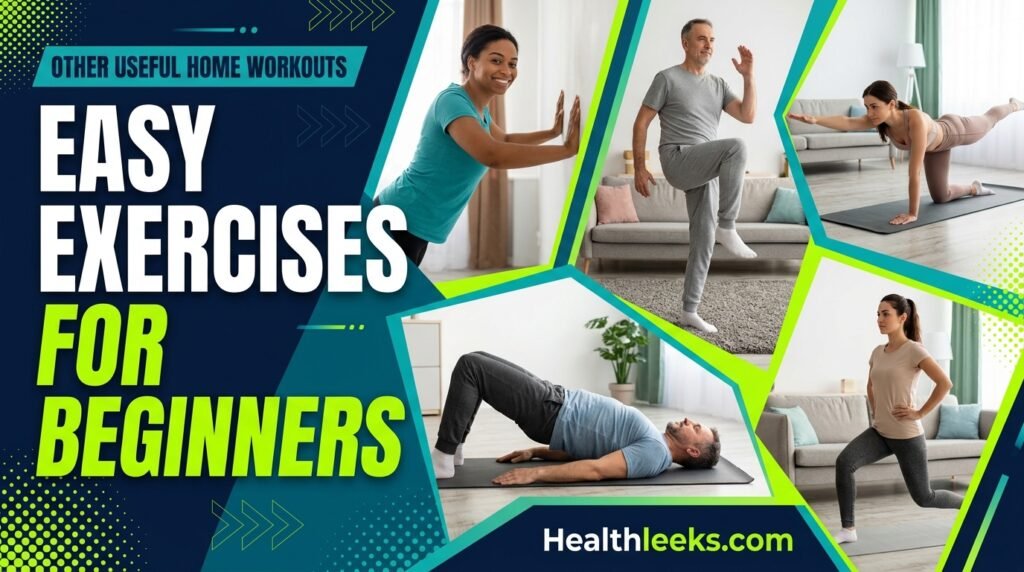
Once the basics feel comfortable, add a few of these.
| Exercise | What It Trains | Notes |
|---|---|---|
| Wall sit | Thighs and endurance | Hold for 20 to 30 seconds |
| Step-up on a sturdy step | Legs and balance | Use a low, stable surface |
| Bird dog | Core and back | Move slowly and keep hips level |
| Calf raise | Calves | Hold a wall for balance |
| Standing knee drive | Core and balance | Alternate sides |
| Hip hinge | Hamstrings and glutes | Push hips back with a flat back |
Beginner Cardio You Can Do at Home
Strength work is half the picture. The CDC guidelines also call for aerobic activity.
Low-Impact Options
- Brisk walking in place or around your home
- Marching with high knees at a comfortable pace
- Step-ups on a low, sturdy step
- Shadow boxing
- Dancing to music you enjoy
How to Judge Intensity
Use the talk test. During moderate activity you can talk but not sing. During vigorous activity you cannot say more than a few words without catching your breath.
Starting Point
Begin with 10 minutes of cardio on non-strength days and build up. Even short bouts count, since the guidelines do not require a minimum bout length.
Your Four-Week Beginner Home Workout Plan
This plan uses three full-body sessions per week on non-consecutive days, such as Monday, Wednesday, and Friday. Alternate Workout A and Workout B.
Each session takes about 20 to 30 minutes, including your five-minute warm-up.
Workout A
| Exercise | Week 1 | Week 2 | Week 3 | Week 4 |
|---|---|---|---|---|
| Bodyweight squat | 2 x 10 | 2 x 12 | 3 x 10 | 3 x 12 |
| Wall or incline push-up | 2 x 8 | 2 x 10 | 3 x 8 | 3 x 10 |
| Glute bridge | 2 x 12 | 2 x 15 | 3 x 12 | 3 x 15 |
| Plank (knees or toes) | 2 x 15 sec | 2 x 20 sec | 3 x 20 sec | 3 x 30 sec |
Workout B
| Exercise | Week 1 | Week 2 | Week 3 | Week 4 |
|---|---|---|---|---|
| Reverse lunge (each leg) | 2 x 6 | 2 x 8 | 3 x 6 | 3 x 8 |
| Knee or incline push-up | 2 x 6 | 2 x 8 | 3 x 6 | 3 x 8 |
| Dead bug (each side) | 2 x 6 | 2 x 8 | 3 x 8 | 3 x 10 |
| Wall sit | 2 x 15 sec | 2 x 20 sec | 3 x 20 sec | 3 x 30 sec |
Rest 45 to 60 seconds between sets.
Sample Weekly Schedule
| Day | Activity |
|---|---|
| Monday | Workout A |
| Tuesday | Rest or a 10 to 20 minute walk |
| Wednesday | Workout B |
| Thursday | Rest or gentle stretching |
| Friday | Workout A |
| Saturday | Light cardio, such as a brisk walk |
| Sunday | Rest |
How to Progress
When you can complete all sets with good form and still feel in control, move to the next week’s numbers. If a week feels too hard, repeat it.
The Golden Rule
Stop each set with one or two good reps left in the tank. Form matters more than numbers.
Quick Express Workouts for Busy Days
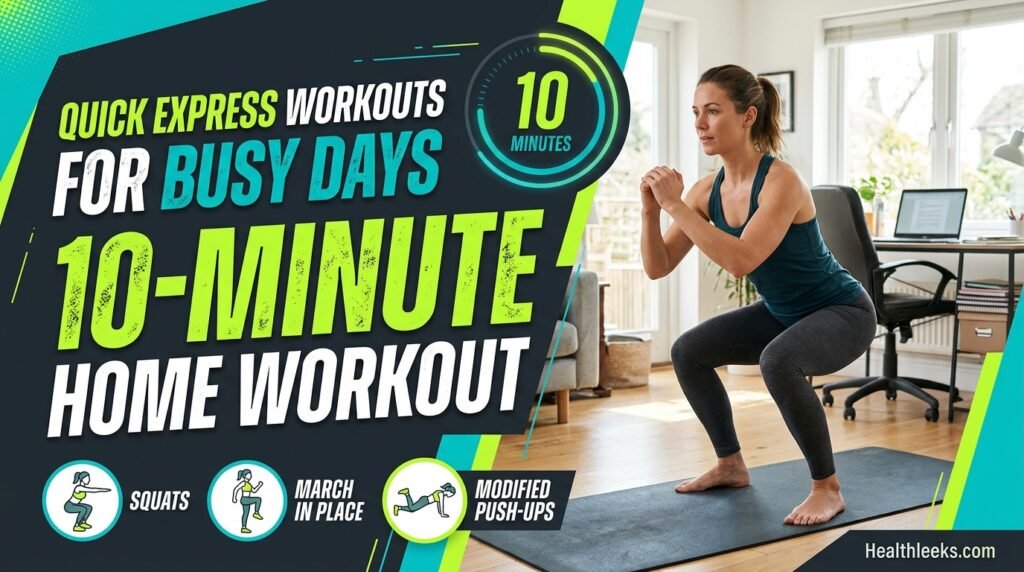
Short sessions still count. Use these when time is tight.
10-Minute Express Workout
Do each exercise for 40 seconds with 20 seconds of rest. Complete the circuit once.
- Bodyweight squats
- Incline push-ups
- Glute bridges
- Marching in place
- Plank (knees or toes)
15-Minute Full-Body Circuit
Repeat the 10-minute circuit twice, resting 30 seconds between rounds.
5-Minute Movement Snack
Do 10 squats, 8 wall push-ups, and a 20-second plank. It is not a full workout, but it keeps the habit alive.
Cool-Down and Stretching
A short cool-down lowers your heart rate and eases tension. It also helps you finish on a calm note.
Simple Five-Minute Cool-Down
- Walk slowly in place for one minute
- Hold a standing quad stretch for 20 seconds per leg
- Hold a hamstring stretch for 20 seconds per leg
- Stretch your chest by clasping hands behind your back
- Take five slow breaths
Why Not Skip It?
Cool-downs help you relax and recover. They also give you a moment to notice how your body feels.
How to Stay Safe
Safety is the most important part of a beginner program. A few habits prevent most problems.
Learn Form First
Master the movement before adding reps or difficulty. Slow, controlled repetitions are better than fast, sloppy ones.
Know the Difference Between Soreness and Pain
Mild delayed-onset muscle soreness, which often peaks 24 to 72 hours after a new workout, is normal. Sharp, shooting, or joint-specific pain is not.
If you feel pain, stop the exercise and use an easier version. If it continues, talk to a doctor or qualified professional.
Do Not Hold Your Breath
Breathe out on the hard part of each movement and in on the easy part. Holding your breath can raise pressure and make you dizzy.
Stop If You Feel Unwell
Stop exercising and seek help if you have chest pain, severe shortness of breath, dizziness, or fainting. If you notice unusual chest tightness after push-ups, read Pulled Chest Muscle: Causes, Signs, & When to Worry to understand common causes, and never ignore chest pain.
Recovering From Injury
If a muscle suddenly hurts or pops during exercise, rest and get it checked. For an example of how serious muscle injuries are managed, see Torn Bicep Recovery Time: Full Guide.
Managing Muscle Soreness
Soreness is a common beginner experience. It is usually a sign that your muscles are adapting.
| Soreness Type | What to Do |
|---|---|
| Mild stiffness for 24 to 48 hours | Keep moving gently and stay hydrated |
| Soreness that lasts more than 72 hours | Add a rest day and reduce volume next time |
| Sharp or joint pain | Stop and get advice |
| Swelling or severe pain | Seek medical attention |
Helpful Habits
- Walk lightly on rest days
- Sleep enough
- Eat enough protein and whole foods
- Stay hydrated
Nutrition for Beginner Workouts
You do not need a special diet to begin. Regular meals with plenty of whole foods support energy and recovery.
Before You Exercise
Eat something light if you are hungry an hour or two beforehand. Fruit, yogurt, or toast works for many people.
After You Exercise
A balanced meal with protein and carbohydrates helps recovery. Water matters too.
For more on fueling, read Body Nutrition Tips: The Complete Guide to Fueling Your Fitness Journey. If you wonder about supplements, Best Protein Shakes For Weight Loss female explains what to look for.
Feeling Shaky Before a Morning Workout?
If you often feel jittery in the morning, review Why Do I Feel Shaky When I Wake Up? before exercising on an empty stomach.
Rest, Sleep, and Recovery

Muscles grow stronger during recovery, not during the workout itself. Skipping rest can slow progress and raise injury risk.
Beginners do well with three or four workout days a week and rest days in between.
Active Recovery
Gentle activity such as walking or stretching can help ease soreness. Think of it as a tune-up rather than a workout.
Sleep
Aim for regular, adequate sleep. Tired muscles and a tired mind both struggle with training.
For a broader look at training, food, and recovery as one system, see TheSpoonAthletic: Fitness, Nutrition & Recovery.
Home Workout for Beginners: Goal-Based Variations
Your goal shapes how you use this plan. Small changes make it fit.
| Goal | How to Adapt the Plan |
|---|---|
| General fitness | Follow the plan as written and add walking |
| Weight loss | Add daily walking and keep a steady routine; pair exercise with balanced eating |
| Strength | Progress push-ups and lunges, and add resistance bands later |
| Flexibility and mobility | Add a short stretching routine after each session |
| Stress relief | Choose gentle sessions and pair them with breathing practice |
| Busy schedule | Use the 10-minute express workout |
A Note on Weight Loss
Exercise supports health and weight management, but results depend on many factors. Consistent habits matter more than any single workout.
Home Workouts for Different Beginners
People start from different places. These notes help you adjust.
If You Are Very Out of Shape
Begin with wall push-ups, chair squats, and short walks. Do one set of each exercise and build up slowly.
If You Are Over 65
The CDC recommends older adults include balance activities in addition to aerobic and strength work. Standing on one foot while holding a chair is a simple balance exercise.
If You Have Limited Mobility
Seated exercises can be a good start. Ask a doctor or physical therapist for safe options.
If You Are Pregnant or Postpartum
The CDC suggests at least 150 minutes of moderate activity a week for healthy pregnant and postpartum women. Always check with your healthcare provider about what is safe for you.
If You Are a Woman Building Self-Care Habits
Small, steady routines work well for busy schedules. For ideas on routines that fit into real life, see LWSpeakCare Self Care Tips from LetWomenSpeak for Everyday Wellness.
How to Stay Motivated
Motivation fades, but habits last. A few strategies help you stay on track.
Set a Small Goal
Aim for something you can do easily, such as three workouts this week. Success builds confidence.
Schedule It
Put workouts in your calendar like any appointment. Pick a time you can keep.
Track Progress
Write down your sets and reps, or tick off days on a calendar. Seeing progress keeps you going.
Use a Cue
Link your workout to something you already do, such as after your morning coffee or before dinner.
Make It Enjoyable
Play music, follow a video, or invite a friend to join online.
Forgive Missed Days
Missing a workout is normal. Restart the next day instead of waiting for Monday.
Common Beginner Mistakes to Avoid
Most beginners make similar errors. Awareness helps you skip them.
| Mistake | Better Approach |
|---|---|
| Doing too much, too soon | Start with two sets and add gradually |
| Skipping the warm-up | Spend five minutes warming up every time |
| Ignoring rest days | Schedule rest and treat it as part of training |
| Poor form | Slow down and use easier variations |
| Comparing yourself to others | Measure progress against your own start |
| Quitting after a few days | Aim for consistency, not perfection |
| Holding your breath | Breathe steadily during every rep |
How to Know It Is Working
Progress shows up in many ways. The scale is only one of them.
Signs of Progress
- You can do more reps or hold longer
- Exercises feel easier
- You have more energy
- Daily tasks feel less tiring
- You sleep better
- You feel more confident
When to Level Up
If you can complete all sets of an exercise with good form and still feel fresh, make it harder. Try a harder push-up variation, slower squats, or an extra set.
Progression Ideas Without Equipment
You can keep improving with no equipment at all. These approaches add challenge.
| Method | Example |
|---|---|
| More reps | Add two reps each week |
| More sets | Move from two to three sets |
| Slower tempo | Lower for three seconds on each squat |
| Harder variation | Move from knee push-up to full push-up |
| Single-leg work | Try single-leg glute bridges |
| Shorter rest | Cut rest from 60 seconds to 45 seconds |
| Pauses | Hold the bottom of a squat for two seconds |
When to Add Equipment
You may want equipment when bodyweight stops feeling challenging. Resistance bands and light dumbbells are low-cost options.
Add one tool at a time and keep form strict. A sturdy backpack with books can also add resistance to squats.
Common Myths About Home Workouts for Beginners
Several myths keep people from starting.
Myth: You Need a Gym to Get Fit
False. Bodyweight exercises count toward the CDC’s muscle-strengthening guidelines.
Myth: You Must Work Out Every Day
False. Beginners do well with three or four days a week and rest days in between.
Myth: No Pain, No Gain
False. Mild soreness is normal, but sharp or joint pain is a warning sign.
Myth: Short Workouts Do Not Count
False. Current guidelines note that activity can be accumulated throughout the day, and some activity is better than none.
Myth: Cardio Is the Only Way to Lose Weight
False. Strength training and daily movement also matter, along with eating habits.
Key Takeaways
- A home workout for beginners needs no equipment, just consistent bodyweight practice.
- Adults should aim for 150 minutes of moderate activity a week plus muscle-strengthening on at least 2 days.
- Learn six patterns: squat, hinge, push, pull, core, and single-leg work.
- Warm up for five minutes and cool down afterward.
- Train three or four days a week with rest days in between.
- Mild soreness is normal; sharp or joint pain means stop and get advice.
- Consistency beats intensity.
Also Read
- Body Nutrition Tips: The Complete Guide to Fueling Your Fitness Journey
- Best Protein Shakes For Weight Loss female
- TheSpoonAthletic: Fitness, Nutrition & Recovery
- Torn Bicep Recovery Time: Full Guide
- Pulled Chest Muscle: Causes, Signs, & When to Worry
- LWSpeakCare Self Care Tips from LetWomenSpeak for Everyday Wellness
- Superfood Guide LWSpeakCare: A Complete Path to Healthier Living
- Why Do I Feel Shaky When I Wake Up? Causes & Solutions
- What to Eat After Throwing Up: Safe Foods for Quick Recovery
- Does Medicare Cover Bone Density Tests?
- Why Do I Have Diarrhea Every Morning? Causes & Relief
- What Causes Itching That Moves Around the Body? Causes, Clues, Tests and Treatment 2026
- Unexplained Itching All Over Body at Night: Causes, Tests, Relief and When to Worry 2026
- What Deficiency Causes Skin Itching? Vitamins, Minerals, Symptoms, Tests and Treatment 2026
- Why Am I Itchy All Over but No Rash? Causes, Relief & When to See a Doctor 2026
- What Causes Sudden Skin Itching: Triggers & Treatment Options
- Spotting Between Periods: Causes, Diagnosis & Treatment
- Tingling in Ear: Causes, Treatment, & When to Worry
- Can UTI Cause Bloating and Gas? Symptoms & Relief Tips
- What Happens If a Sinus Infection Goes Untreated?
- Why Does My Ear Keep Popping When I Swallow? Relief Tips
- How to Treat Green Nails at Home
- Castor Oil in Belly Button: Benefits, Risks & Myths
Frequently Asked Questions (FAQs)
What is a good home workout for beginners?
A good start is three full-body sessions a week using squats, wall or incline push-ups, glute bridges, planks, reverse lunges, and dead bugs, with a five-minute warm-up.
How many days a week should a beginner work out at home?
Three to four days a week with rest days in between is a sustainable starting point for most beginners.
How long should a beginner home workout be?
About 20 to 30 minutes, including a five-minute warm-up, is enough to start. Shorter sessions also count.
Do I need equipment for a home workout?
No. Bodyweight exercises are enough. Resistance bands and light dumbbells are optional upgrades later.
What are the best bodyweight exercises for beginners?
Squats, push-up variations, glute bridges, planks, reverse lunges, and dead bugs are common choices because they work many muscles and scale easily.
How much exercise do adults need each week?
The CDC recommends at least 150 minutes of moderate-intensity activity a week, or 75 minutes of vigorous activity, plus muscle-strengthening on at least 2 days.
Do bodyweight exercises count as strength training?
Yes. The CDC lists exercises that use your body weight for resistance, such as push-ups and sit-ups, as muscle-strengthening activities.
How many sets and reps should a beginner do?
Start with two sets of 8 to 12 reps for most exercises and build to three sets. The CDC says one set is the minimum and two or three sets add benefit.
Should I work out every day as a beginner?
No. Rest days let your muscles recover. Gentle walking or stretching on rest days is fine.
How do I do a push-up if I cannot do one?
Start with wall push-ups, then progress to incline push-ups, knee push-ups, and finally full push-ups.
Is muscle soreness normal when starting a workout?
Mild soreness for 24 to 72 hours is normal. Sharp, shooting, or joint pain is not, and you should stop and get advice.
What should I do if I feel pain during exercise?
Stop the exercise and use an easier version. If the pain continues, talk to a doctor or qualified professional.
Should I warm up before a home workout?
Yes. Five minutes of light movement raises your heart rate, loosens joints, and lowers injury risk.
How do I know if my workout is hard enough?
You should feel challenged but in control. In strength work, aim for the point where another repetition would be hard without help while keeping good form.
What is the talk test?
During moderate activity you can talk but not sing. During vigorous activity you can say only a few words before pausing for breath.
Can I lose weight with home workouts?
Exercise supports weight management and health, but results depend on eating habits, sleep, and consistency. Pair your workouts with balanced nutrition.
How long does it take to see results from a home workout?
Many people notice better energy, mood, and strength within a few weeks, but timelines vary from person to person.
What should I eat before a home workout?
If you are hungry, a light snack such as fruit, yogurt, or toast an hour or two before is a common choice.
What should I eat after a workout?
A balanced meal with protein and carbohydrates, plus water, supports recovery.
Can I do home workouts if I am over 65?
Yes, with your doctor’s approval. The CDC recommends aerobic activity, strength work on 2 days, and balance activities for adults 65 and older.
Is it safe to exercise during pregnancy?
Many healthy pregnant people can stay active, and the CDC suggests at least 150 minutes of moderate activity a week. Check with your healthcare provider first.
Should I see a doctor before starting a workout plan?
If you have a health condition, injury, or concerns, yes. It is a common recommendation even for bodyweight routines.
What if I only have 10 minutes?
Use the 10-minute express workout. Short sessions still count toward your weekly activity.
How do I stay motivated to work out at home?
Set small goals, schedule workouts, track progress, link sessions to an existing habit, and forgive missed days.
When should I make my workout harder?
When you can complete all sets with good form and still feel fresh, add reps, sets, a slower tempo, or a harder variation.
Conclusion
A home workout for beginners does not need to be complicated. A few foundational moves, a five-minute warm-up, three sessions a week, and rest days in between give your body what it needs to get stronger without burning out.
The guidelines are clear: aim for 150 minutes of moderate activity a week and muscle-strengthening on at least two days, but start wherever you are. Even five minutes counts, and any activity is better than none.
Pick your first workout, put it on your calendar, and keep the first week easy. Focus on form, listen to your body, check with a doctor if you have health concerns, and let consistency do the heavy lifting.