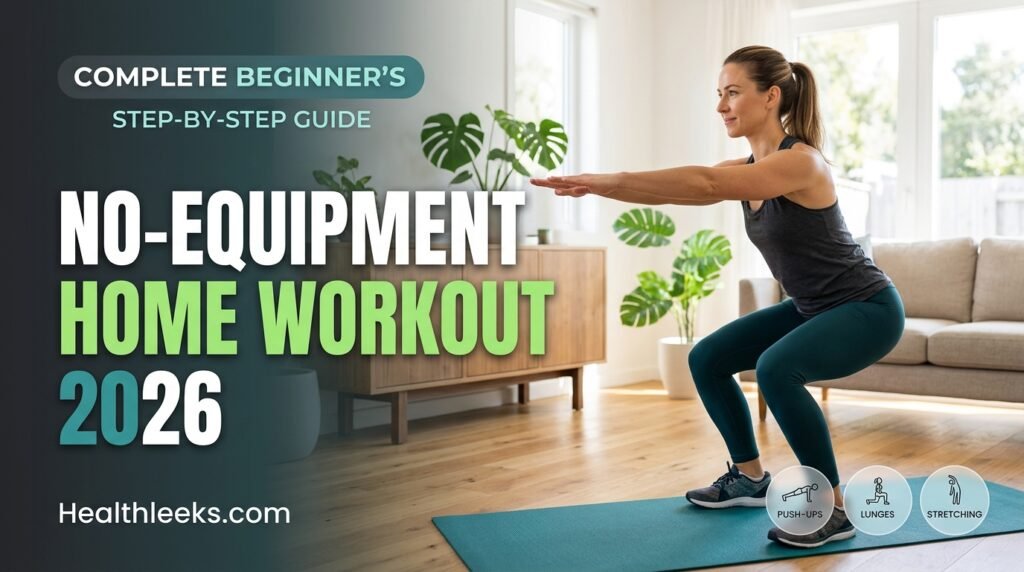
A home workout for beginners no equipment is the quiet answer to every excuse you have ever made. No gym fee, no commute, no waiting for a machine, and no awkward stares. Just a patch of floor, a little time, and the one piece of equipment you already own.
But here is the question that stops most people before they start: where do you actually begin? Which moves are safe, how many should you do, and how do you know it is working? Keep reading, and you will get a clear plan you can start today, even in a tiny apartment.
Table of Contents
Home Workout for Beginners No Equipment

A good beginner home workout uses simple bodyweight moves such as squats, glute bridges, incline push-ups, planks, and marching in place. Do a full-body session two to four times a week, rest on the days between, and add a little more each week.
Start with 15 to 20 minutes, focus on form before speed, and stop any move that causes sharp pain.
Your Starter Routine at a Glance
| Part | Time | What to do |
|---|---|---|
| Warm-up | 5 minutes | March in place, arm circles, hip circles |
| Strength circuit | 10 to 15 minutes | Squats, push-ups, bridges, planks, lunges |
| Cool-down | 3 to 5 minutes | Gentle stretches and slow breathing |
The Three Golden Rules for Beginners
- Start small and build slowly
- Put good form ahead of speed and reps
- Rest and recover as seriously as you train
Can You Really Get Fit With a No-Equipment Home Workout?
Yes, you can. Your body weight is real resistance, and for a beginner it is more than enough to build strength, endurance, and confidence.
Bodyweight training also teaches you to control your own movement, which is the base for every other type of exercise.
Benefits of Bodyweight Home Workouts
- No cost, no equipment, and no commute
- Flexible timing, from five minutes to an hour
- Lower barrier for people who feel nervous in gyms
- Easy to scale up or down as you improve
- Builds strength, balance, and mobility together
- Works for travel, small spaces, and busy schedules
What Bodyweight Training Does Well
It builds muscle endurance, basic strength, and good movement habits. It also raises your heart rate when you string moves together, so you get cardio benefits too.
Where Bodyweight Training Has Limits
At some point, you may need heavier resistance to keep building strength. That is a good problem to have, and you can reach it by using harder variations first, as explained later in this guide.
Before You Start: Safety First
Most healthy adults can begin gentle exercise safely, but a quick check is smart. This section is general information, not medical advice.
Talk to a doctor before starting if you have a heart condition, chest pain, dizziness, a recent injury or surgery, or a chronic health condition. The same goes if you are pregnant, or have been inactive for a long time and have health concerns.
Warning Signs to Stop Exercising
- Chest pain or pressure
- Severe shortness of breath
- Dizziness or fainting
- Sharp or sudden joint pain
- Nausea or a racing, irregular heartbeat
If any of these happen, stop and seek medical help if they do not pass quickly. Do not push through them.
Normal vs Worrying Discomfort
| Feeling | Usually normal? | What to do |
|---|---|---|
| Muscle burning during a set | Yes | Rest when you need to |
| Mild soreness one or two days later | Yes | Move gently and rest |
| Sharp pain in a joint | No | Stop that move |
| Pain that gets worse each day | No | Rest and see a professional |
| Chest pain or fainting | No | Stop and get medical help |
How Much Exercise Do Beginners Need?
Public health guidelines in the United States suggest adults aim for about 150 minutes of moderate aerobic activity each week. They also suggest muscle-strengthening activities on two or more days.
You do not have to reach that on day one. Think of it as a destination, and build up gradually.
Simple Weekly Targets for Beginners
| Level | Strength days | Cardio or walking | Total time |
|---|---|---|---|
| Week 1 to 2 | 2 days | 2 short walks | About 60 to 80 minutes |
| Week 3 to 4 | 3 days | 2 to 3 walks or cardio sessions | About 90 to 120 minutes |
| Week 5 and beyond | 3 to 4 days | 2 to 3 cardio sessions | About 120 to 150 minutes |
How Often Should Beginners Work Out?
Two to four sessions per week is a good range. Leave at least one rest day between hard strength sessions so your muscles can recover.
Consistency matters more than intensity. Three modest workouts every week beat one huge session once a month.
How Hard Should You Work? The Talk Test and Effort Scale

Beginners often push too hard or not hard enough. Two simple tools help you find the right level.
The Talk Test
During moderate effort, you should be able to talk but not sing. If you can barely say a few words, slow down.
The Effort Scale
Rate effort from 1 to 10, where 1 is sitting and 10 is an all-out sprint.
| Effort | Feels like | Good for |
|---|---|---|
| 3 to 4 | Easy, can chat comfortably | Warm-up, cool-down |
| 5 to 6 | Moderate, slightly breathless | Most beginner workouts |
| 7 | Hard, short sentences only | Short bursts for fitter beginners |
| 8 to 10 | Very hard | Not recommended early on |
Aim for a 5 to 6 during most sessions, and finish feeling tired but good, not wrecked.
Setting Up Your Home Workout Space
You do not need a gym corner. A small clear area is enough.
What You Need
- Floor space about the size of a yoga mat
- A non-slip surface, such as a rug, carpet, or towel
- Comfortable clothes and supportive shoes if you prefer them
- A bottle of water
- A timer or phone for intervals
Optional Household Helpers
These are not equipment, just handy things you may already have.
- A sturdy chair for step-ups or incline push-ups
- A wall for wall push-ups and wall sits
- A towel to cushion your knees
- Stairs for gentle step-ups
Make It Easy to Start
Leave your workout clothes where you can see them. Choose a set time and treat it like any other appointment.
The Warm-Up: Five Minutes That Protect You
A warm-up raises your heart rate, loosens your joints, and tells your body that movement is coming. It lowers the chance of strains and makes the workout feel smoother.
Never skip it, even on short days.
A Simple Five-Minute Warm-Up
| Move | Time | How to do it |
|---|---|---|
| March in place | 60 seconds | Lift knees to a comfortable height |
| Arm circles | 30 seconds each way | Start small and grow bigger |
| Hip circles | 30 seconds each way | Hands on hips, draw big circles |
| Bodyweight squats (easy) | 10 reps | Half range of motion |
| Cat-cow | 8 slow breaths | On hands and knees |
| Torso twists | 30 seconds | Gentle and slow |
The Best Bodyweight Exercises for Beginners
These twelve moves cover your whole body, and every one can be made easier or harder. Learn them slowly and watch your form.
1. Bodyweight Squat
Squats strengthen your thighs, glutes, and core. They also train a movement you use every time you sit and stand.
- Stand with feet shoulder-width apart
- Push your hips back and bend your knees
- Keep your chest up and your heels on the floor
- Stand tall by pressing through your whole foot
Easier: squat down to a chair and stand up. Harder: add a pause at the bottom for two seconds. Common mistake: letting knees cave inward.
2. Glute Bridge
Glute bridges strengthen your hips and the back of your legs. They are gentle on the knees and easy on the lower back.
- Lie on your back with knees bent and feet flat
- Press through your heels and lift your hips
- Squeeze your glutes at the top
- Lower slowly
Easier: lift only a few inches. Harder: pause for three seconds at the top. Common mistake: arching the lower back instead of using the glutes.
3. Wall Push-Up
Push-ups train your chest, shoulders, and arms. The wall version lets beginners learn the pattern without strain.
- Stand an arm’s length from a wall
- Place your hands on the wall at shoulder height
- Bend your elbows and lean in
- Push back to the start
Progression: move to an incline push-up on a counter or sturdy chair, then to knee push-ups, then to full push-ups. Common mistake: letting hips sag or flare elbows wide.
4. Incline Push-Up
Hands on a sturdy counter, table, or couch arm make push-ups easier than on the floor. The lower your hands go, the harder it gets.
- Keep your body in a straight line
- Lower your chest toward the surface
- Push away smoothly
5. Reverse Lunge
Lunges build leg strength and balance. Stepping backward is gentler on the knees than stepping forward.
- Stand tall with feet together
- Step one foot back and lower your hips
- Keep your front knee over your ankle
- Push through the front heel to return
Easier: hold a wall or chair for balance. Harder: pause at the bottom.
6. Plank (Knee or Incline)
Planks train your core, shoulders, and back. They teach your body to stay stable.
- Place forearms on the floor, elbows under shoulders
- Hold a straight line from head to knees or toes
- Squeeze your abs and glutes
- Breathe steadily
Easier: knees down, or hands on a counter. Harder: full toe plank for longer time. Common mistake: hips sagging or lifting too high.
7. Dead Bug
The dead bug builds deep core strength without straining your neck or back.
- Lie on your back, arms up, knees bent over hips
- Slowly lower one arm and the opposite leg
- Keep your lower back close to the floor
- Return and switch sides
8. Bird Dog
Bird dogs improve balance and train the muscles along your spine.
- Start on hands and knees
- Extend one arm forward and the opposite leg back
- Keep hips level and neck neutral
- Hold briefly, then switch
9. Step-Up
Step-ups use a bottom stair or a sturdy low step. They build leg strength and heart rate in a low-impact way.
- Place one foot fully on the step
- Press through that heel to stand up
- Lower slowly and repeat
- Switch legs after a set
10. Standing March or Low-Impact Jacks
Marching builds cardio without jumping. If your joints feel good, you can try low-impact jacks by stepping side to side instead of hopping.
- Lift your knees and swing your arms
- Keep a steady rhythm
- Add arm raises to raise the effort
11. Calf Raise
Calf raises strengthen your lower legs and improve ankle stability.
- Stand with feet hip-width apart
- Rise onto your toes
- Lower slowly
- Hold a wall for balance if needed
12. Superman
Superman strengthens your back, glutes, and shoulders, which helps balance all the pushing and squatting.
- Lie on your stomach with arms forward
- Lift your arms and legs slightly
- Hold for two seconds
- Lower with control
Quick Reference Table
| Exercise | Main muscles | Beginner version |
|---|---|---|
| Squat | Thighs, glutes | Chair squat |
| Glute bridge | Glutes, hamstrings | Small lift |
| Push-up | Chest, shoulders, arms | Wall or incline |
| Reverse lunge | Legs, glutes | Hold a wall |
| Plank | Core, shoulders | Knees or incline |
| Dead bug | Deep core | Smaller range |
| Bird dog | Back, core | Arms or legs only |
| Step-up | Legs, heart | Low step |
| March or jacks | Heart, legs | Marching |
| Calf raise | Calves | Hold a wall |
| Superman | Back, glutes | Lift only arms |
Beginner Full-Body Home Workout (20 Minutes, No Equipment)

This is your core routine. It trains every major muscle group in a short session, and you can repeat it two to three times a week.
Do each move for the time or reps listed, rest briefly, and move to the next. After the last move, rest for one to two minutes and repeat the circuit.
The Circuit
| Order | Exercise | Work | Rest |
|---|---|---|---|
| 1 | Bodyweight squat | 10 to 12 reps | 30 seconds |
| 2 | Incline or wall push-up | 6 to 10 reps | 30 seconds |
| 3 | Glute bridge | 12 reps | 30 seconds |
| 4 | Reverse lunge | 6 to 8 reps each leg | 30 seconds |
| 5 | Knee or incline plank | 20 to 30 seconds | 30 seconds |
| 6 | Dead bug | 6 reps each side | 30 seconds |
| 7 | March in place | 45 seconds | 30 seconds |
How Many Rounds?
- Week 1: 2 rounds
- Week 2: 2 to 3 rounds
- Week 3: 3 rounds
- Week 4: 3 rounds with shorter rests
How to Make It Work for You
If a move feels too hard, use the easier version. If it feels too easy, slow the tempo or add a pause at the hardest point.
15-Minute Home Workout for Beginners
Short on time? Fifteen focused minutes still count. This version uses fewer moves and tighter rest.
The Routine
- Warm-up for 3 minutes.
- Squats for 40 seconds, rest 20.
- Wall or incline push-ups for 40 seconds, rest 20.
- Glute bridges for 40 seconds, rest 20.
- Marching or low-impact jacks for 40 seconds, rest 20.
- Plank for 20 to 30 seconds, rest 30.
- Repeat steps 2 to 6 once more.
- Cool down for 2 minutes.
Who This Is For
This routine suits busy days, travel, and the first two weeks of any new habit. It teaches you to show up, which matters most.
30-Minute Home Workout for Beginners
When you are ready for more, this routine adds more rounds and a short cardio finisher.
| Block | Time | What to do |
|---|---|---|
| Warm-up | 5 minutes | March, circles, easy squats |
| Strength round 1 | 8 minutes | Squats, push-ups, bridges, lunges |
| Active rest | 2 minutes | Slow walking in place |
| Strength round 2 | 8 minutes | Dead bug, bird dog, plank, calf raise |
| Cardio finisher | 4 minutes | March or low-impact jacks, 40 seconds on, 20 off |
| Cool-down | 3 minutes | Stretching |
No-Equipment Cardio Workout for Beginners
Cardio makes your heart and lungs stronger and helps you feel more energetic. You can do it at home without a treadmill.
Start with low-impact moves and build gradually.
Low-Impact Cardio Options
- Marching in place with arm swings
- Step-ups on a low stair
- Side steps with arm raises
- Standing knee lifts
- Shadow boxing at a gentle pace
- Dancing to your favorite songs
- Brisk walking around your home or outside
A Simple Cardio Interval Workout
| Round | Move | Time |
|---|---|---|
| 1 | March in place | 40 seconds |
| 2 | Side steps with arms | 40 seconds |
| 3 | Standing knee lifts | 40 seconds |
| 4 | Easy shadow boxing | 40 seconds |
| 5 | Rest and sip water | 40 seconds |
Repeat for 3 to 4 rounds, adding a round each week.
Adding Jumping Safely
Jumping jacks, high knees, and squat jumps raise the effort, but they are also higher impact. Try them only when low-impact moves feel easy, and stop if your joints complain.
If you are pregnant or have joint concerns, our guide on whether jumping affects early pregnancy covers safer ways to stay active.
Low-Impact Home Workout for Sore Joints or Heavier Bodies
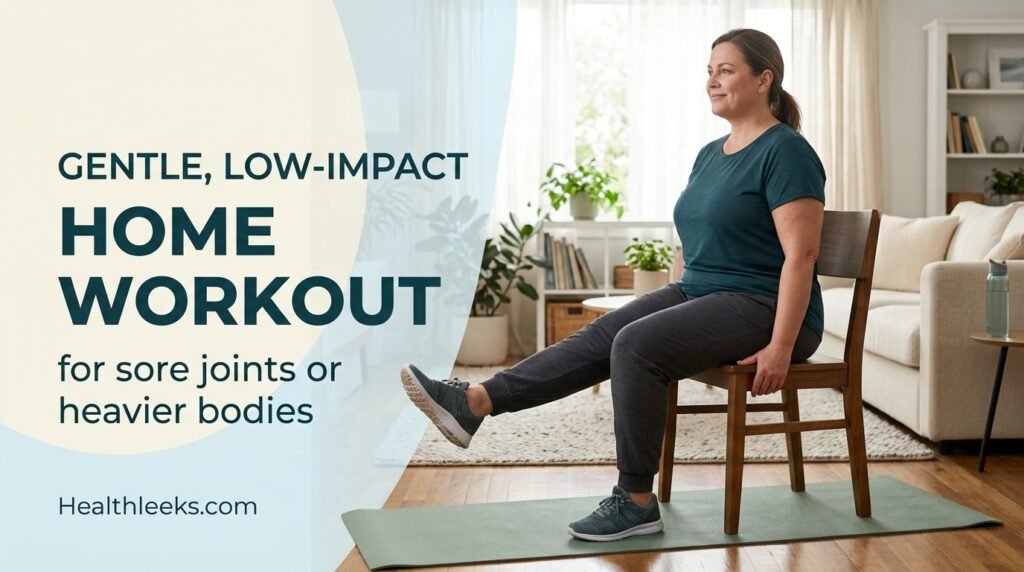
Low-impact does not mean low-value. It means no hopping or pounding, which is gentler on knees, ankles, and hips.
This approach is great for beginners who feel nervous about jumping or who are returning after a long break.
Low-Impact Routine
| Move | Reps or time |
|---|---|
| Chair squat | 8 to 10 reps |
| Wall push-up | 8 to 10 reps |
| Glute bridge | 10 to 12 reps |
| Standing march | 45 seconds |
| Bird dog | 6 reps each side |
| Side steps | 45 seconds |
Tips for Joint-Friendly Training
- Use a mat or carpet to soften the floor
- Keep movements smooth and controlled
- Reduce range of motion if a joint feels tight
- Avoid locking your knees or elbows
- Stop any move that causes sharp joint pain
Quiet Apartment Workout: No Jumping, No Noise
Worried about neighbors? You can train hard without a single stomp. Choose slow, controlled moves and a soft surface.
Quiet Exercises That Still Work
- Slow squats and pause squats
- Glute bridges and bridge marches
- Wall and incline push-ups
- Planks and dead bugs
- Reverse lunges, lowered gently
- Standing marches with a soft landing
- Superman and bird dog
Quiet Workout Tips
- Wear socks or soft shoes
- Place a towel or mat under your feet
- Move slowly, which adds difficulty and reduces noise
- Avoid jumping or dropping to the floor
Beginner Ab Workout at Home
A strong core helps your posture, balance, and back. The best beginner ab moves are gentle and controlled, not fast sit-ups.
Focus on bracing your belly, as if preparing for a light tap.
Simple Core Routine
| Move | Reps or time |
|---|---|
| Dead bug | 6 reps each side |
| Bird dog | 6 reps each side |
| Knee plank | 20 to 30 seconds |
| Glute bridge | 12 reps |
| Side plank on knees | 15 seconds each side |
Do two rounds, resting 30 seconds between moves.
Why Crunches Are Not the Best Start
Crunches can strain the neck and do little for deep core stability. The moves above train your abs while protecting your back.
Beginner Lower-Body Home Workout
Your legs and glutes are the biggest muscles in your body. Training them burns energy and builds a strong base for daily life.
| Move | Sets and reps |
|---|---|
| Bodyweight squat | 2 sets of 10 to 12 |
| Glute bridge | 2 sets of 12 |
| Reverse lunge | 2 sets of 6 to 8 each leg |
| Step-up | 2 sets of 8 each leg |
| Calf raise | 2 sets of 12 |
Rest 30 to 45 seconds between sets.
Beginner Upper-Body Home Workout
You can build the chest, shoulders, arms, and back with no weights. Push-up variations and back-extension moves do most of the work.
| Move | Sets and reps |
|---|---|
| Wall or incline push-up | 2 sets of 6 to 10 |
| Superman | 2 sets of 8 |
| Bird dog | 2 sets of 6 each side |
| Plank | 2 sets of 20 to 30 seconds |
| Shoulder blade squeeze | 2 sets of 10 |
A Note About Back Training
Without equipment, back training is limited. Include supermans and bird dogs, and consider adding a resistance band or a pull-up option later if you want more.
Four-Week Home Workout Plan for Beginners
A plan removes guesswork. Follow this schedule for four weeks, then repeat or move on to something harder.
Week 1: Learn the Moves
| Day | Workout |
|---|---|
| Monday | 15-minute workout |
| Tuesday | 20-minute walk |
| Wednesday | 15-minute workout |
| Thursday | Rest or gentle stretching |
| Friday | 15-minute workout |
| Saturday | 20-minute walk |
| Sunday | Rest |
Week 2: Build Rhythm
| Day | Workout |
|---|---|
| Monday | 20-minute full-body circuit |
| Tuesday | 20-minute walk |
| Wednesday | 20-minute full-body circuit |
| Thursday | Rest |
| Friday | 20-minute full-body circuit |
| Saturday | Cardio intervals, low impact |
| Sunday | Rest |
Week 3: Add Challenge
| Day | Workout |
|---|---|
| Monday | 20 to 25-minute circuit, 3 rounds |
| Tuesday | Cardio intervals |
| Wednesday | Lower-body workout |
| Thursday | Rest or walk |
| Friday | Upper-body and core workout |
| Saturday | 30-minute workout |
| Sunday | Rest |
Week 4: Peak and Reflect
| Day | Workout |
|---|---|
| Monday | 30-minute workout |
| Tuesday | Cardio intervals |
| Wednesday | Lower-body workout |
| Thursday | Rest |
| Friday | Upper-body and core workout |
| Saturday | 30-minute workout |
| Sunday | Rest and review your progress |
What to Do After Week Four
Repeat the plan with harder variations, or move on to a longer program. The 60-day workout plan is a natural next step once you feel ready.
How to Progress Without Equipment

Progress means making exercises slightly harder over time. Without weights, you still have many options.
A structured approach to this idea is explained in the progressive overload workout plan guide.
Ways to Make Bodyweight Moves Harder
| Method | Example |
|---|---|
| More reps | Go from 8 to 12 squats |
| More sets | Add one extra round |
| Slower tempo | Take three seconds to lower in a squat |
| Pauses | Hold at the hardest point |
| Harder variation | Move from wall to incline to knee push-ups |
| Less rest | Cut rest from 45 to 30 seconds |
| Single-leg versions | Try assisted single-leg bridges |
A Simple Rule
Change only one thing at a time. If you add reps and shorten rest in the same week, you may overshoot.
Form Cues That Keep You Safe
Good form protects your joints and helps you get more from each rep. These cues apply to nearly every move.
- Keep your spine long and neutral
- Brace your belly lightly
- Breathe out on the effort, in on the easier part
- Move with control, not momentum
- Keep knees tracking over your toes
- Avoid locking out joints
- Stop a set when form breaks down
Breathing Basics
Do not hold your breath. Exhale as you push, lift, or stand, and inhale as you lower or relax.
Use a Mirror or Record Yourself
Watching your own movement can reveal problems you cannot feel. A short phone video is a very effective coach.
The Cool-Down: Stretches to Finish Strong
A cool-down helps your heart rate settle and leaves you feeling relaxed. Spend three to five minutes on slow breathing and gentle stretches.
Hold each stretch for 20 to 30 seconds, and never bounce.
Simple Cool-Down Routine
| Stretch | Where you feel it | Hold |
|---|---|---|
| Standing quad stretch | Front of thigh | 20 seconds each side |
| Standing hamstring stretch | Back of thigh | 20 seconds each side |
| Chest opener (hands behind back) | Chest and shoulders | 20 seconds |
| Child’s pose | Back and hips | 30 seconds |
| Figure-four stretch (lying) | Glutes and hips | 20 seconds each side |
| Slow deep breathing | Whole body | 5 breaths |
Home Workout for Weight Loss: What Really Helps
Many beginners start exercising to lose weight. Home workouts can help, but weight change depends on the whole picture, not just exercise.
Be patient, and treat movement as one part of a healthy lifestyle.
What Exercise Can Do
- Burn energy and support a healthy routine
- Build muscle, which supports your metabolism
- Improve mood, sleep, and energy
- Make daily activities easier
What Exercise Cannot Do Alone
You cannot out-train a poor diet, and spot reduction does not work. Crunches will not melt belly fat, and no single move targets one area of the body.
A Balanced Approach
| Habit | Why it matters |
|---|---|
| Regular strength sessions | Builds and protects muscle |
| Daily walking | Adds low-effort movement |
| Balanced meals | Supports energy and recovery |
| Enough sleep | Helps appetite and recovery |
| Patience | Real change takes weeks and months |
If you want food guidance to support your training, read our body nutrition tips for a practical overview. Women exploring protein options may find our guide on the best protein shakes for weight loss for women helpful.
For personal diet advice, a registered dietitian or doctor can tailor recommendations to your needs.
Home Workout for Beginner Women
Women can follow the same bodyweight basics as everyone else. Strength training supports bone health, posture, and confidence.
A few considerations can help you train comfortably.
Helpful Tips
- Focus on glute bridges, squats, and lunges for lower-body strength
- Include push-up variations and back exercises for upper-body balance
- Wear a supportive sports bra for cardio
- Adjust intensity around your energy levels and cycle if needed
- Talk to your doctor if you are pregnant, postpartum, or have pelvic floor concerns
Home Workout for Beginner Men
Men can use the same routine, with an extra focus on form and recovery. Many beginners rush into hard push-ups and skip legs, core, and mobility.
A balanced plan lowers the risk of overuse and uneven strength.
Helpful Tips
- Do not skip lower-body training
- Balance pushing moves with pulling and back moves
- Start with incline push-ups to protect shoulders
- Respect rest days, even when motivation is high
Home Workout for Adults Over 40 or Returning After a Break
Starting later in life is absolutely possible. Strength and balance training are especially valuable as we age.
Start gently, progress slowly, and talk to your doctor if you have health concerns.
Smart Starting Points
- Begin with chair squats and wall push-ups
- Add balance practice near a stable surface
- Include walking in your weekly routine
- Allow extra recovery time between sessions
- Keep sessions short at first, then build up
Nutrition and Hydration for Home Workouts
Your workout is only half the story. What you eat and drink affects your energy, recovery, and results.
You do not need a perfect diet. A few steady habits go a long way.
Eat for Energy and Recovery
| Meal timing | Simple idea |
|---|---|
| Before training | A light snack such as a banana or yogurt if you feel hungry |
| After training | A balanced meal with protein and carbohydrates |
| Throughout the day | Plenty of vegetables, fruit, whole grains, and lean protein |
For a deeper look at fueling your fitness journey, see our body nutrition tips and the superfood guide.
Hydration Basics
Drink water before, during, and after exercise. Thirst, a dry mouth, dark urine, or a pounding head can be signs you need more fluid.
If you often get headaches after workouts, read about what dehydration headaches feel like.
If You Feel Shaky or Lightheaded
Training on an empty stomach, poor sleep, or low blood sugar can leave you shaky. Our article on why you may feel shaky when you wake up explains common causes, and a doctor can help if it keeps happening.
Recovery: Sleep, Rest Days, and Soreness
Muscles get stronger during rest, not during the workout itself. Skipping recovery is the most common reason beginners get stuck or injured.
Treat rest as part of the plan.
Why Rest Days Matter
- Muscles repair and adapt
- Your joints and tendons get a break
- Energy and motivation stay higher
- Injury risk drops
Sleep and Your Results
Aim for a regular sleep schedule with seven or more hours when possible. A consistent bedtime supports mood, appetite, and recovery.
Recovery is part of a bigger system, which is explained well in TheSpoonAthletic fitness, nutrition and recovery guide.
Understanding Muscle Soreness
Delayed onset muscle soreness, or DOMS, is the achy feeling that appears one to three days after new or harder exercise. It is common for beginners and usually fades within a few days.
| Soreness type | What it feels like | What to do |
|---|---|---|
| Normal DOMS | Dull ache in worked muscles | Gentle movement, walking, stretching |
| Mild fatigue | Tired but fine | Light activity, extra rest |
| Sharp pain | Stabbing or pinching | Stop and rest, see a professional if it persists |
| Joint pain | Pain inside a joint | Skip the move and check form |
Easing Soreness
- Walk or move gently
- Stretch lightly
- Drink water and eat balanced meals
- Get enough sleep
- Use a warm shower for comfort
Common Beginner Aches and What They Mean
Minor aches can appear in a new routine, but some signals need attention. Here is how to tell the difference.
Muscle Strains
Sharp pain during a move, especially with sudden effort, may be a strain. Our guide on a pulled chest muscle explains why chest pain should never be ignored, and our torn bicep recovery time guide shows how serious arm injuries are managed.
Knee Discomfort in Squats and Lunges
Check that your knees track over your toes and your heels stay down. Shorten your range of motion and use a chair for support.
Wrist Pain in Planks and Push-Ups
Wrists can complain when pressed flat. Try forearm planks, push-ups on fists, or incline versions.
Lower-Back Strain in Bridges and Planks
Engage your abs and glutes, and avoid arching the lower back. Reduce hold time or range if it persists.
When to Stop and Get Checked
Do not train through sharp pain, swelling, numbness, or chest symptoms. See a healthcare professional if pain lasts more than a few days.
Common Mistakes Beginners Make at Home
Almost everyone makes a few of these. Spot them early, and you will save time and avoid setbacks.
Doing Too Much Too Soon
Seven hard days in a row is a recipe for burnout. Start small and build.
Skipping the Warm-Up
A cold body is more likely to strain. Five minutes makes a difference.
Rushing Through Reps
Fast, sloppy reps train momentum, not muscle. Slow down and control each rep.
Holding Your Breath
Holding your breath raises pressure and makes you tire faster. Breathe steadily.
Ignoring Rest and Sleep
Progress happens during recovery. Protect your rest days.
Comparing Yourself to Others
Social media workouts are often filmed by trained athletes. Compare today’s you to last month’s you.
Changing the Plan Constantly
Switching routines every few days stops you from seeing progress. Stick with a plan for at least four weeks.
Skipping Progressions
Doing the same thing for months stalls progress. Increase challenge gradually.
How to Stay Consistent With Home Workouts
The best workout plan is the one you actually do. Motivation fades, so build habits that do not depend on it.
Habit-Building Tips
- Schedule workouts like appointments
- Pair them with an existing habit, such as after morning coffee
- Start with just five minutes on tough days
- Track your sessions on a calendar
- Celebrate small wins, such as finishing a week
- Find a friend or family member to join you
- Prepare your clothes and space the night before
Make It Fun
Play music, try new routines, and mix walking with strength days. Enjoyment is the strongest motivator over the long run.
Be Kind to Yourself
You will miss days. That is normal. Restart without guilt, and keep going.
Support Your Whole Wellbeing
Fitness works best alongside rest, stress management, and healthy relationships. For more on everyday habits, read these self care tips from LWSpeakCare.
How to Track Your Progress
Tracking keeps you motivated and shows you what is working. You do not need a complicated app.
Easy Ways to Track
| Method | What to record |
|---|---|
| Workout log | Exercises, sets, reps, and how you felt |
| Calendar check marks | Days you worked out |
| Monthly photos | Same light, same pose |
| Simple tests | Squats in 60 seconds, plank hold time |
| Energy and mood notes | Daily feelings and sleep quality |
Signs You Are Improving
- Moves feel easier
- You recover faster
- You hold planks longer
- You sleep better and feel more energetic
- Daily tasks like climbing stairs feel lighter
When You Are Ready for the Next Step
After a few months, you may want more challenge. You can build on your bodyweight base with longer plans, resistance bands, or a gym.
Options to Consider
- A longer structured program such as a 60-day workout plan
- Adding resistance bands or dumbbells
- Joining a gym once your routine feels solid. If you are comparing options, see our GoodLife Fitness membership price guide
- Learning barbell and trap bar lifts, explained in our trap bar deadlift vs barbell deadlift guide
Home Workout Checklist for Beginners
Use this list before you begin and as a regular reminder.
Before You Start
- Talk to a doctor if you have health concerns
- Clear a small space and grab water
- Wear comfortable clothes
- Plan a time and a routine
During the Workout
- Warm up for five minutes
- Focus on form and breathing
- Rest when needed
- Stop for sharp pain or chest symptoms
After the Workout
- Cool down and stretch
- Drink water and eat a balanced meal
- Note how you felt
- Plan your next session
When to See a Doctor or Fitness Professional
Home workouts are safe for most people, but some situations call for expert help.
- Chest pain, dizziness, or fainting during exercise
- Joint pain that lasts or gets worse
- Numbness, tingling, or weakness
- Ongoing back or knee pain
- Pregnancy, heart or lung conditions, or recent surgery
- Trouble improving after several weeks despite good habits
A doctor or certified trainer can tailor a plan to your needs and keep you safe.
A Note on Health and Safety
This guide gives general information about beginner exercise. It is not medical advice, and every body is different.
Talk with a healthcare professional before starting any new exercise program, especially if you have a medical condition.
Also Read:
- 60-Day Workout Plan: The Complete Guide to Transform Your Body in 2 Months
- Progressive Overload Workout Plan: Complete Guide 2026
- Trap Bar Deadlift vs Barbell Deadlift: Which Is Better?
- TheSpoonAthletic: Fitness, Nutrition & Recovery
- Body Nutrition Tips: The Complete Guide to Fueling Your Fitness Journey
- Best Protein Shakes For Weight Loss female
- Torn Bicep Recovery Time: Full Guide
- Pulled Chest Muscle: Causes, Signs, & When to Worry
- What Do Dehydration Headaches Feel Like?
- Does Jumping Affects Early Pregnancy? Find Out Now
- Why Do I Feel Shaky When I Wake Up? Causes & Solutions
- Superfood Guide LWSpeakCare: A Complete Path to Healthier Living
- LWSpeakCare Self Care Tips from LetWomenSpeak for Everyday Wellness
- What to Eat After Throwing Up: Safe Foods for Quick Recovery
- GoodLife Fitness Membership Price Guide 2026
- Does Medicare Cover Bone Density Tests?
- Castor Oil in Belly Button: Benefits, Risks & Myths
- Can UTI Cause Bloating and Gas? Symptoms & Relief Tips
- Why Do I Have Diarrhea Every Morning? Causes & Relief
- Tingling in Ear: Causes, Treatment, & When to Worry
- Why Does My Ear Keep Popping When I Swallow? Relief Tips
- What Happens If a Sinus Infection Goes Untreated?
- Spotting Between Periods: Causes, Diagnosis & Treatment
- Why Am I Itchy All Over but No Rash? Causes, Relief & When to See a Doctor 2026
Frequently Asked Questions (FAQs)
What is the best home workout for beginners with no equipment?
A full-body routine of squats, glute bridges, wall or incline push-ups, lunges, planks, and marching works well. Do it two to four times a week and rest in between.
How often should a beginner work out at home?
Two to four times per week is a good starting range. Leave at least one rest day between strength sessions.
How long should a beginner home workout be?
Fifteen to twenty minutes is enough at first. You can build up to 30 minutes as your fitness improves.
Can I build muscle with no equipment?
Yes, beginners can build muscle and strength using bodyweight moves. Progress by adding reps, slowing the tempo, or choosing harder variations.
Can I lose weight with a home workout and no equipment?
Exercise can support weight loss, but results also depend on food, sleep, and consistency. There is no way to burn fat from one specific area.
What are the best bodyweight exercises for beginners?
Squats, glute bridges, wall push-ups, reverse lunges, planks, dead bugs, bird dogs, and step-ups are great starting points. All can be made easier or harder.
Do I need to warm up before a home workout?
Yes, a five-minute warm-up raises your heart rate and loosens your joints. It lowers the chance of strains.
How many reps and sets should a beginner do?
Start with one to two sets of 8 to 12 reps for strength moves. Add a set or a few reps as the moves feel easier.
Should I do a home workout every day?
Most beginners do better with rest days. Walking or gentle stretching on off days is fine.
How long until I see results?
Many people feel more energetic and strong within a few weeks. Visible changes usually take longer and vary from person to person.
What if I cannot do a push-up?
Start with wall push-ups, then incline push-ups, then knee push-ups. Move to the next step when the current one feels easy.
Is it okay to feel sore after a workout?
Mild muscle soreness one to three days later is normal for beginners. Sharp or joint pain is not, so stop and rest.
What if jumping hurts my knees?
Choose low-impact options such as marching, step-ups, and side steps. They still raise your heart rate without pounding your joints.
Can I work out at home in a small apartment?
Yes, all you need is the space of a yoga mat. Quiet, no-jump moves are great for apartment living.
Should I see a doctor before starting?
If you have a medical condition, are pregnant, or have not exercised in a long time and have concerns, check with a doctor first. Stop if you feel chest pain, dizziness, or severe shortness of breath.
How do I stay motivated to work out at home?
Schedule your workouts, start with short sessions, track your progress, and forgive missed days. Enjoyment and consistency matter more than perfection.
Conclusion
A home workout for beginners no equipment is one of the simplest ways to build strength, energy, and confidence. Start with a warm-up, practice a handful of bodyweight moves, and finish with a gentle cool-down.
Keep sessions short, focus on form, and rest between workouts. Build gradually by adding reps, slowing your tempo, or choosing harder variations when a move feels easy.
Fuel your body, stay hydrated, and sleep well, because recovery is where progress happens. Listen to your body, stop for sharp pain, and see a doctor when something feels wrong.
Your first workout does not need to be perfect. It only needs to happen. Start small today, repeat it this week, and let consistency do the heavy lifting.